Lesson 3: Describing Housing, Furniture & Possessive Pronouns (Lektion 15)
Describing rooms and shared flat (WG) furniture, antonym adjectives, and mastering possessive pronouns (sein / ihr) in Nominativ and Akkusativ
Welcome to Lesson 3 of Level A1.2 (Lesson 15 from the official Momente curriculum)! Today, we will learn how to describe housing and shared student flats (Wohngemeinschaft / WG), identify parts of the house and items of furniture, express opinions about rooms and objects using adjectives, and cover a simplified, thorough explanation of third-person possessive pronouns (sein / ihr) and their declensions in both Nominativ and Akkusativ cases.
All words and sentences in this lesson are supported by high-precision interactive audio pronunciation. To ensure the best audio experience, please open this lesson via Google Chrome.
1. Housing, Rooms & Furniture Vocabulary (Wohnung, Zimmer & Möbel)
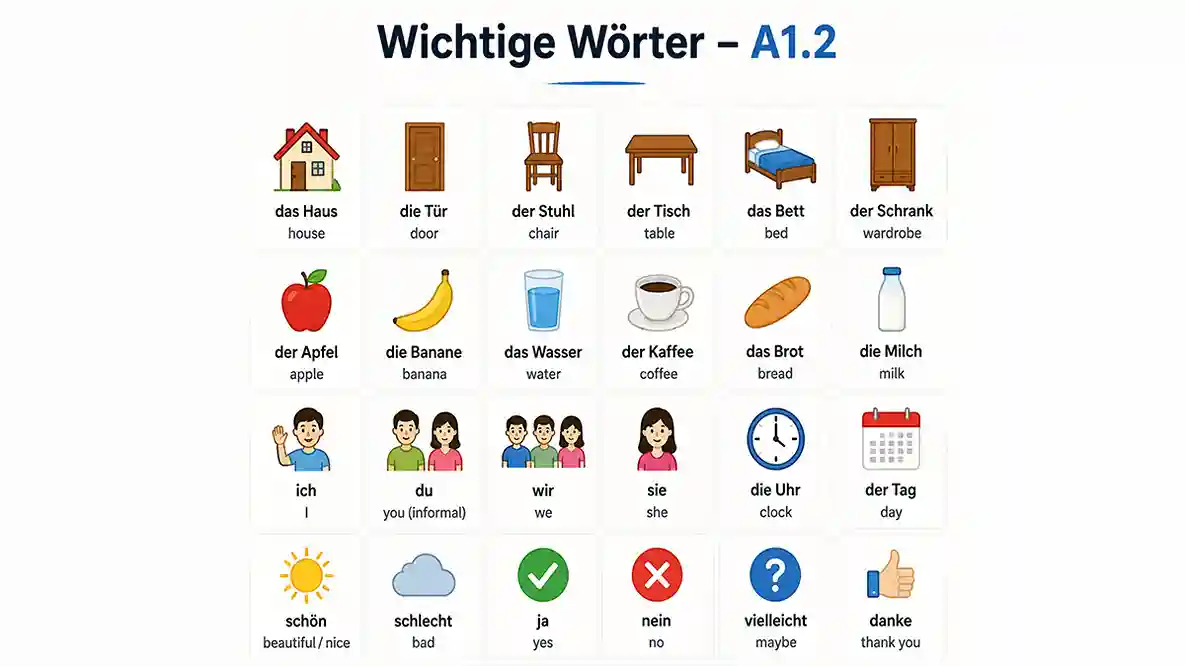
First, let's learn the names of rooms, parts of the home, and essential terms used when discussing living arrangements and shared flats:
| German Term (Deutsch) | English Translation | Listen |
|---|---|---|
|
die Wohngemeinschaft (WG)
|
Shared student flat / apartment share | |
|
das Schlafzimmer
|
Bedroom | |
|
das Wohnzimmer
|
Living room | |
|
der Flur / die Treppe
|
Hallway / Stairs | |
|
der Balkon / der Garten
|
Balcony / Garden | |
|
der Sessel / die Kommode
|
Armchair / Chest of drawers (dresser) |
2. Adjectives for Furniture, Housing & Opinions (Eigenschaften & Meinungen)
To express your personal opinion about furniture or apartment elements using the structure Ich finde... (I find...), we use adjectives and their antonyms:
| Adjective (Positiv) | Opposite (Gegenteil) | Example Sentence |
|---|---|---|
| schön (beautiful) | hässlich (ugly) | Das Sofa finde ich sehr schön. Es ist überhaupt nicht hässlich. |
| ordentlich (tidy/neat) | unordentlich (messy) | Kais Zimmer ist aber ordentlich! Er muss nicht aufräumen. |
| gemütlich (cozy/comfortable) | ungemütlich (uncomfortable) | Der Sessel ist sehr gemütlich. |
| günstig (affordable/cheap) | zu teuer (too expensive) | Die Wohnung ist günstig, sie ist nicht zu teuer. |
| modern (modern) | altmodisch / langweilig (old-fashioned / boring) | Ich finde die Lampe sehr modern, nicht langweilig. |
| praktisch (practical) | unpraktisch (impractical) | Den Schrank finde ich sehr praktisch. |
3. Third-Person Possessive Pronouns (sein / ihr) in Nominativ & Akkusativ
When referring to something owned by a third person, we use two primary possessive roots:
• sein: for a masculine or neutral owner (he / er / it / es).
• ihr: for a feminine owner (she / sie) or plural owners (they / sie).
Their endings change depending on the **gender of the owned object** and the **grammatical case (Nominativ / Akkusativ)**:
Nominative Case (Nominativ) - Singular Owner
| Owned Noun Gender | Masculine Owner (er) -> sein | Feminine Owner (sie) -> ihr |
|---|---|---|
| Masculine (der Teppich/Garten) | Das ist sein Garten. | Das ist ihr Teppich. |
| Neutral (das Bett/Smartphone) | Das ist sein Smartphone. | Das ist ihr Bett. |
| Feminine (die Lampe/Sonnenbrille) | Das ist seine Sonnenbrille. | Das ist ihre Lampe. |
| Plural (die Stühle/Tassen) | Das sind seine Tassen. | Das sind ihre Stühle. |
Accusative Case (Akkusativ) - Masculine Changes Only!
In the Accusative case (when the owned item acts as a direct object with verbs like "finden" or "mögen"), only the masculine owned noun causes the possessive pronoun to change by adding the -en ending:
| Owned Noun Gender | Masculine Owner (er) -> sein | Feminine Owner (sie) -> ihr |
|---|---|---|
| Masculine (der Teppich/Garten) | Ich mag seinen Garten. | Ich finde ihren Teppich schön. |
| Neutral (das Bett/Smartphone) | Ich mag sein Smartphone. | Ich mag ihr Bett. |
| Feminine (die Lampe/Sonnenbrille) | Seine Sonnenbrille finde ich gut. | Ihre Lampe finde ich gut. |
| Plural (die Stühle/Tassen) | Ich mag seine Tassen. | Ich mag ihre Stühle. |
4. Finn's Blog Post & Practice (Finns Blog & Übungen)
Here is the full text from Finn's Blog (Finns Blog) in the workbook to consolidate apartment vocabulary, adjectives, and housing terms:
Finns Blog (Describing the New Shared Flat):
Frequently Asked Questions (FAQ)
When do we use the possessive pronoun 'sein' and when do we use 'ihr'?
We use sein for a masculine or neutral owner (he / er / it / es), whereas we use ihr for a feminine owner (she / sie) or plural owners (they / sie).
How do possessive pronoun endings (sein/ihr) change in the Accusative case (Akkusativ)?
They take the ending -en with masculine owned nouns (seinen / ihren), and the ending -e with feminine and plural owned nouns (seine / ihre), while remaining without an added ending for neutral nouns (sein / ihr).
What is the core vocabulary for parts of an apartment in German?
Essential home terms include: der Flur (hallway), die Küche (kitchen), das Bad (bathroom), das Schlafzimmer (bedroom), der Balkon (balcony), and der Garten (garden).
How do I express my opinion about furniture and apartments using German adjectives?
You can use the expression: Ich finde... (I find...) followed by adjectives such as: schön (beautiful), gemütlich (cozy), praktisch (practical), or their antonyms like hässlich (ugly) and teuer (expensive).
Educational References & Sources
Accredited Textbooks & Curricula
This lesson has been designed, structured, and reviewed based on internationally accredited German curricula and sources:
- Momente A1 (Kursbuch & Arbeitsbuch Lektion 15) - Hueber Verlag
- Schritte International Neu (A1.2) - Hueber Verlag
- Netzwerk neu A1.2 - Klett Sprachen
- Begegnungen A1+ - Schubert-Verlag
- Grammatik aktiv A1-B1 - Cornelsen Verlag
Lessons & Articles Related to Level A1.2