
Top 520 Words for the C2.1 Level
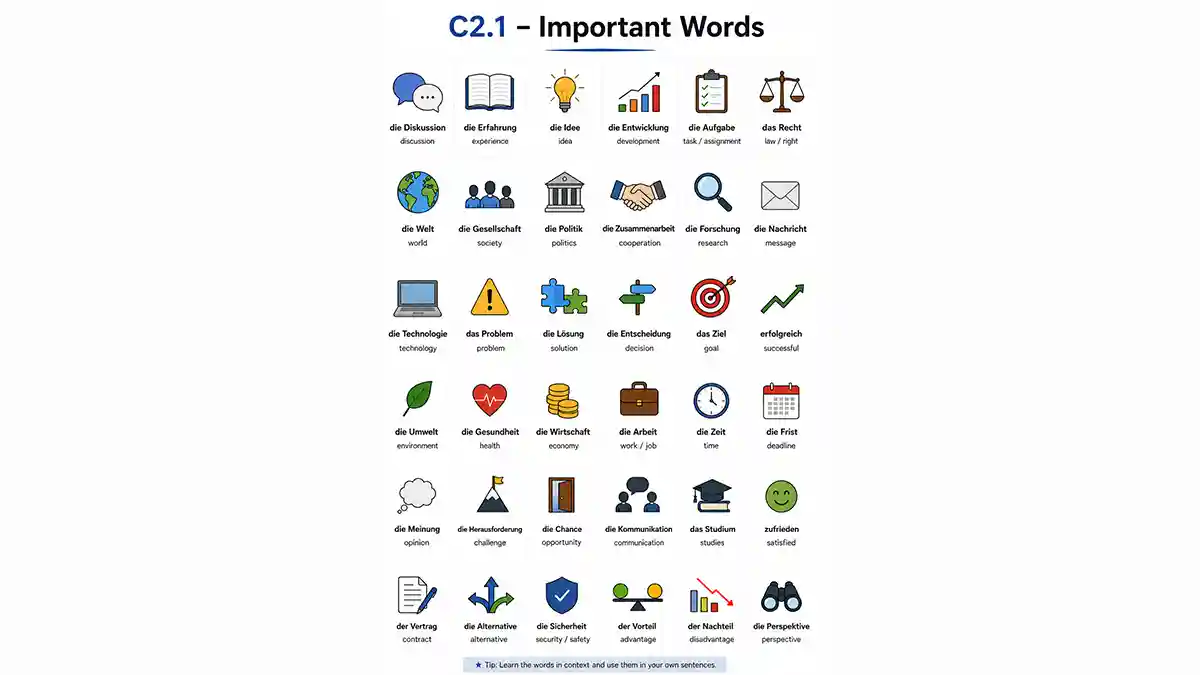
Welcome to the highest and most profound stage of academic and linguistic mastery in the German language. This dictionary represents the ultimate comprehensive guide to **520 of the most important vocabulary words** for the ninth level **C2.1**. These words empower you to draft critical essays, philosophical arguments, engage in complex legal negotiations, and conduct advanced economic analysis.
These 520 vocabulary words were curated and formatted based on the academic standards of the Goethe-Institut exams for the C2 level and official international curricula. They are categorized by definite article to ensure maximum comprehension and retention.
All vocabulary words in this guide support high-definition interactive pronunciation. Please make sure to open this page in Google Chrome to fully enjoy the audio feature.
Academic Application & Linguistic Analysis of C2.1 Vocabulary
Mastering the C2.1 level goes beyond simply memorizing complex words in isolation; it demands a deep comprehension of the syntactic and semantic contextualization (Syntaktische und Semantische Kontextualisierung) required in academic discourse and legal argumentation. Transitioning to full native-like proficiency (Muttersprachliches Niveau) requires learners to master collocations (Kollokationen) and idiomatic structures associated with each term, ensuring logical coherence and rigorous academic reasoning.
■ 1. Structuring Philosophical Arguments & Critical Thinking (Argumentationstheorie)
When drafting critical essays or research papers in German, terms like Das Axiom (postulate) and Die Prämisse (premise) form the core of valid logical reasoning. Distinguishing between empirical evidence (Der Empirismus) and abstract rationalism (Der Rationalismus) is critical to constructing persuasive academic debates. Furthermore, leveraging terms like Der Trugschluss (logical fallacy) enables writers to dissect weak arguments and critique opposing theories with precision according to German university standards.
■ 2. Legal Drafting & Political Analysis (Rechtssprache und Politik)
German legal and administrative prose relies on strict precision and complex compound nouns (Komposita). Terminology such as Der Präzedenzfall (legal precedent) and Das Plädoyer (closing argument) places the learner at the heart of high-level legal discourse. Utilizing these terms correctly requires a solid grasp of the passive voice (Passiv) and subjunctive moods (Konjunktiv I & II), enabling formal documentation of administrative acts (Der Verwaltungsakt) and legal appeals through an objective, evidence-based style.
■ 3. Effective Methodology for Retaining C2.1 Vocabulary
To transform these advanced terms from a passive vocabulary (Passiver Wortschatz) into active usage (Aktiver Wortschatz), implementation of Spaced Repetition strategies alongside contextual sentence construction is highly recommended. Additionally, pairing interactive audio pronunciation features on our platform with argument-driven essay writing (Erörterung) ensures long-term retention of grammatical genders and plural forms without confusion.
Frequently Asked Questions about C2.1 (FAQ)
What is the main difference between C1.2 and C2.1 levels?
C2.1 represents the beginning of native-like fluency, where the learner masters complex philosophy, superior rhetoric, literary criticism methods, and the precise use of rare vocabulary.