
Top 500 C2.2 German Vocabulary Words (Schlüsselwörter)
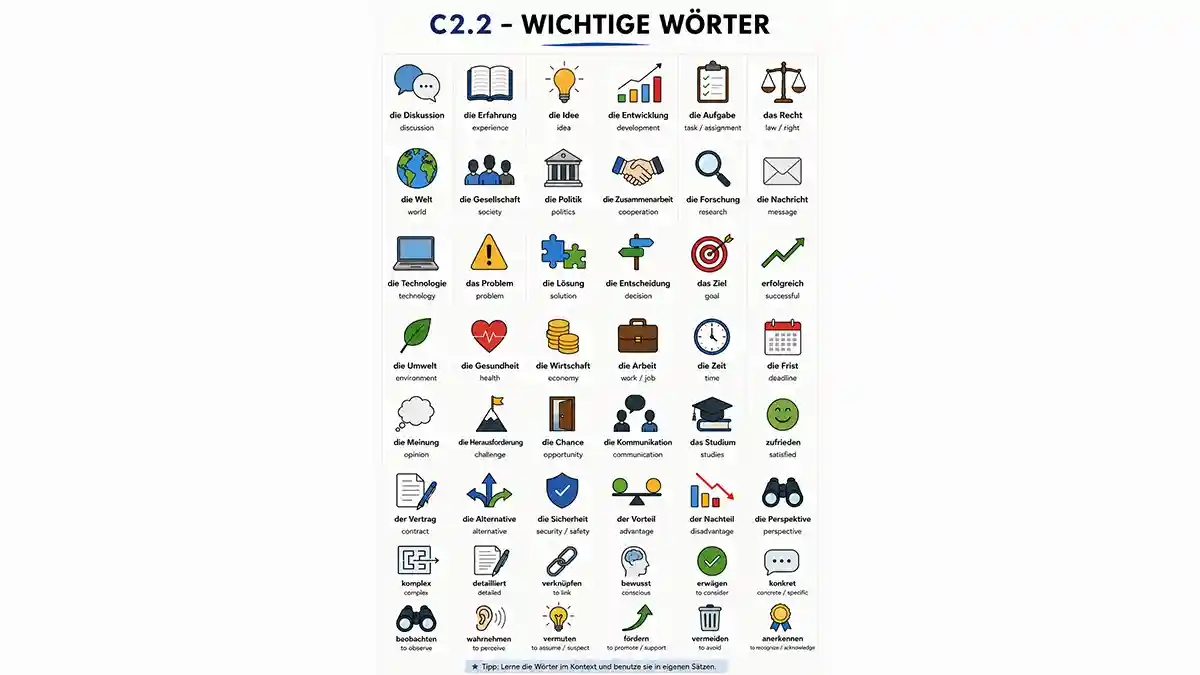
Welcome to the ultimate pinnacle of German mastery. This comprehensive dictionary contains the top 500 essential vocabulary words for Level C2.2 (Großes Deutsches Sprachdiplom)—the ultimate academic phase enabling you to speak, debate, and write with native-like fluency.
Curated according to standard C2 exam guidelines (Goethe-Zertifikat C2), these words are organized into 6 core academic domains: Science & Philosophy, Law & Governance, Economics & Finance, Psychology & Mindset, Literature & Aesthetics, and Society & Rhetoric, along with advanced C2.2 verbs and idiomatic expressions.
All vocabulary cards support high-precision interactive audio pronunciation. Please ensure you open this page in Google Chrome for full audio functionality.
Science, Research & Philosophy (Wissenschaft & Philosophie)
Elite academic terminology and precise vocabulary used in specialized papers and intellectual debates at the C2.2 level.
Law, Governance & Politics (Recht, Staatswesen & Politik)
Precise legal, constitutional, and governance vocabulary for advanced academic argumentation.
Economics, Finance & Commerce (Wirtschaft & Finanzen)
High-level terminology covering macroeconomics, financial markets, and global commerce.
Psychology, Emotions & Mindset (Psychologie & Geist)
Sophisticated expressions describing human psyche, cognitive mechanisms, and emotional nuances.
Literature, Art & Aesthetics (Literatur, Kunst & Ästhetik)
High literary theory, artistic analysis, and aesthetic criticisms.
Society, Sociology & Rhetoric (Gesellschaft & Rhetorik)
Advanced terms regarding sociology, social cohesion, political discourse, and public rhetoric.
Key C2.2 Verbs & Expressions (Wichtige Verben & Ausdrücke)
Elite academic verbs and contextual expressions required to master analysis and formal writing at level C2.2.
🎯 How to Leverage C2.2 Vocabulary to Achieve Top Scores in the Goethe-Zertifikat C2 Exam
Reaching the C2.2 level is not merely about memorizing complex words or recognizing rarely used synonyms; the real challenge lies in effectively deploying these terms within a precise structural context. This demonstrates to the evaluation board at the Goethe-Institut that you have attained native-level proficiency. In the written module (Schreiben) of the C2 exam, candidates are required to compose argumentative essays and research papers covering intricate topics such as globalization, humanistic philosophy, and financial evolution. Employing advanced rhetorical terms like Der Paradigmenwechsel (paradigm shift) or Das Postulat der Wertfreiheit (the postulate of value neutrality) gives your text a refined academic tone that instantly elevates your score.
Furthermore, the oral examination (Sprechen) at this level evaluates your capacity for improvisation and your use of sophisticated logical connectors. Expressing complex ideas using terms like Die Diskrepanz to highlight a sharp contrast between two philosophical perspectives, or utilizing governance terminology such as Der Präzedenzfall when discussing legal topics, proves to your examiners that you are not translating literally from your native language, but rather thinking and articulating directly within the deep structures of formal German.
📘 Stylistic Differences Between Everyday Conversational German and High-Level Academic German
The German language is characterized by a significant gap between everyday spoken register (Umgangssprache) and formal scientific discourse (Wissenschaftssprache). In the introductory levels (A1–B2), learners express cause and effect using basic conjunctions such as "weil" or "wegen". However, upon advancing to C2.2, the stylistic architecture shifts entirely, moving from simple sentence structures to advanced nominal style (Nominalstil). For example, instead of constructing a standard phrase like "The idea changed because of experience," high-level discourse demands an academic structure such as: "Der Erkenntnisgewinn erfolgte durch den Empirismus".
This structural transformation distinguishes conversational fluency from academic mastery. Understanding nuanced causal relationships relies on precise conceptual differentiation; the term Die Kausalität denotes direct, definitive causality, whereas Der Synergismus refers to multi-factor synergy and interaction. Mastering these subtle distinctions equips you to read and analyze research papers and scientific journals at German universities without hesitation or reliance on translation.
💡 Spaced Repetition and Audio Practice Strategies for Retaining Specialized C2 Vocabulary
Given that C2.2 vocabulary consists of abstract and conceptually dense terms (such as specialized vocabulary in epistemology and jurisprudence), traditional visual rote memorization proves ineffective and leads to rapid attrition. The most effective strategy for mastering this extensive lexicon is combining Spaced Repetition systems with interactive audio tools available on DeutschPlay. Listening to native pronunciation for complex words—such as Die Interdisziplinarität—while repeating them aloud builds phonetic muscle memory, instilling total confidence during formal debates and interviews.
To maximize retention, language acquisition experts recommend learning vocabulary within contextual sample sentences (Beispielsätze) tailored to specific domains rather than in isolation. Maintain a dedicated notebook organized by topic: record the academic term, its grammatical gender/article, its plural form, and an authentic sentence illustrating a real-world scenario. This method effectively transitions words from your passive recognition memory into your active speaking and writing vocabulary.
Frequently Asked Questions about C2.2 (FAQ)
What is the key difference between C2.1 and C2.2 levels?
While C2.1 focuses on broad academic understanding and writing specialized texts, C2.2 represents absolute native-like fluency. At C2.2, learners master high rhetoric, subtle irony, stylistic nuances, and complex figurative expressions seamlessly.
Does learning this list guarantee passing the Goethe-Zertifikat C2 exam?
Yes, this 500-word vocabulary list is built strictly upon official standards for the Großes Deutsches Sprachdiplom (C2) and covers the most frequently recurring themes in reading, writing, and oral examination modules.
How can I best utilize the interactive audio button for retention?
Listen to the native voice playback, repeat the pronunciation aloud three times, and immediately construct a full academic sentence with the word to solidify it in long-term memory.
What is the most effective method to review these advanced words?
The best approach is categorized spaced repetition using the color-coded article columns (Der / Das / Die) provided in this guide to remember noun genders alongside their plural forms.
Academic Books & Curricula (References)
Academic and Linguistic Sources
This vocabulary compilation was compiled and documented based on the following standard international German references:
- Duden - Das große Wörterbuch der deutschen Sprache - Primary standard reference dictionary for the German language.
- Goethe-Zertifikat C2: Großes Deutsches Sprachdiplom Wortliste - Official Goethe Institute C2 word list.
- Erkundungen C2 C2.2 Kursbuch und Arbeitsbuch - Hueber Publishing C2 courseware.
- C-Grammatik: Das Grammatikbuch für die Mittel- und Oberstufe (C1/C2) - Klett Sprachen publishing.
- DWDS - Digitales Wörterbuch der deutschen Sprache - Digital Dictionary of German at the Berlin-Brandenburg Academy of Sciences.