Official Assessment Criteria in Goethe & telc Exams
| Criterion | What the Examiner Looks For |
|---|---|
| Task Fulfillment (Aufgabenerfüllung) | Addressing all prompt guide points thoroughly, adhering to the requested word count, and utilizing the correct format (email, forum post, formal complaint). |
| Cohesion & Coherence (Kohärenz & Kohäsion) | Logical flow of arguments, paragraph division, correct punctuation, and seamless sentence connectors. |
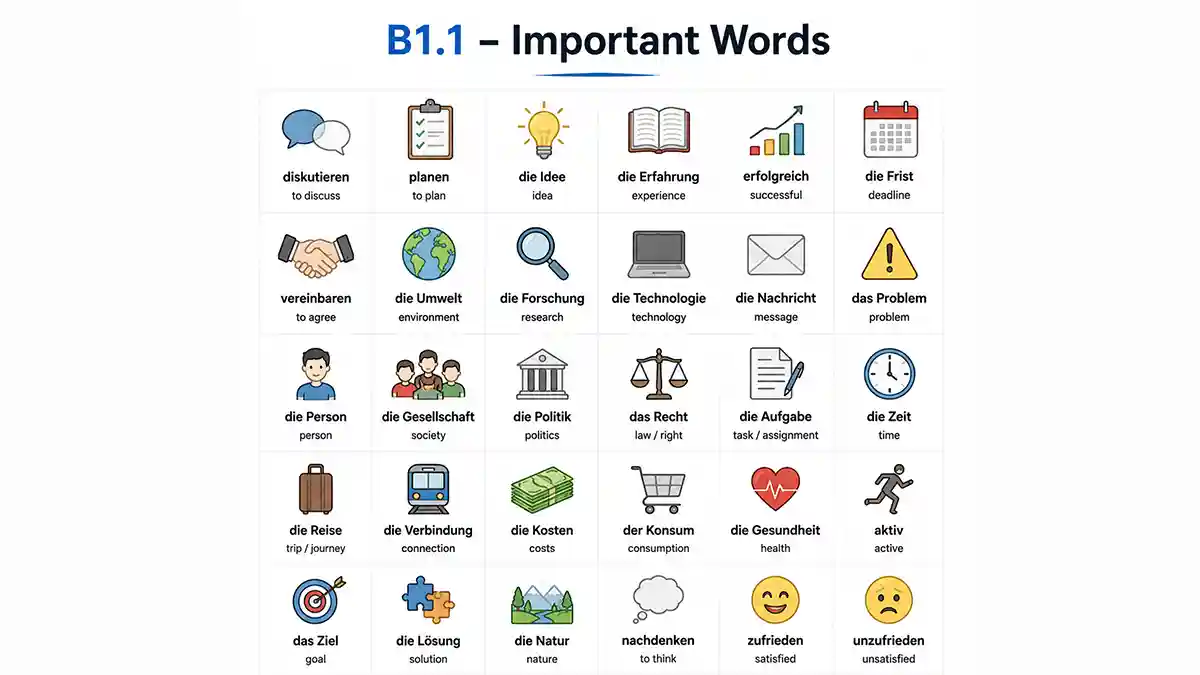
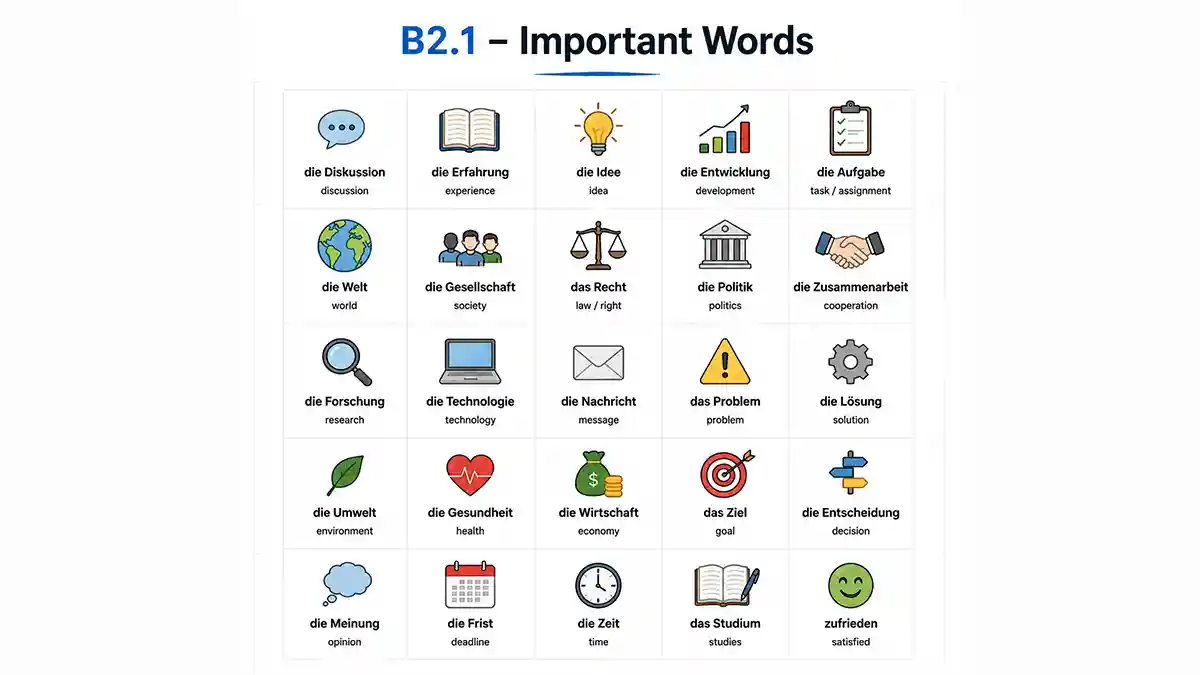
| Vocabulary Range (Wortschatz) | Lexical variety, precision in terminology, and avoidance of basic repetitions. Strengthen your vocabulary with B1.1 Core Keywords and B2.1 Advanced Lexicon. |
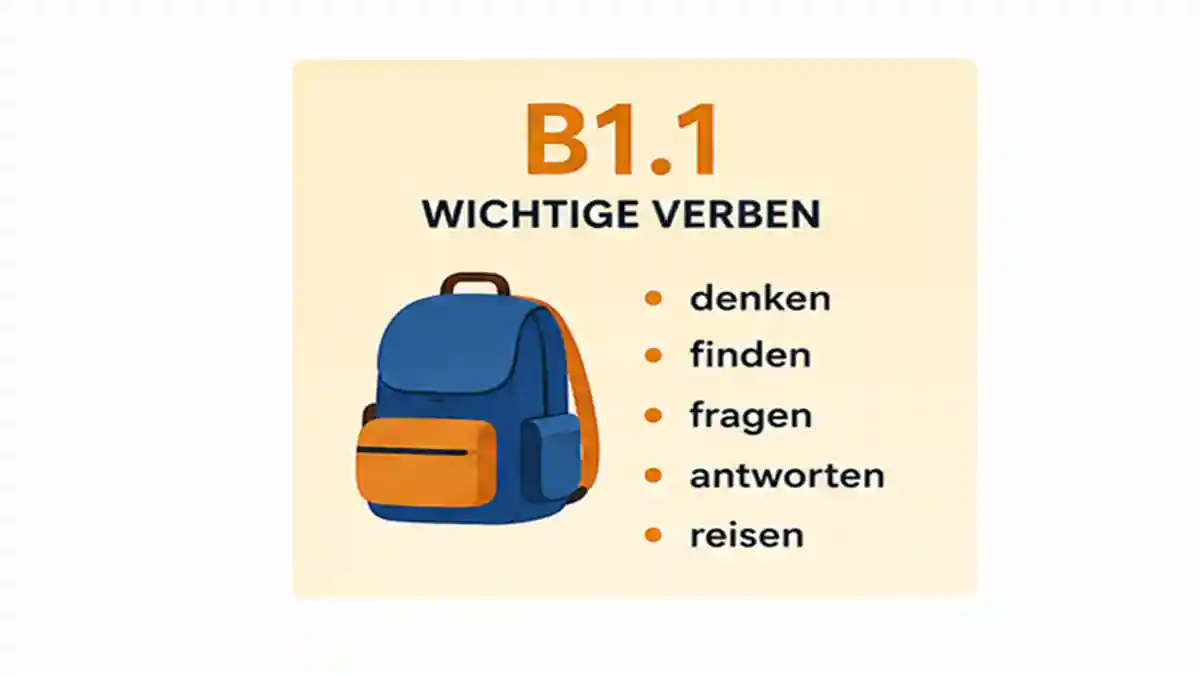
| Grammatical & Spelling Accuracy (Korrektheit) | Minimizing Case errors (Kasus), correct verb placement in main and subordinate clauses, adjective endings, and spelling accuracy. Master key verbs with Essential B1 Verbs and the interactive Verb Conjugator Tool. |
Writing Strategy for CEFR B1 Level
Structure of Goethe B1 Writing Tasks: The B1 exam consists of three distinct modules:
- Task 1 (Teil 1): Writing a personal/informal email to a friend (~80 words). Browse pre-structured templates in our Email Templates Section.
- Task 2 (Teil 2): Writing a forum comment expressing your viewpoint on a trending social topic (~80 words).
- Task 3 (Teil 3): Writing a brief formal/semi-formal message apologizing or submitting a request (~40 words), such as a Formal Appointment Cancellation or an Invitation Decline.
B1 Opinion Essay Blueprint (Teil 2)
1. General Introduction: Introduce the topic importance or refer to a previous discussion:
2. Personal Experience (Persönliche Erfahrung): Sharing your background using Personal Background & Presentations structures:
3. Situation in Home Country (Situation im Heimatland):
4. Advantages & Disadvantages (Vor- und Nachteile):
5. Personal Opinion & Conclusion (Eigene Meinung & Schluss):
Writing Strategy for CEFR B2 Level
Structure of Goethe B2 Writing Tasks: The B2 exam consists of two comprehensive tasks:
- Task 1 (Teil 1): Writing a balanced argumentative forum essay (~150 words).
- Task 2 (Teil 2): Writing a formal business letter (inquiry, apology, or formal complaint) (~100 words). Check our complete guides for Job Cover Letters (Anschreiben) and Official Complaint Letters.
B2 Argumentative Essay Structure (Teil 1)
Incorporate advanced sentence starters and transitional markers to deliver academic depth:
Introduction & Topic Formulation:
Presenting Alternatives & Justifications (Alternativen & Begründung):
Advanced Argumentative Connectors:
Drafting Formal Business & Complaint Letters (B2 Teil 2)
Formal Salutation:
Reason for Writing (Grund des Schreibens):
Objective Description of the Issue:
Demands & Proposed Solutions:
Formal Conclusion & Sign-Off:
Practical Model Solution: German B2 Forum Essay
Mustertext: Homeoffice (B2 Level)
Einerseits bietet die Arbeit in den eigenen vier Wänden erhebliche Vorzüge. Beschäftigte sparen wertvolle Pendelzeit, was wiederum zu einer besseren Vereinbarkeit von Familie und Beruf führt. Zudem ermöglicht die flexible Zeiteinteilung oft ein stressfreieres Arbeiten. Andererseits darf man die Schattenseiten keineswegs vernachlässigen: Viele Arbeitnehmer klagen über den Mangel an sozialem Austausch mit Kollegen und die Gefahr, dass die Grenze zwischen Berufs- und Privatleben verschwimmt.
Als sinnvolle Alternative bietet sich das sogenannte „hybride Modell“ an. Anstatt ausschließlich von zu Hause aus zu arbeiten, verbringen die Mitarbeiter zwei bis drei Tage im Betrieb und den Rest im Homeoffice. Dies stärkt den Teamgeist, ohne auf die Flexibilität verzichten zu müssen.
Zusammenfassend bin ich der Überzeugung, dass Homeoffice ein zukunftsweisendes Modell darstellt, sofern klare Rahmenbedingungen geschaffen werden, um eine Überlastung der Angestellten zu verhindern.
Accurate English Translation:
In today's world of work, the topic of "working from home" (Homeoffice) is increasingly gaining significance as digital infrastructure has developed rapidly. On this occasion, I would like to present my viewpoints regarding this development.
On the one hand, working within one's own four walls provides substantial advantages. Employees save valuable commuting time, which in turn leads to a superior work-life balance. Furthermore, flexible time management frequently fosters a significantly less stressful working environment. On the other hand, one must by no means overlook the negative aspects: many employees complain about the lack of social interaction with colleagues and the looming risk that the boundary between professional and private life blurs.
As a pragmatic alternative, the so-called "hybrid model" presents itself. Rather than working exclusively from home, employees spend two to three days on company premises and the remainder working remotely. This reinforces team cohesion without necessitating the abandonment of flexibility.
In conclusion, I am convinced that working from home constitutes a forward-looking paradigm, provided that clear regulatory frameworks are established to prevent employee burnout and excessive workload.
Common Mistakes to Avoid During the Exam
To ensure you achieve the highest possible score in the Writing (Schreiben) section for B1 and B2 exams, memorizing ready-made templates isn't enough. You must also avoid common pitfalls that could cost you valuable points:
🔹 Ignoring Task Requirements (Aufgabenstellung): Missing any required point directly leads to losing marks in the task fulfillment criterion. It is best to highlight each item before you begin.
🔹 Literal Translation from Native Language: Translating sentence structures word-for-word causes fatal errors in word order (Satzstellung) and connective structures like (dass and weil).
🔹 Repeating Vocabulary: Relying on simple, repetitive words like (gut / schlecht) lowers your score; replace them with advanced vocabulary like (vorteilhaft / nachteilhaft).
🔹 Neglecting Cases and Articles (Kasus): Allocating a few minutes at the end to review endings and articles significantly reduces grammatical mistakes.