1. Grammatical Structure of Open Questions (W-Fragen)
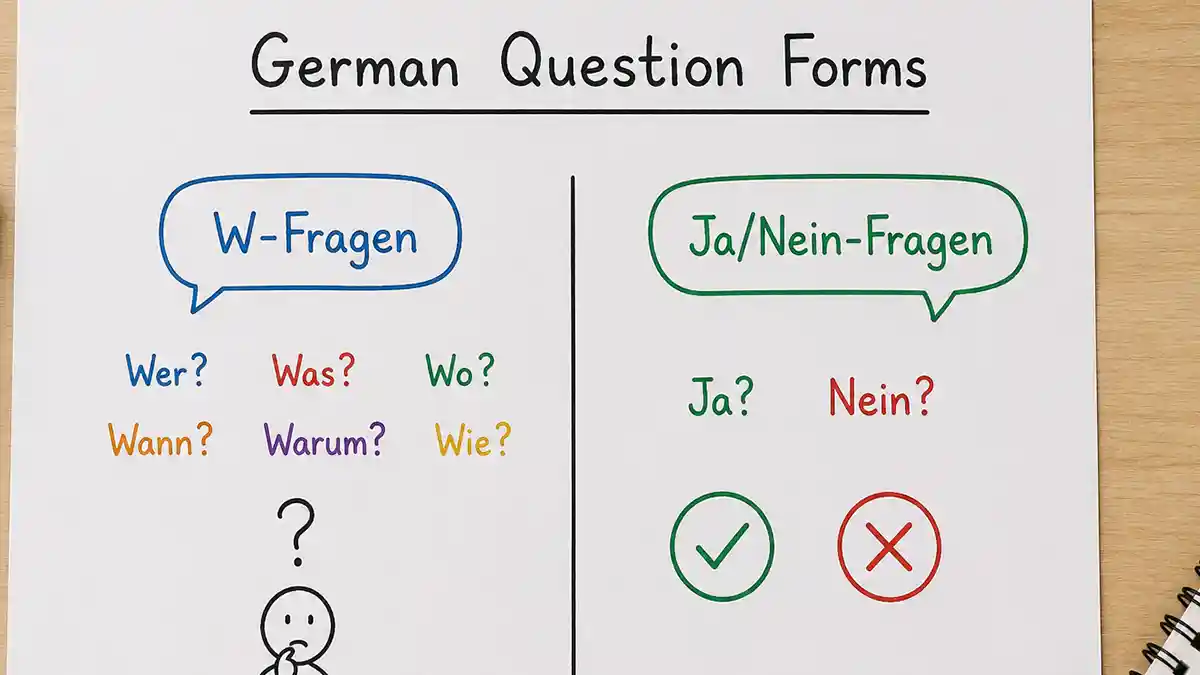
Open questions are called W-Fragen because every German question word begins with the letter W. The core rule dictates that the conjugated verb strictly occupies Position 2. For further standalone practice, check out our guide on Basics of German Question Formats.
Golden Rule for W-Fragen
1. Question Word + 2. Conjugated Verb + 3. Subject + Rest?
[Fragewort (1) - Verb (2) - Subject (3)]
2. Essential Question Words for Beginners
Here are the most fundamental German question words used daily, paired with native pronunciation and responses. You can dive deeper in our German W-Question Words Lesson:
Wer ist das?
Who is this? - This is my teacher.
Wer = Who (Subject / Nominative)
Was ist das?
What is this? - This is a book.
Was = What (Inanimate objects / ideas)
Wo wohnst du?
Where do you live? - I live in Berlin.
Wo = Where (Static location)
Wohin gehst du?
Where are you going (to)? - To the supermarket.
Wohin = Where to (Destination / Movement). For distinctions between location prepositions, see Wo vs. Wohin vs. Woher.
Woher kommen Sie?
Where are you from? - I am from Egypt.
Woher = Where from (Origin / Source)
Wann beginnt der Kurs?
When does the course start? - At 9 o'clock.
Wann = When (Time / Schedule). Review clock time in our German Numbers & Time Lesson A1.1.
Advertisement
3. Advanced Question Words & Case Declensions
In German, question words can adapt according to grammatical cases or join with adjectives to express quantity and manner:
Warum lernst du Deutsch?
Why are you learning German? - Because I want to work in Germany.
Warum = Why (Reason / Purpose)
Wie geht es Ihnen?
How are you (formal)? - Thanks, good!
Wie = How (Manner / Condition). Learn more greetings in How are you in German.
Wie viel kostet das Hemd?
How much does the shirt cost? - It costs 20 Euros.
Wie viel = How much (Uncountable / Price)
Wie viele Bücher hast du?
How many books do you have? - I have 3 books.
Wie viele = How many (Countable plural)
Wie lange bleibst du in Berlin?
How long are you staying in Berlin? - For one week.
Wie lange = How long (Duration)
Wen suchst du?
Whom are you looking for? - I am looking for the doctor.
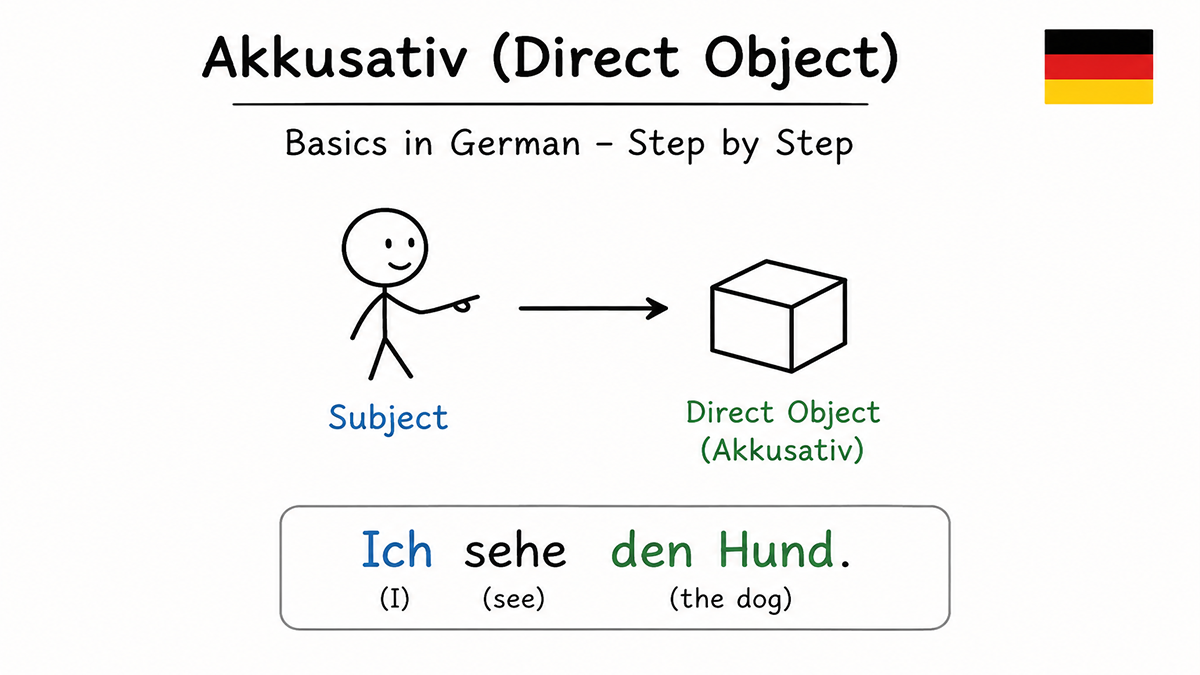
Wen = Whom (Direct Object / Akkusativ). See verbs taking direct objects in Important Accusative Verbs.
Wem gehört das Auto?
To whom does the car belong? - It belongs to my father.
Wem = To whom (Indirect Object / Dativ)
4. Yes/No Questions (Ja/Nein-Fragen)
In German, there is no standalone word for "do/does" to form closed questions. To create a Yes/No question, move the conjugated verb directly to Position 1.
Trinkst du Kaffee?
Do you drink coffee? - Yes, I drink coffee.
[Verb Trinkst in Position 1]
Sprechen Sie Deutsch?
Do you speak German? - Yes, a little bit.
[Formal address with pronoun Sie]
Hast du heute Zeit?
Do you have time today? - No, I have no time.
[Using the verb Hast in Position 1]
5. How to Answer Questions & The Magic Word "Doch"
When answering a closed question, choose between 3 options depending on whether the question is affirmative or contains a negative word like nicht or kein . Read our dedicated standalone lesson on Yes/No Questions & The Doch Rule:
Kommst du aus Kairo?
Are you from Cairo?
Affirmative Answer: Ja! (Yes)
Kommst du aus Kairo?
Are you from Cairo?
Negative Answer: Nein! (No)
Kommst du nicht aus Ägypten?
Aren't you from Egypt? (Negative question with nicht)
Contradictory Affirmative: Doch! (On the contrary, yes!)