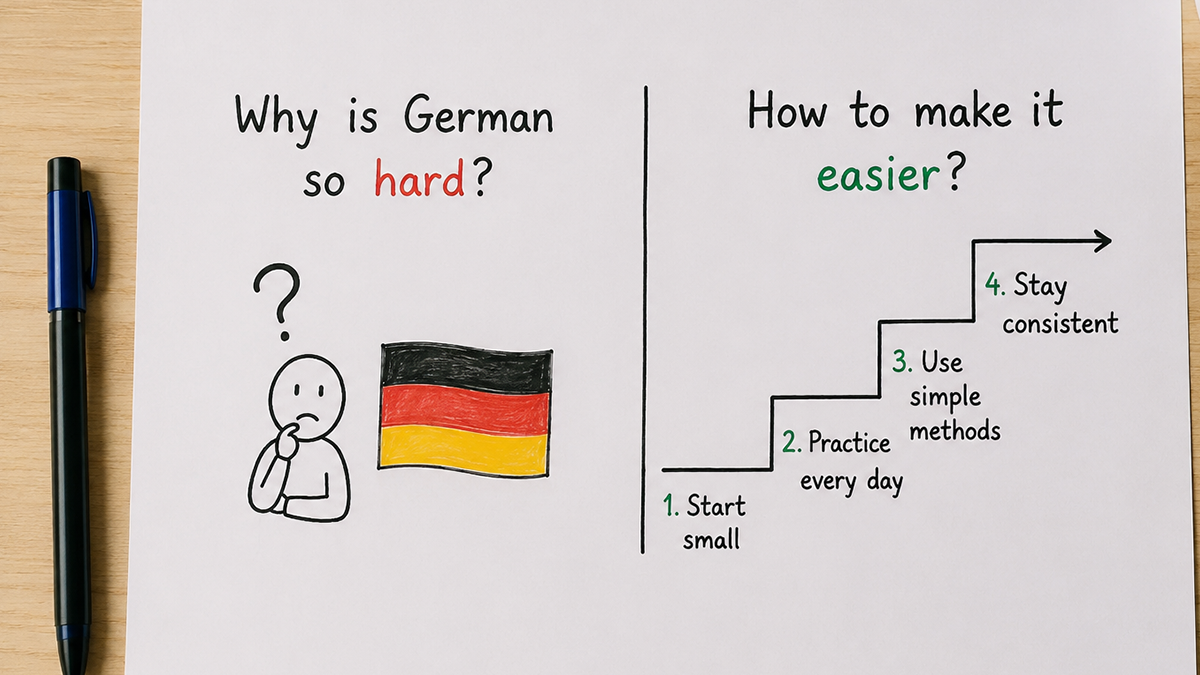
Why Does German Seem Difficult? (4 Main Pillars)
- 1. Three Grammatical Genders (Die Artikel): Nouns in German are assigned masculine (Der), feminine (Die), or neuter (Das) genders. They don't always align with biological logic—for example, "young girl" is neuter (Das Mädchen).
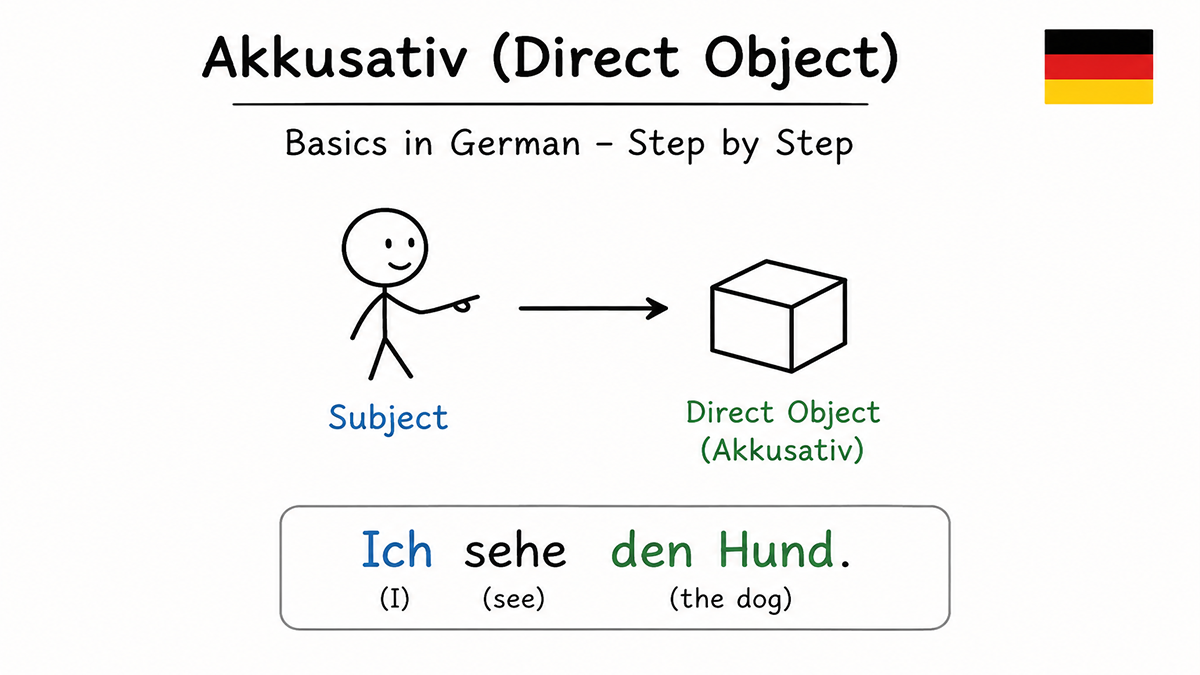
- 2. Four Grammatical Cases (Kasus): German utilizes Nominative, Accusative, Dative, and Genitive cases. These alter article forms, pronoun endings, and adjective suffixes based on the noun's function in a sentence. You can deepen your understanding by reviewing our guides on the Basics of the Accusative Object and Accusative Prepositions.
- 3. Long Compound Words (Komposita): German creates ultra-specific nouns by glueing smaller words together. While intimidating at first sight—like Krankenhaus (Hospital: "sick" + "house")—they are logical once decoded.
- 4. Strict Sentence Structure (Satzbau): Verbs often get pushed to the end of subordinate clauses or split into two pieces (separable verbs), requiring learners to adjust how they construct thoughts. For a clear breakdown of syntax, read about How to Form Questions in German.
Strategy 1: Set Clear Goals & Practice Active Immersion
First, clarify your motivation: Are you aiming to pass an official B1/B2 exam for an Ausbildung visa, or do you need conversational German for career advancement? Clear goals maintain momentum.
The Immersion Technique: Surround yourself with German daily:
- Change Device Languages: Switch your phone, tablet, and browser interface to German for instant daily passive vocabulary.
- Listen to Podcasts & Music: Tune into beginner podcasts like Slow German or Nicos Weg to build familiarity with German rhythm (Sprachmelodie).
- Watch German Media with Subtitles: Start with German audio and English subtitles, progress to German subtitles, and finally turn subtitles off completely.
Strategy 2: Smart Hacks for Gender Articles (Der, Die, Das)
- Learn Nouns with Their Articles: Never memorize Apfel alone; always memorize Der Apfel as a single unseparable block. To streamline memorization, consult our Level A1.1 Keywords Vocabulary Guide.
- Color-Coding (Visual Memory): Assign colors when writing down vocabulary: Blue for Masculine (Der), Red for Feminine (Die), and Green for Neuter (Das). You can also test your memory via our interactive German Colors Game.
- Master Word Endings: Word endings often dictate gender. For example, nouns ending in -ung, -keit, -heit are always feminine (Die), while nouns ending in -chen, -lein are always neuter (Das).
Strategy 3: Decoding Grammar & Compound Nouns
Deconstructing Compound Words: Treat complex words like LEGO bricks. Take Arbeitslosigkeitsversicherung (Unemployment Insurance): break it into Arbeit (work) + los (less/without) + keit (suffix) + Versicherung (insurance). Crucially, the article of the final word dictates the gender of the entire compound.
Mastering Sentence Patterns: German enforces strict word order rules (like verb-second position in main clauses). Focus on pattern recognition through repetitive sentence building rather than dry memorization, starting with how to introduce yourself professionally in German.
Strategy 4: Effective Practice & Practical Resources
- Focus on High-Frequency Vocabulary: Prioritize top daily-use words and industry-specific terminology (such as medical German vocabulary if working in healthcare), and explore our essential list of important German verbs with Accusative.
- Embrace Mistakes: Making errors is a required step in rewiring neural language networks. Native speakers value your effort and will understand your core meaning.
- Language Exchange (Tandem): Find a German language buddy interested in practicing English. It provides authentic conversational feedback and cultural insights.