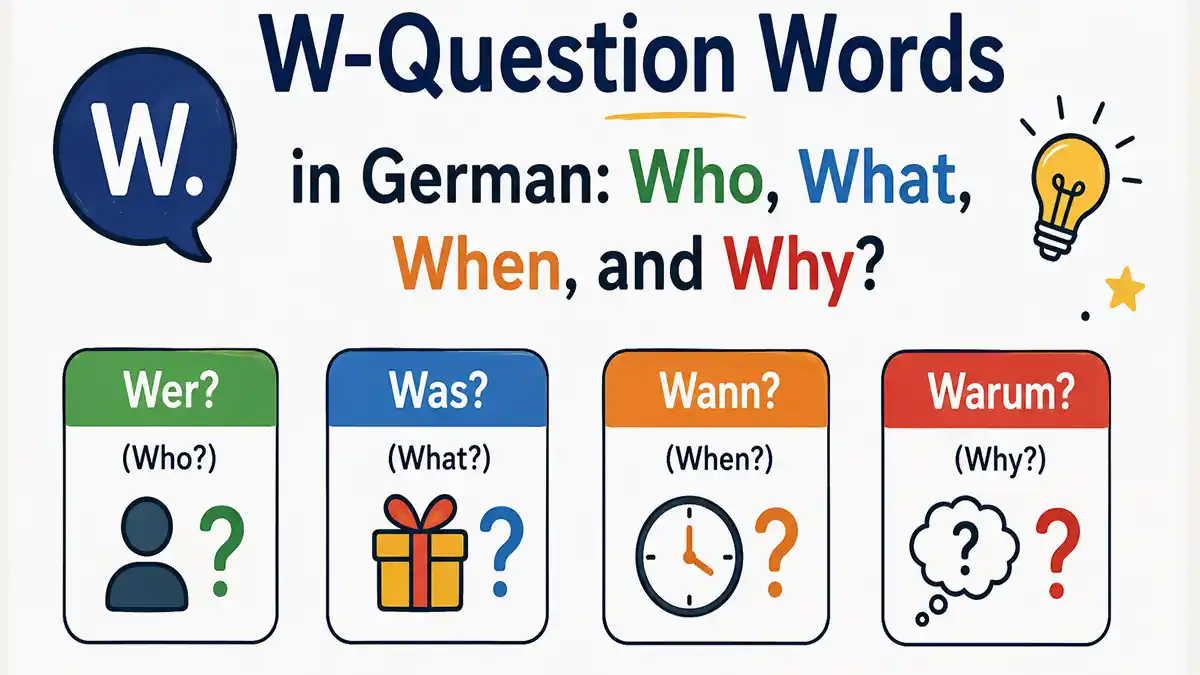
W-Question Words: Who, What, When, and Why?

W-Question words in German

Question words starting with the letter W are the cornerstone of daily communication in German; without them, you won't be able to initiate conversations or inquire about specific information when navigating the job market and universities in Germany.

This linguistic family is remarkably direct, as each word precisely specifies the expected answer type. Today, we cover the four essential question words for beginners to construct correct questions across various German language levels.

All sentences and examples in this article feature interactive high-quality audio pronunciation. Click on the speaker icon in any card to hear the correct German pronunciation, preferably using Google Chrome for best performance.

Advertisement

The Magic Formula for W-Fragen

Word order in German questions is strict and consistent, which applies to everyday situations like self-introductions and personal details. Always keep this visual structure in mind:

W-Frage + Verb (Pos. 2) + Subjekt + Rest ?

1. The Word Wer (Who) - For Persons

Used when asking about someone's identity. The expected answer is always a person's name or personal pronoun, which is very useful when discussing family affairs and relatives.
Wer bist du?
Who are you?
Ich bin Ahmed. (I am Ahmed)
Wer kommt heute?
Who is coming today?
Der Lehrer kommt. (The teacher is coming)

2. The Word Was (What) - For Non-Persons

When asking about an object, idea, activity, or an action requiring correct verb conjugation, Was is your primary choice. You can also practice interactively with educational games and apps to reinforce this concept.
Was machst du?
What are you doing?
Ich lerne Deutsch. (I am learning German)
Was ist das?
What is this?
Das ist ein Buch. (This is a book)
Advertisement

3. The Word Wann (When) - For Time

Used to request information regarding time, appointments, hours, days, or timeframes. This is essential when writing appointment cancellation letters. For more on reading time, review the A1.1 Numbers and Time lesson.
Wann beginnt der Kurs?
When does the course start?
Um 9:00 Uhr. (At 9 o'clock)
Wann kommst du?
When are you coming?
Morgen. (Tomorrow)

4. The Word Warum (Why) - For Reasons

Used to inquire about reasons or justifications behind an event. Answers typically begin with a causal conjunction like Weil (because), which becomes crucial when submitting a cover letter for vocational training (Ausbildung) or jobs.
Warum lernst du Deutsch?
Why are you learning German?
Weil ich in Deutschland arbeiten möchte.
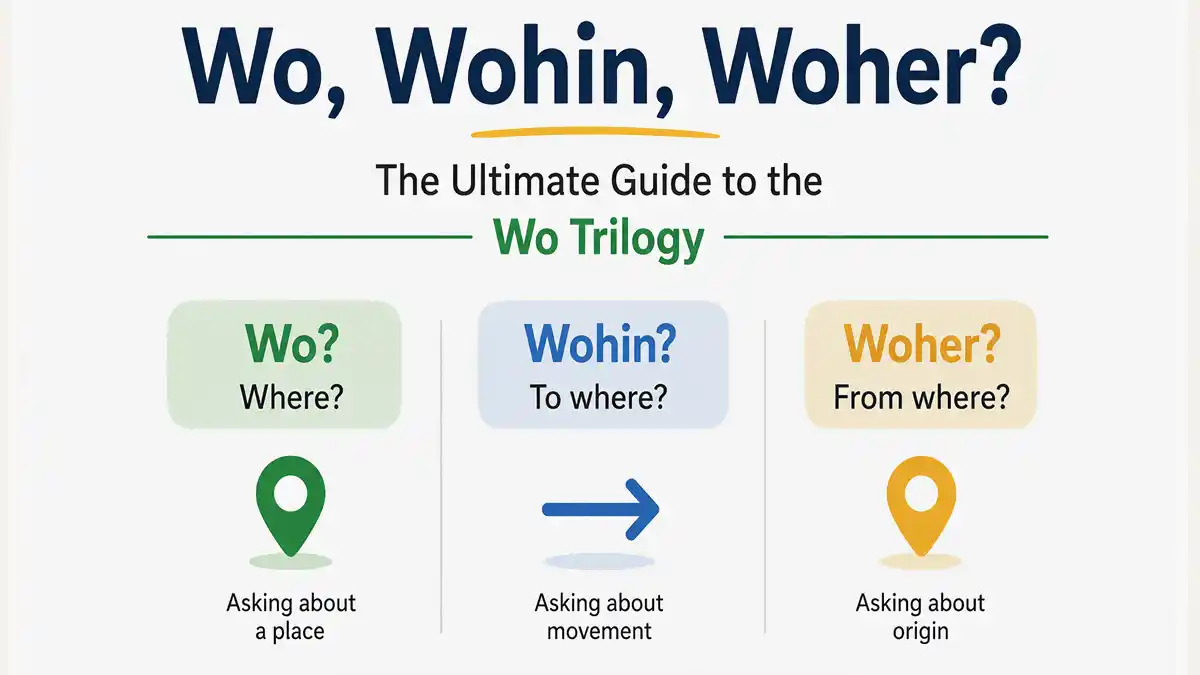
5. Essential Question Words: Wo (Where) & Wie (How)

To complete your foundational knowledge, here are two essential question words used daily in both formal and informal conversations:
Wo wohnst du?
Where do you live? (Asks about a fixed location)
Ich wohne in Berlin. (I live in Berlin)
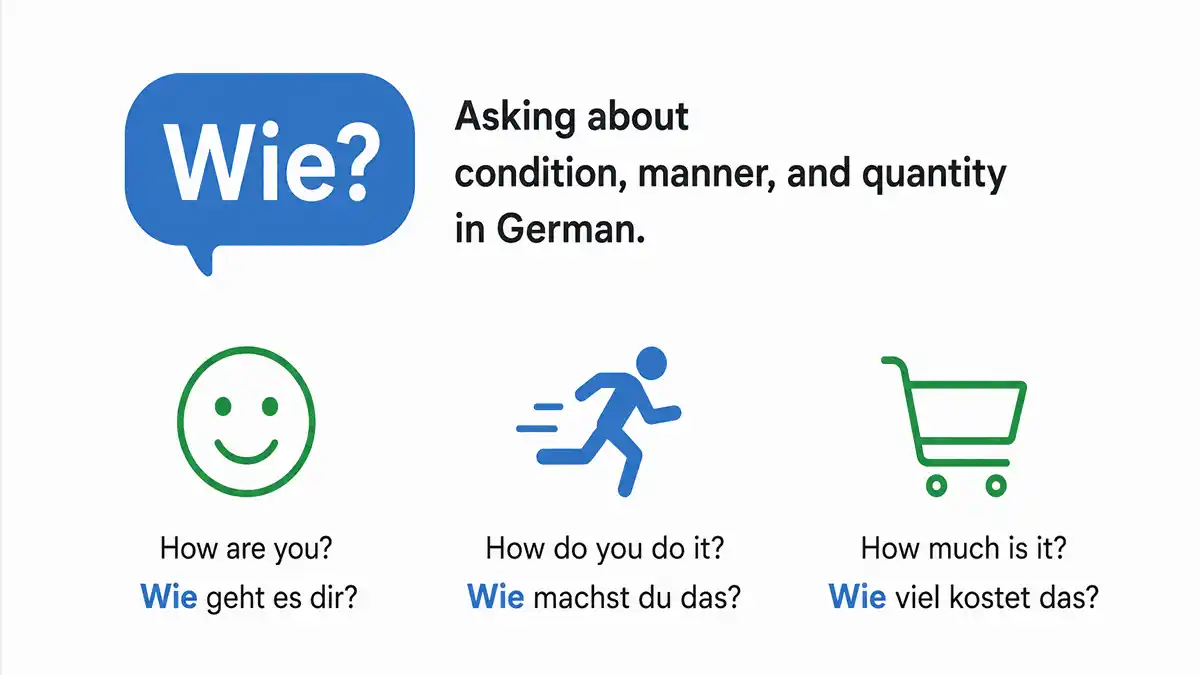
Wie heißt du?
What is your name? / How are you called? (Asks about name or state)
Ich heiße Sarah. (My name is Sarah)

Golden Rules for Mastering W-Questions

When forming any German question starting with a W-Question word, keep these three key rules in mind:

Frequently Asked Questions (FAQ)

What is the expected answer when asking with the question word Wer?

The question word Wer asks specifically about subject persons, so the answer must always be a person's name or a personal pronoun referring to a human.

What is the core difference between Was and Wer in German questions?

Wer is used exclusively to ask about people (who), whereas Was is used to ask about non-humans (what), such as objects, activities, or actions.

How do I correctly answer a question starting with Warum?

Since Warum asks for the reason (why), a typical answer often begins with a causal conjunction like Weil (because) or provides a direct justification.

What is the correct position of the verb in a W-Question (W-Frage)?

The conjugated verb always takes Position 2 right after the question word, followed immediately by the subject in Position 3.

Advertisement