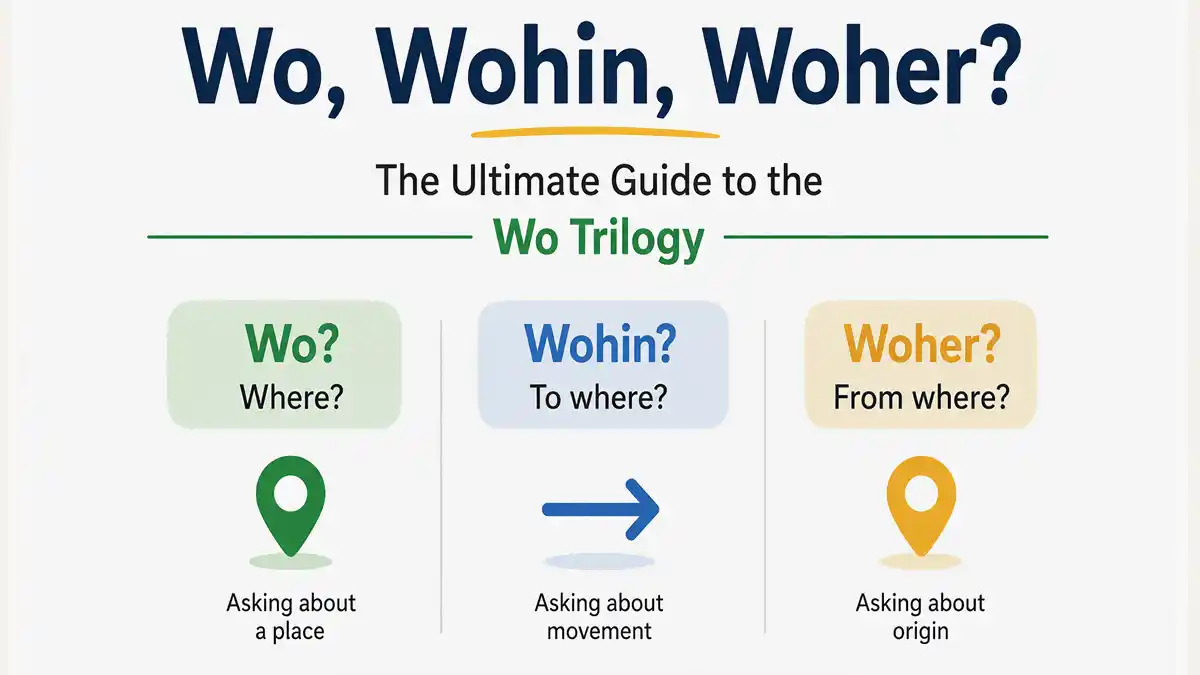
1. The Word Wo (Where) - For Stationary Location
- Wo bist du? (Where are you?) -> Ich bin im Supermarkt. (I am in the supermarket).
- Wo liegt das Buch? (Where is the book lying?) -> Das Buch liegt auf dem Tisch.
2. The Word Wohin (Where to) - For Direction & Movement
- Wohin gehst du? (Where are you going?) -> Ich gehe in den Supermarkt.
- Wohin fährst du? (Where are you driving/travelling to?) -> Ich fahre nach Berlin. You can also practice these rules through our educational games and apps.
3. The Word Woher (Where from) - For Origin
- Woher kommst du? (Where do you come from / Where are you from?) -> Ich komme aus Ägypten. It is essential when covering self-introductions and origin.
- Woher kommst du gerade? (Where are you coming from right now?) -> Ich komme von der Arbeit.
Quick Practical Comparison Table (The "Home" Test)
The best way to lock in this rule is to apply it to a single word in all three scenarios. Let's see what happens with the word "Haus" (Home):
| Question Word | Meaning | Practical Example (Haus) |
|---|---|---|
| Wo (Where?) | Stationary location | Ich bin zu Hause. (I am at home) |
| Wohin (Where to?) | Direction & movement | Ich gehe nach Hause. (I am going home) |
| Woher (Where from?) | Source / Origin | Ich komme von zu Hause. (I am coming from home) |
Quick Comparison: German Question Words of Place
A comprehensive summary of the core differences between Wo, Wohin, and Woher, including movement types, grammatical cases, and common prepositions:
| Question Word | Meaning | Movement Type | Grammatical Case | Common Prepositions |
|---|---|---|---|---|
| Wo | Where (location) | Static (No movement) | Dativ | in, an, auf, bei, nach |
| Wohin | Where to (destination) | Dynamic (Movement towards) | Akkusativ | in, nach, zu, auf |
| Woher | Where from (origin) | Source / Starting point | Dativ | aus, von |
Separating Question Words in Spoken German (Wo ... hin / her)
In everyday spoken German (Umgangssprache), the directional prefixes (hin / her) are often separated and placed at the end of the sentence without changing the meaning:
• Wo gehst du hin? = Wohin gehst du? (Where are you going?)
• Wo kommst du her? = Woher kommst du? (Where do you come from?)
Common Mistakes and How to Avoid Them
Avoid these frequent grammatical errors made by A1 and A2 German learners:
Verbs Commonly Associated with Each Question Word
You can easily determine the correct question word based on the nature of the verb in the sentence: