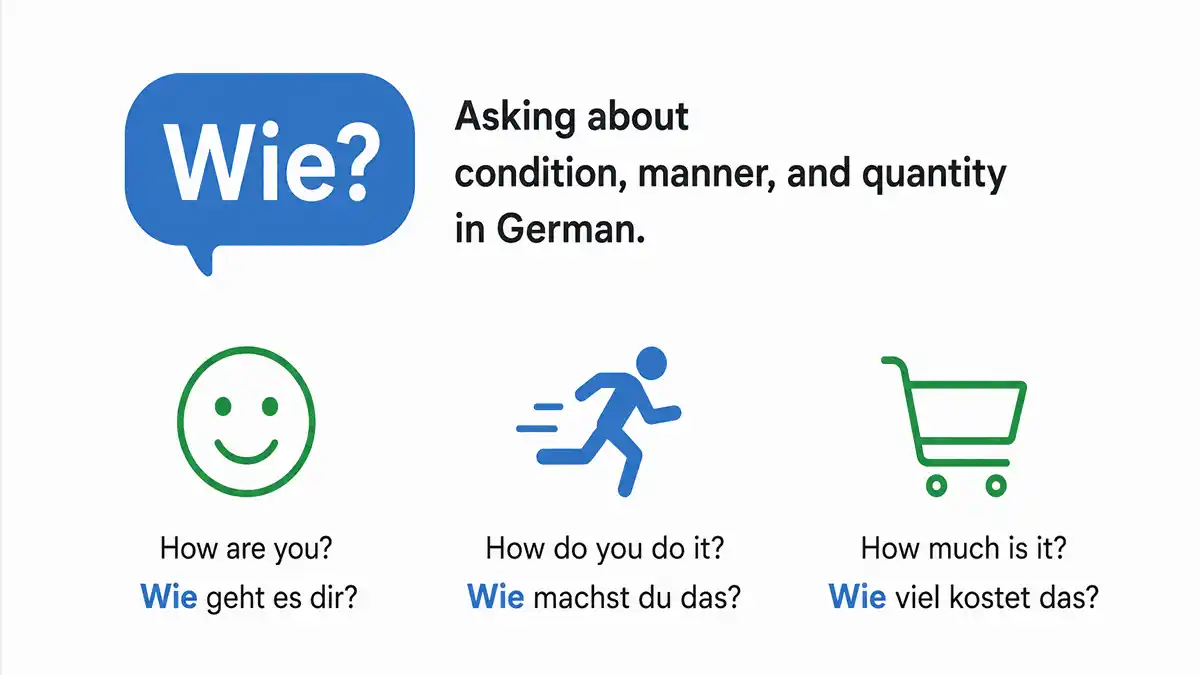
1. Using Wie (How) for Well-being & Introductions
The primary usage of "Wie" is to ask about someone's condition, manner, or name in introductory sentences, taking care to follow German verb conjugation rules.
Wie (+ optional adj.) + Verb (Pos. 2) + Subjekt ?
- Wie geht es dir? (How are you?)
- Wie heißt du? (What is your name? / What are you called?) - Learn more in our self-introductions and personal details lesson.
- Wie ist das Wetter? (How is the weather?)
2. Quantities and Numbers (Wie viel / Wie viele)
When we attach the adjective "viel" to "Wie", we obtain a question tool for quantities and numbers. This splits into two crucial categories for shopping and daily life that complement other W-Question words.
A) Wie viel (For Uncountable Quantities)
Used for things that cannot be counted individually (like money, water, or open food items):
- Wie viel kostet das? (How much does this cost?)
- Wie viel Zucker isst du? (How much sugar do you eat?)
B) Wie viele (For Countable Plural Items)
We add an "e" at the end when asking about items counted individually. The noun that follows is always in the plural form. You can practice this using our educational games and apps:
- Wie viele Äpfel brauchst du? (How many apples do you need?)
- Wie viele Kinder haben Sie? (How many children do you have?)
Advertisement
3. Duration (Wie lange)
Whenever you want to ask about timeframes or the duration of an event, use "Wie lange". This is especially important when clarifying schedules or writing appointment cancellation letters.
- Wie lange lernst du schon Deutsch? (How long have you been learning German?)
- Wie lange dauert der Film? (How long does the movie last?)
4. Age (Wie alt)
The most famous introductory question regarding age is formed by combining "how" with the adjective "old". It forms a essential basis when preparing cover letters for jobs and vocational training.
- Wie alt bist du? (How old are you?) -> Ich bin 25 Jahre alt. (I am 25 years old).