Lesson 3: Familie, Sprachen und Fragen
Family Members, Possessive Pronouns, Question Structures, Responding with 'Doch' & Spoken Languages
Every vocabulary word and dialog line in this curriculum supports high-definition interactive pronunciation. Please make sure to open this lesson inside Google Chrome browser to fully and properly experience the audio pronunciation system.
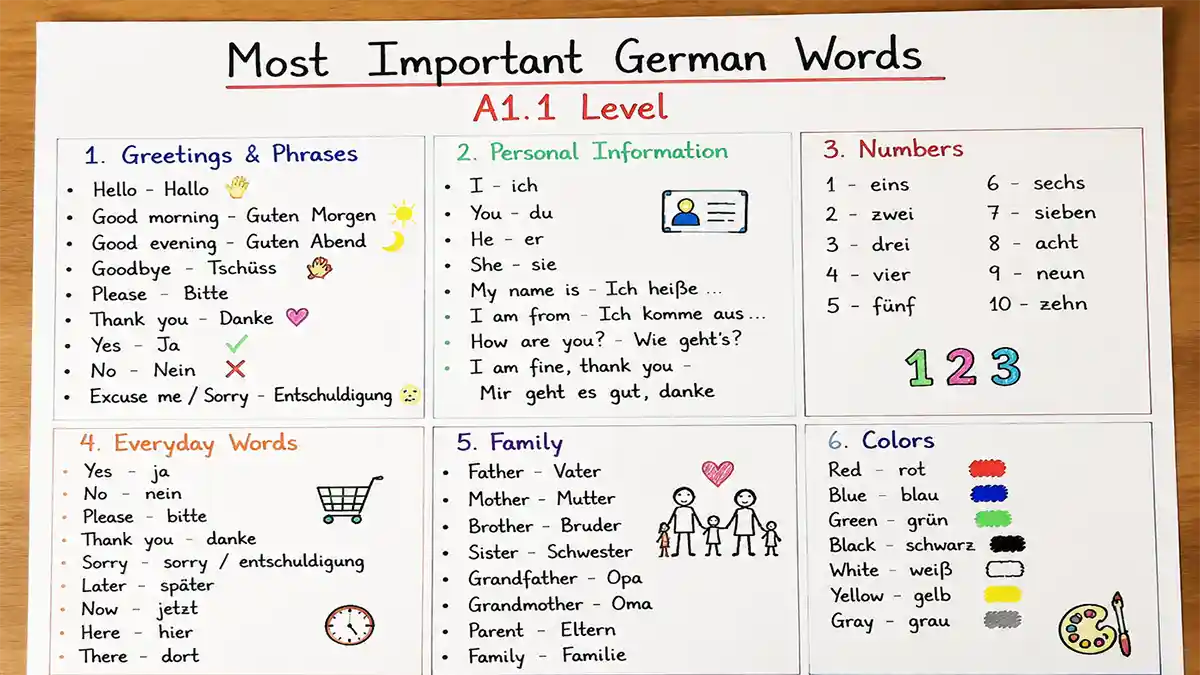
1. Family Members (Die Familie)
Family is one of the most essential topics in introductory conversations. In German, remember that masculine family members take the article der, while feminine members take die.
| German Term (Listen) | English Translation |
|---|---|
|
der Vater
|
the father |
|
die Mutter
|
the mother |
|
der Opa
|
the grandfather |
|
die Oma
|
the grandmother |
|
der Sohn
|
the son |
|
die Tochter
|
the daughter |
|
die Schwester
|
the sister |
📌 Important Grammar Rule: Genitive -s
To express possession with proper names in German, add an s directly to the owner's name without an apostrophe.
Examples: Jan's mother = Jans Mutter | Frank's father = Franks Vater
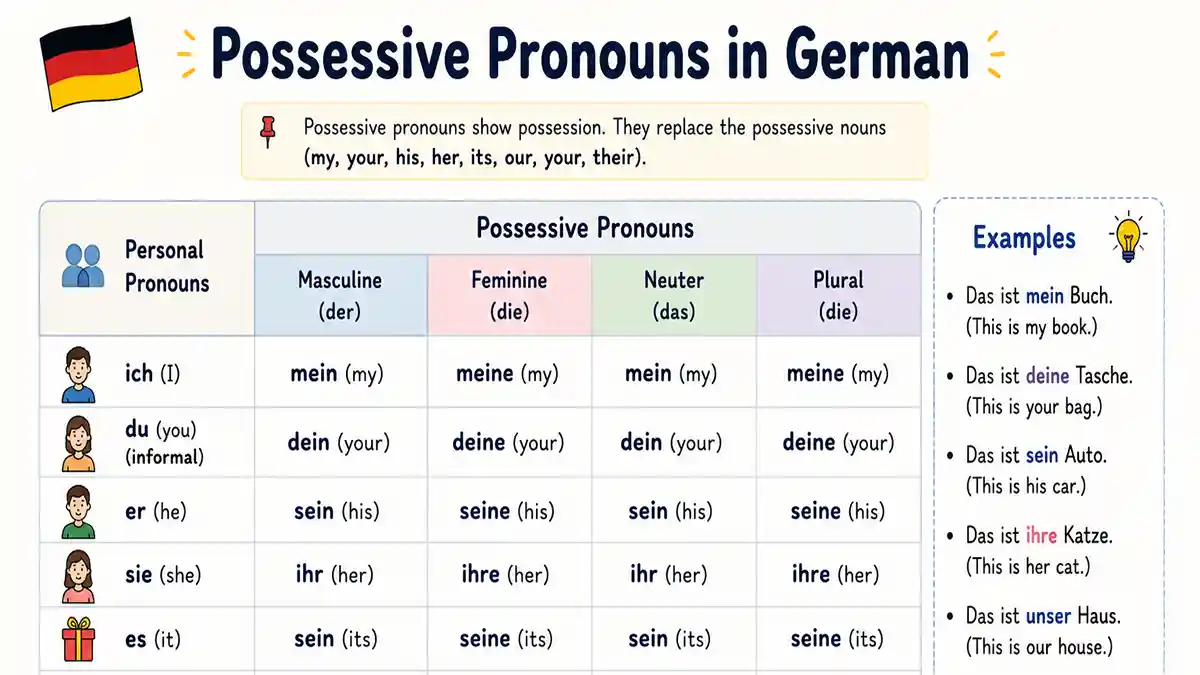
2. Possessive Pronouns (mein / dein)
To say "my father" or "your mother", we use the possessive pronouns mein (my) and dein (your, informal). If the following noun is masculine (der) or neutral (das), use mein / dein. If the noun is feminine (die) or plural, add an -e ending to form meine / deine.
| German Sentence (Listen) | English Translation |
|---|---|
|
Das ist mein Vater.
|
This is my father. |
|
Ist das deine Mutter?
|
Is this your mother? |
|
Nein, das ist meine Schwester.
|
No, this is my sister. |
3. Forming Questions (Fragen)
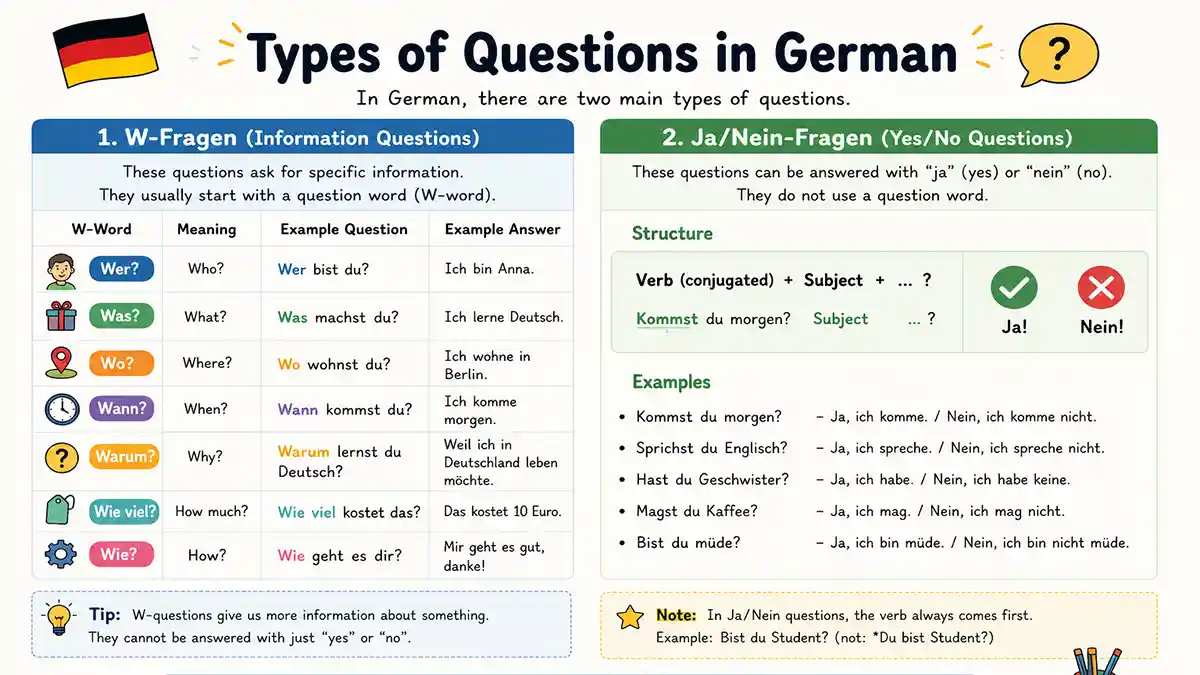
Forming questions in German relies on the position of the conjugated verb. Questions fall into two main categories:
1. W-Questions (W-Fragen)
Questions that start with a W-question word (e.g., Wer = Who, Was = What, Wo = Where). The conjugated verb always occupies Position 2.
- Wer ist das? (Who is that?)
- Was bist du von Beruf? (What is your profession?)
- Wo wohnt deine Schwester? (Where does your sister live?)
2. Yes/No Questions (Ja/Nein-Fragen)
Questions answered with yes or no. These start directly with the verb, putting the conjugated verb in Position 1.
- Ist das deine Mutter? (Is this your mother?)
- Lebt deine Schwester in Berlin? (Does your sister live in Berlin?)
- Bist du Journalistin? (Are you a journalist?)
4. Responding with 'Doch'
The word Doch is a unique German response word used to contradict a negative question or statement with an affirmative "yes, on the contrary!".
| Negative Question (Listen) | Answering with 'Doch' (Listen) |
|---|---|
|
Das ist nicht deine Mutter, oder?
(That's not your mother, right?)
|
Doch, das ist meine Mutter.
(Oh yes, it is my mother!)
|
|
Herr Beerli kommt nicht aus der Schweiz, oder?
(Mr. Beerli doesn't come from Switzerland, right?)
|
Doch.
(Yes, he does!)
|
5. Languages & The Verb 'Sprechen'
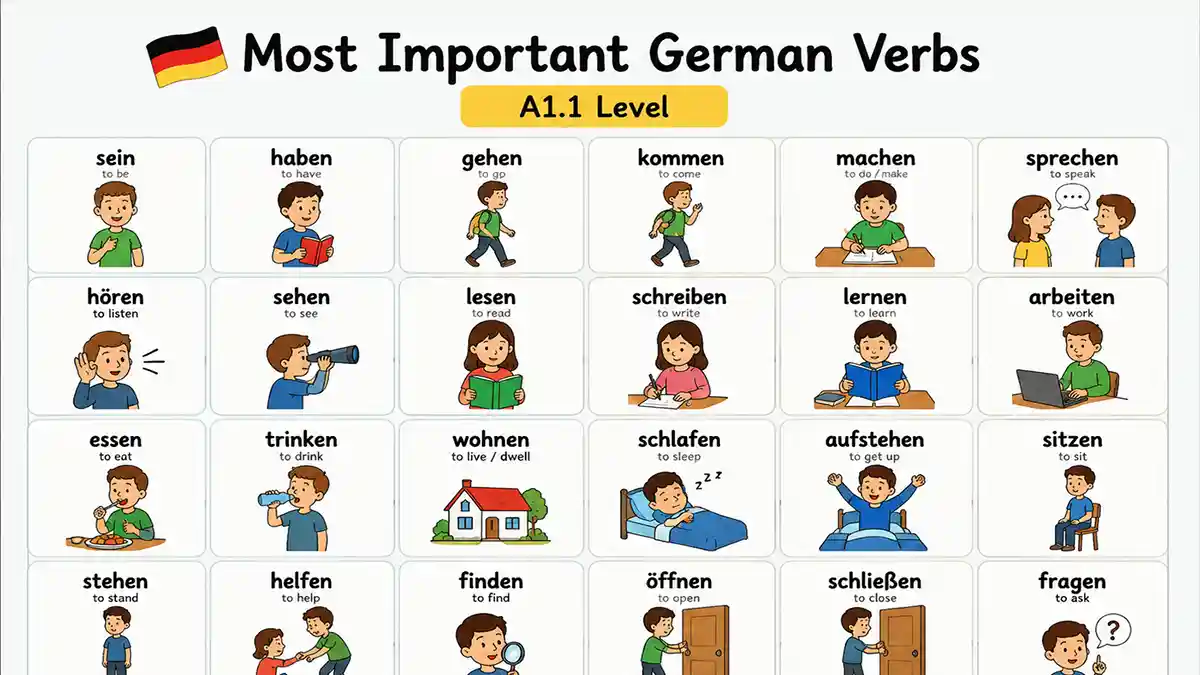
The verb to speak in German is sprechen. It is an irregular verb where the stem vowel e changes to i for du and er/sie.
Conjugation of 'sprechen':
- ich spreche (I speak)
- du sprichst (you speak) *vowel change e → i
- er/sie spricht (he/she speaks) *vowel change e → i
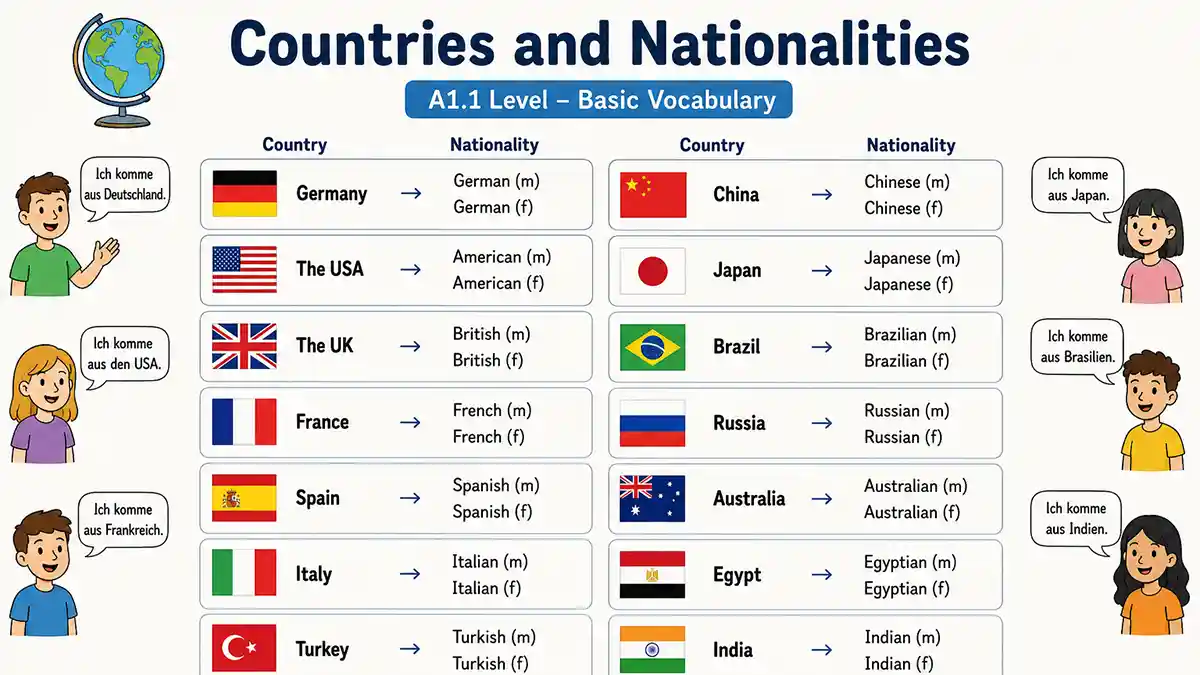
Key world languages in German:
💬 6. Practical Dialogue (Dialog)
Listen to a full conversational practice sentence by sentence or play the entire dialogue at once.
Tim & Lina Dialogue
Hallo Lina, ist das dein Vater?
Nein, das ist mein Onkel.
Ah, okay. Und spricht er Deutsch?
Ja, er spricht Deutsch und Englisch.
Wohnst du nicht in Berlin?
Doch, ich wohne in Berlin.
Frequently Asked Questions (FAQ)
When do I use 'mein' versus 'meine'?
Use mein with masculine (der) and neutral (das) nouns. Add an '-e' to form meine when paired with feminine (die) or plural nouns.
What is the difference between W-Fragen and Ja/Nein-Fragen?
W-Fragen start with a question word and place the conjugated verb in Position 2. Ja/Nein questions start directly with the conjugated verb in Position 1.
How is the word 'Doch' used in German conversation?
The word Doch is used to answer a negative question in the affirmative, contradicting the negative assumption (equivalent to "yes, it is!").
How does the verb 'sprechen' conjugate in the present tense?
The verb sprechen is irregular: the vowel changes from e to i for du (sprichst) and er/sie/es (spricht).
How do we express family possession with names like Jan?
You simply append an 's' to the proper noun without an apostrophe, for example, 'Jans Mutter'.
What articles do family members take in German?
Masculine family titles take 'der' (der Vater, der Opa, der Sohn), while feminine family titles take 'die' (die Mutter, die Oma, die Tochter, die Schwester).
Can 'Doch' be used alone as a full response?
Yes, 'Doch' can be used completely by itself to strongly affirm a negative query.
Is prior German grammar necessary for Lesson 3?
It is recommended to understand basic pronoun rules from Lessons 1 and 2 to easily grasp possessive articles.
References & Educational Resources
Approved Textbooks & Curriculum Materials
This lesson has been structured and verified using 6 certified German learning references:
- Momente A1 (Kursbuch & Arbeitsbuch) - Hueber Verlag
- Schritte International Neu (A1.1) - Hueber Verlag
- Netzwerk neu A1.1 - Klett Sprachen
- Begegnungen A1+ - Schubert-Verlag
- Grammatik aktiv A1-B1 - Cornelsen Verlag
- Studio [21] A1 - Cornelsen Verlag
Related A1.1 Lessons & Guides