Forming Questions in German (A1.1 Level)... Structure and Answers
Welcome to an essential foundation lesson on German sentence structure. Asking questions correctly is your primary key to effective communication and active conversation. By understanding question formation and interrogative pronouns, you will be able to introduce yourself, gather information, and ask for directions with confidence. Make sure to check our guide on Grundlagen deutscher Fragen for additional foundations.
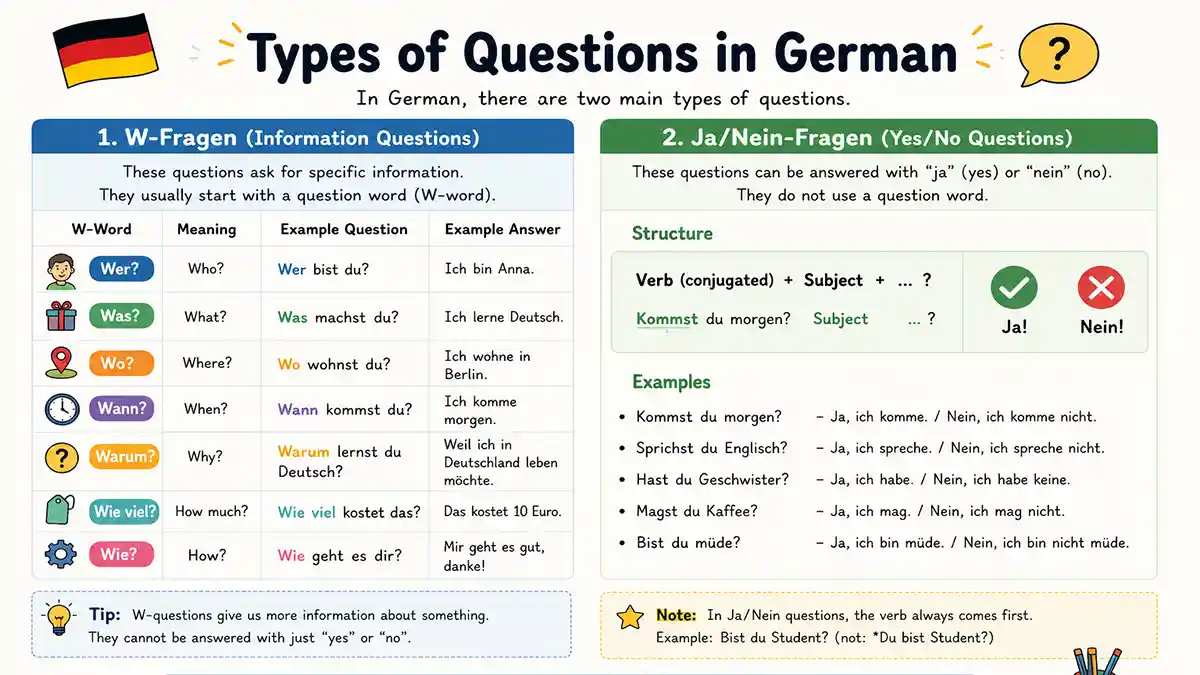
In German, questions are categorized into two primary types: Open Questions (W-Fragen) that require detailed responses, and Closed Questions (Ja/Nein-Fragen) answered with yes or no. In this guide, we break down these structures step-by-step with clear examples and audio exercises.
Every word in this guide supports interactive high-definition audio. Please ensure you open this page inside Google Chrome browser to experience full audio functionality.
1. W-Questions (W-Fragen)
2. Yes/No Questions (Ja/Nein-Fragen)
3. Word Order in Questions (Satzbau)
Golden Tips for Mastering Question Formation in German (A1.1)
Focus on Conjugated Verb Position (Position 2 vs Position 1)
The essential secret to distinguishing between the two question types lies in word order. In open-ended questions (W-Fragen), the verb always takes Position 2 right after the question word, whereas in yes/no questions (Ja/Nein-Fragen), the verb moves to Position 1. Memorizing these two patterns guarantees accurate sentence structure.
Practice Pronunciation with Interactive Audio
Don't just read grammar rules passively! Take advantage of the audio buttons throughout the article to hear the correct pronunciation for every question word and sentence. Repeat out loud while focusing on intonation raising your pitch at the end of Ja/Nein questions helps signal a question in everyday conversations.
Transition Confidence into Live Conversations
By mastering question words and sentence structure, you now hold the key to introducing yourself, gathering information, and starting basic everyday conversations in German with confidence. Keep practicing daily and combining questions with core verbs to prepare for upcoming lessons and higher levels.
Frequently Asked Questions (FAQ)
What is the difference between 'Wie viel' and 'Wie viele'?
We use Wie viel for uncountable quantities or price inquiries (e.g., water, money, time). Example: Wie viel kostet das?
We use Wie viele for countable items (e.g., books, children, days) and it is always followed by a plural noun. Example: Wie viele Bücher hast du?
Where is the verb placed in an open W-Question?
In W-Questions (W-Fragen), the conjugated verb is always positioned in Position 2 of the clause, immediately after the W-word.
When do I use 'Doch' in an answer instead of Ja or Nein?
Doch is used to contradict a negative question (a question containing 'nicht' or 'kein') with a positive assertion.
Example: Kommst du nicht mit? (Aren't you coming along?).
Answer: Doch, ich komme mit. (Yes, I am coming!). Read our dedicated detailed guide on Wie geht es dir to explore common conversational question responses.
Does the ending of 'Welcher' change?
Yes! The stem Welch- inflects like a definite article and alters its ending depending on the grammatical gender (masculine, feminine, neutral, plural) and case (Nominative, Accusative, etc.) of the noun that follows.
References & Educational Resources
Academic and Linguistic Sources
This guide on question formation was gathered and verified using certified German linguistic standards and reference textbooks:
- Duden Online Wörterbuch - Standard reference for German grammar rules.
- DWDS (Digitales Wörterbuch der deutschen Sprache) - Comprehensive linguistic database.
- Menschen A1 Kursbuch - Hueber Verlag curriculum.
- Netzwerk neu A1 - Klett Sprachen curriculum.