Lesson 7: Hobbys, können und Pluralformen
Hobbies & Leisure Activities, The Modal Verb können, and Mastering the 5 Plural Forms
Every vocabulary word and dialog line in this curriculum supports high-definition interactive pronunciation. Please make sure to open this lesson inside Google Chrome browser to fully and properly experience the audio pronunciation system.
1. Hobbies & Daily Activities (Hobbys und Aktivitäten)
How do you spend your free time? Let's explore the core action verbs used to express hobbies and leisure activities:
| German Term (Listen) | English Translation |
|---|---|
|
tanzen
|
to dance |
|
Musik hören
|
to listen to music |
|
spazieren gehen
|
to go for a walk |
|
kochen
|
to cook |
|
backen
|
to bake |
|
schwimmen
|
to swim |
|
Gitarre spielen
|
to play the guitar |
Expressing Skill Levels (Bewertung)
2. The Modal Verb können (Can / To be able to)
The modal verb können is used to express ability, talent, or possibility in German.
💡 Golden Rule (Verb Placement in Modal Sentences):
- The conjugated modal verb können occupies Position 2 in standard clauses.
- The primary action verb (describing the activity) is pushed to the very end of the sentence in its base infinitive form.
Examples:
• Sie können wirklich super tanzen! (You can really dance great!)
• Ich kann überall tanzen! (I can dance everywhere!)
• Kannst du schwimmen? (Can you swim?)
Conjugation of 'können'
| Pronoun | Conjugation Form |
|---|---|
| ich (I) | kann |
| du (you) | kannst |
| er / sie / es (he / she / it) | kann |
| wir (we) | können |
| ihr (you plural) | könnt |
| sie / Sie (they / formal you) | können |
3. Plural Masterclass (Die Pluralformen)
Unlike English which relies on adding 's', German utilizes 5 distinct plural inflections. Let's master all 5 patterns in depth:
Category 1: Zero Change ( - ) or Umlaut ( ¨ )
Applied to masculine (der) and neutral (das) nouns ending in: -er, -en, -el, -chen, -lein. The noun remains identical; only the article changes to die, optionally taking an Umlaut.
der Apfel ➝ die Äpfel (apples - with Umlaut)
Category 2: Adding (-e) or (¨e)
Common for short, single-syllable masculine nouns and several neutral nouns. Masculine nouns frequently take an Umlaut if they contain (a, o, u).
der Stuhl ➝ die Stühle (chairs - with Umlaut)
Category 3: Adding (-er) or (¨er)
Primarily used for neutral nouns (das). Mandatory Rule: Any noun taking this plural ending containing (a, o, u) must take an Umlaut!
das Buch ➝ die Bücher (books - mandatory Umlaut)
Category 4: Adding (-n) or (-en)
The safest and most common rule for over 90% of feminine nouns (die). Never takes an Umlaut.
die Uhr ➝ die Uhren (clocks)
Category 5: Adding (-s)
Reserved primarily for international loanwords and words ending in full vowels (a, i, o, u).
das Handy ➝ die Handys (mobile phones)
💬 4. Practical Dialogue (Über Hobbys sprechen)
Listen to a full conversational practice regarding hobbies and free-time activities.
Hobbies Chat Dialogue
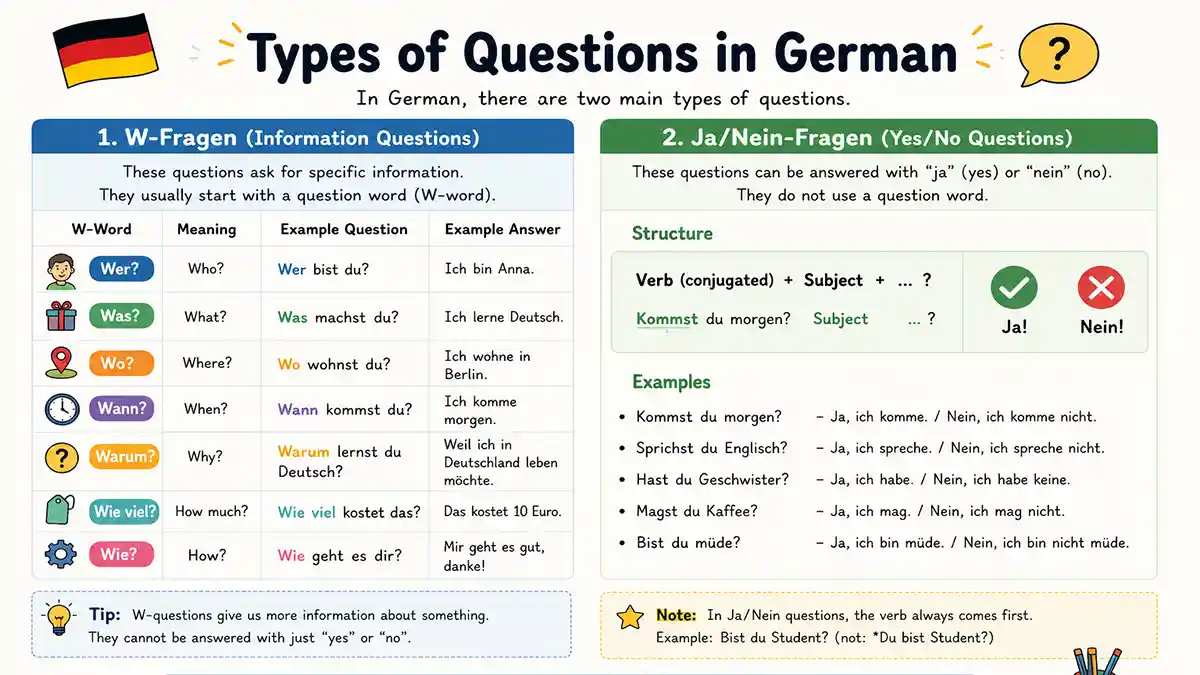
Was sind deine Hobbys?
Meine Lieblingshobbys sind Skifahren und Radfahren. Und du? Was machst du in deiner Freizeit?
Ich mache gern Musik. Ich singe gern und ich spiele Gitarre.
Das macht auch Spaß. Und Kochen!
Frequently Asked Questions (FAQ)
How are verbs ordered when using the modal verb können?
The modal verb können is conjugated in position 2 of the sentence, while the base action verb is sent to the very end of the sentence in its infinitive form.
What are the 5 plural formation rules in German?
The 5 plural categories are: 1. Zero change. 2. Adding -e. 3. Adding -er with mandatory Umlaut. 4. Adding -n or -en for feminine nouns. 5. Adding -s for loanwords.
How does the modal verb 'können' conjugate across pronouns?
It conjugates as follows: ich kann, du kannst, er/sie/es kann, wir können, ihr könnt, sie/Sie können. Note that 'ich' and 'er/sie/es' share the exact same form.
How do you express your skill level or proficiency in a hobby?
You use appraisal expressions such as super (great), sehr gut (very good), gut (good), ein bisschen (a little), or gar nicht (not at all).
Do all feminine nouns (die) share the same plural ending?
Yes, over 90% of feminine nouns form their plural by appending -n or -en without any vowel modification.
Why is it important to memorize German nouns along with their plural forms?
Because there is no universal rule for pluralization in German, memorizing the noun with its article and plural suffix is the most reliable path to accuracy.
How do you ask someone about their favorite hobbies in German?
You can ask using "Was sind deine Hobbys?" or "Was machst du gern in deiner Freizeit?".
Does the plural article change across different noun genders?
All plural nouns in German take the unified definite article die, regardless of whether their singular form was der, das, or die.
References & Educational Resources
Approved Textbooks & Curriculum Materials
This lesson has been structured and verified using 6 certified German learning references:
- Momente A1 (Kursbuch & Arbeitsbuch) - Hueber Verlag
- Schritte International Neu (A1.1) - Hueber Verlag
- Netzwerk neu A1.1 - Klett Sprachen
- Begegnungen A1+ - Schubert-Verlag
- Grammatik aktiv A1-B1 - Cornelsen Verlag
- Studio [21] A1 - Cornelsen Verlag
Related A1.1 Lessons & Guides