Lesson 08: Die Uhrzeit, Wochentage und Verabredungen
Formal & Informal Telling Time, Days of the Week, Public Places, Sentence Structure, and Scheduling Appointments
Every vocabulary word and dialog line in this curriculum supports high-definition interactive pronunciation. Please make sure to open this lesson inside Google Chrome browser to fully and properly experience the audio pronunciation system.
1. Public Places & Entertainment (Orte und Aktivitäten)
In daily life, we visit various venues for entertainment or socializing. Let's learn core public places in German:
2. Days of the Week & Temporal Expressions (Wochentage)
All days of the week in German are masculine and take the article der. To specify an event on a particular day, use the preposition am.
💡 Essential Time Adverbs:
- vorgestern (day before yesterday) | gestern (yesterday) | heute (today) | morgen (tomorrow) | übermorgen (day after tomorrow)
- am Wochenende (on the weekend)
3. Sentence Structure & Verb Position (Satzbau)
The cardinal rule of German sentence structure: The conjugated verb must always occupy Position 2 in declarative clauses.
You can begin a sentence with the subject or a time adverbial. Once your first element is locked in, the verb remains locked in Position 2, shifting the subject to Position 3 if it wasn't first.
Example of Time Fronting:
Am Montag (1) hat (2) Julia (3) keine Zeit (4).
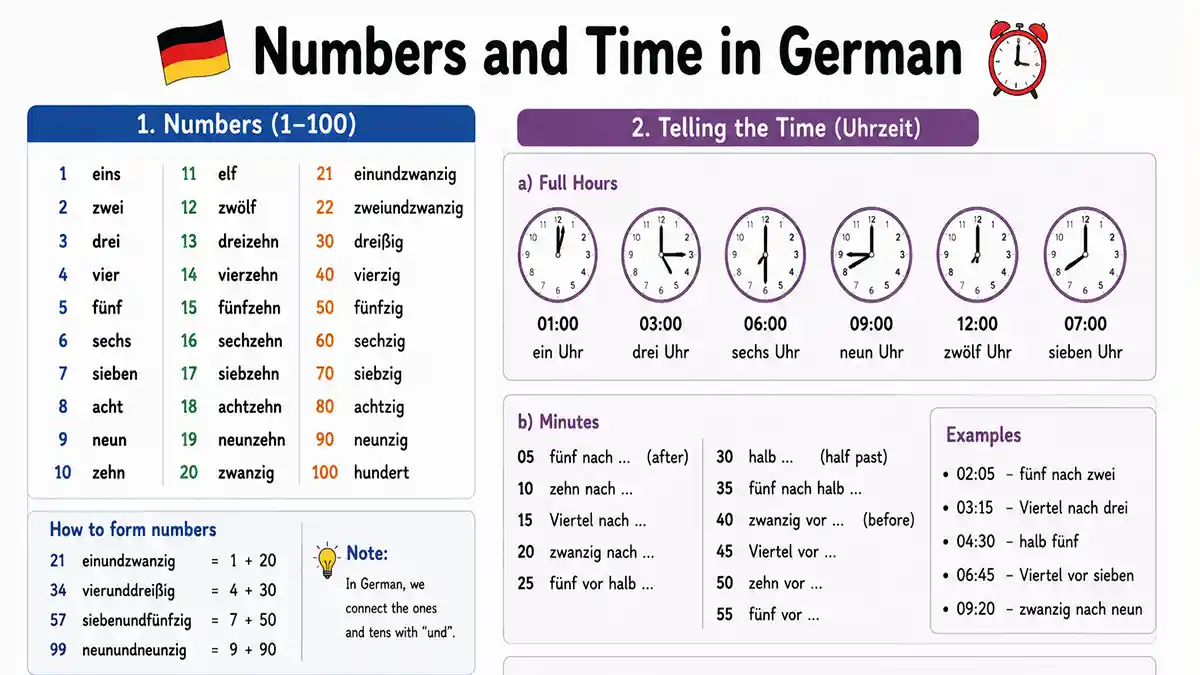
4. Telling Time (Die Uhrzeit)
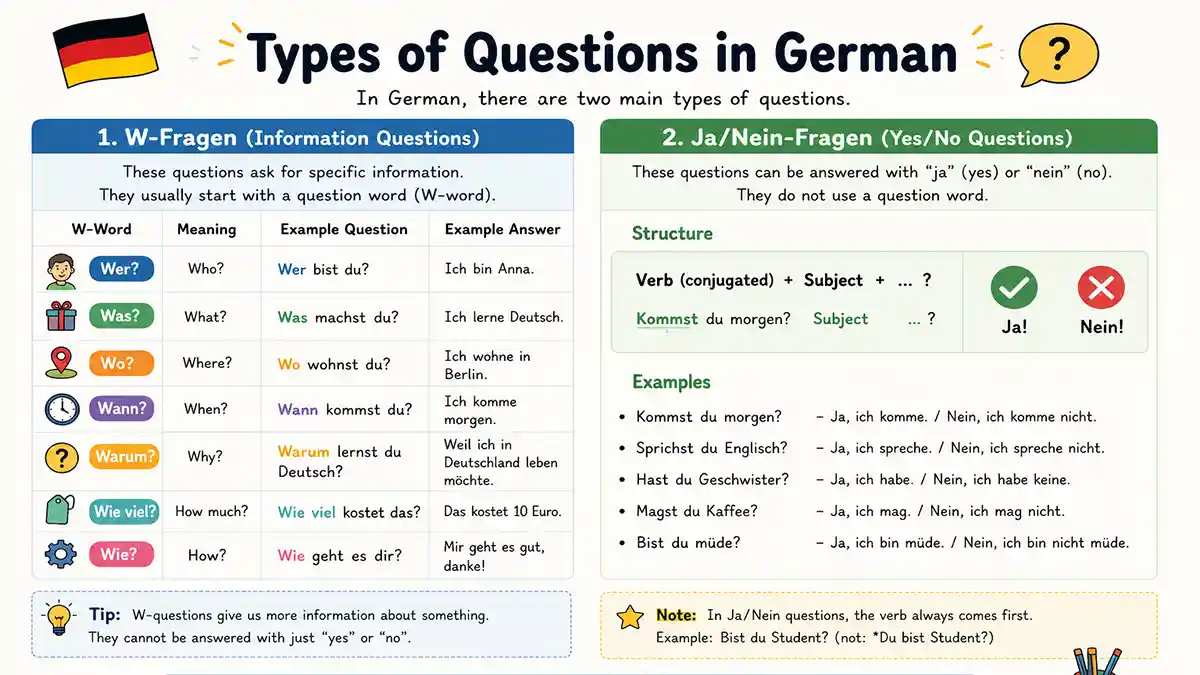
To ask for the time, use Wie spät ist es? or Wie viel Uhr ist es? Responses always begin with Es ist....
Formal Style (Formelle Uhrzeit)
Uses the 24-hour format: Hours + Uhr + Minutes.
Informal Style (Informelle Uhrzeit)
Uses 12-hour format with keywords like nach (past) and vor (to).
⚠️ Crucial 'Halb' Rule:
For 07:30, Germans say "half eight" (halb acht), referencing the upcoming hour.
5. Scheduling Appointments & Invitations (Verabredungen)
How do you propose hanging out and respond with acceptance or polite refusal?
Proposing & Responding to Dates
Making a Proposal:
Vielleicht können wir mal wieder ins Theater gehen?
Accepting:
Gute Idee! Ja, da kann ich.
Declining:
Nein, heute Abend habe ich leider keine Zeit.
Frequently Asked Questions (FAQ)
What is the difference between telling time formally and informally?
The formal method uses a 24-hour clock format, reading the hour, the word 'Uhr', and the minutes sequentially. The informal method uses a 12-hour clock, stating the minutes first using 'nach' or 'vor' followed by the hour.
Why is 07:30 translated as 'half eight' (halb acht) in German?
Because daily German convention looks ahead to the upcoming hour; 'halb acht' literally means we are halfway toward eight o'clock.
What gender article do the days of the week take?
All days of the week in German are masculine and take the definite article der. When scheduling an action on a specific day, use the preposition am.
Where must the conjugated verb be placed in a standard declarative sentence?
The rule is absolute: the conjugated verb must always occupy Position 2 in a declarative sentence, regardless of whether the sentence begins with the subject or a time expression.
How do you propose an appointment or invite a friend out?
You can use expressions like "Vielleicht können wir mal wieder ins Theater gehen?" or "Hast du Lust auf Kino?".
How do you politely decline an appointment or invitation?
You can use polite phrases such as "Nein, heute Abend habe ich leider keine Zeit" or "Das geht leider nicht".
How does the verb 'wissen' conjugate with the pronoun 'ich'?
The verb 'wissen' conjugates with 'ich' and 'er/sie/es' as weiß.
When do we use 'am' versus 'um' with time references?
We use am with days of the week and parts of the day (e.g., am Montag, am Morgen), whereas we use um with precise clock hours (e.g., um 8 Uhr).
References & Educational Resources
Approved Textbooks & Curriculum Materials
This lesson has been structured and verified using 6 certified German learning references:
- Momente A1 (Kursbuch & Arbeitsbuch) - Hueber Verlag
- Schritte International Neu (A1.1) - Hueber Verlag
- Netzwerk neu A1.1 - Klett Sprachen
- Begegnungen A1+ - Schubert-Verlag
- Grammatik aktiv A1-B1 - Cornelsen Verlag
- Studio [21] A1 - Cornelsen Verlag
Related A1.1 Lessons & Guides