Lesson 11: Das Perfekt und Zeitangaben
The Present Perfect Tense (Das Perfekt), Past Participle Formation (Partizip II), and Temporal Prepositions
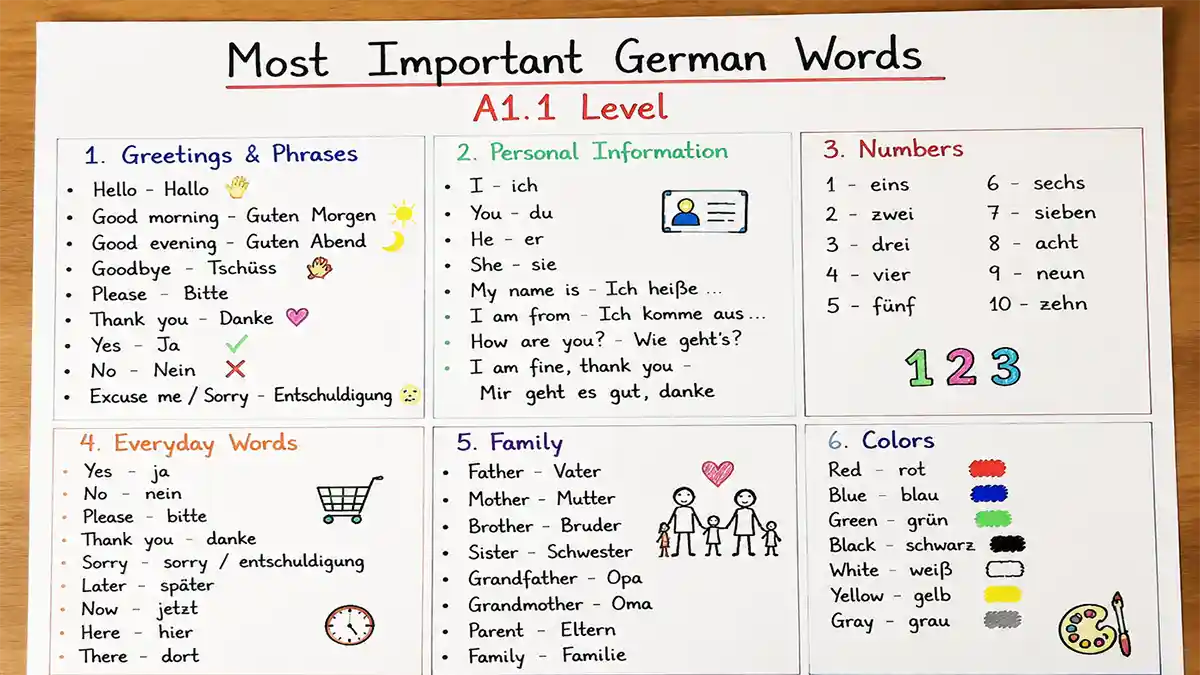
Welcome to Lesson 11! Today we take a major step forward in our German learning journey: mastering the present perfect tense (Perfekt), forming past participles, and using temporal prepositions effectively. You can review our Key A1.1 Vocabulary Guide to expand your phrasebook.
Every vocabulary word and dialog line in this curriculum supports high-definition interactive pronunciation. Please make sure to open this lesson inside Google Chrome browser to fully and properly experience the audio pronunciation system.
1. Daily Activities in the Past (Alltagsaktivitäten)
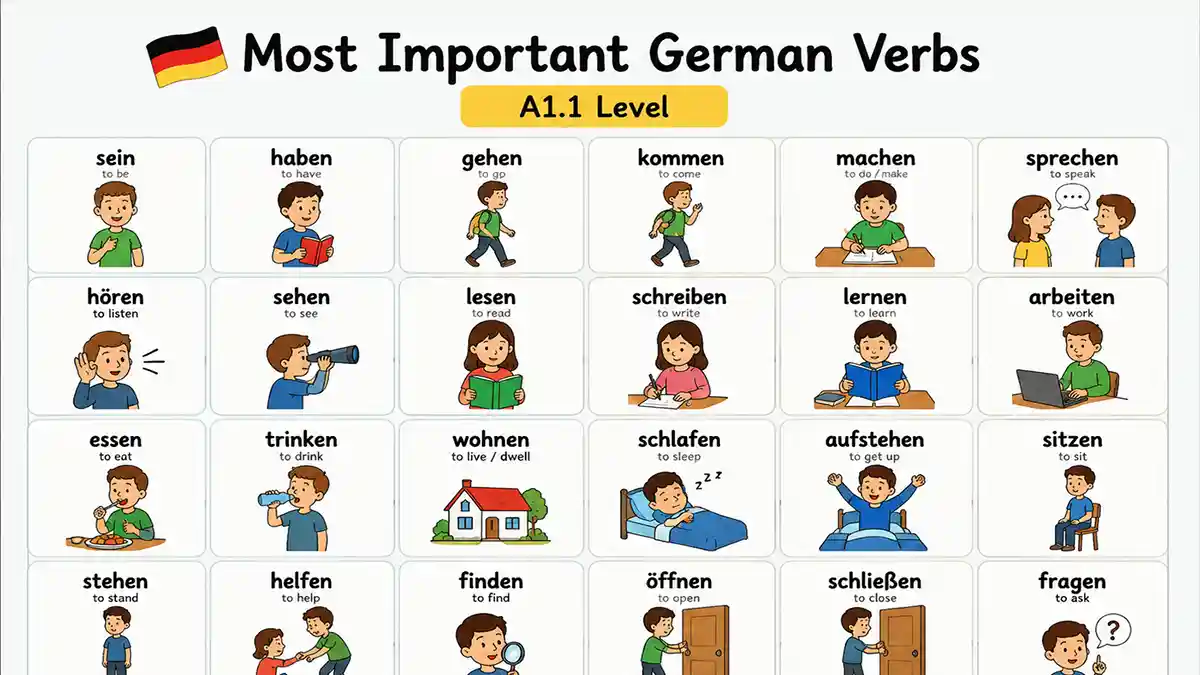
What do you typically do? Let's review everyday verbs in the present tense and their equivalents in the present perfect tense. For a deeper verb breakdown, use our interactive Verb Conjugation Tool or read our Essential German Verbs Guide for A1.1:
| Present Tense (Präsens) | English Translation | Present Perfect (Perfekt) |
|---|---|---|
|
Zeitung lesen
|
to read a newspaper |
Zeitung gelesen
|
|
arbeiten
|
to work |
gearbeitet
|
|
einkaufen
|
to shop |
eingekauft
|
2. Sentence Structure in the Perfect Tense (Das Perfekt)
The present perfect tense (Perfekt) is used to talk about completed past events and is the preferred tense in everyday spoken German conversations. To learn how accusative objects interact with past tense structures, explore our guide on Important Accusative Verbs in German.
The Auxiliary Verb (haben / sein)
Occupies Position 2 and is conjugated according to the subject. The vast majority of verbs take haben.
The Past Participle (Partizip II)
Stays fixed at the very end of the sentence clause without further conjugation.
3. Past Participle Formation (Partizip II) Masterclass
Here are the core rules for constructing past participles based on verb categories. As covered in Lesson 10: Separable and Inseparable Verbs, prefixes change past participle formation rules:
Category Rules:
- Regular Verbs:
ge + verb stem + t(e.g., machen -> gemacht). - Irregular Verbs:
ge + stem vowel change + en(e.g., lesen -> gelesen). - Verbs Ending in '-ieren':
verb stem + t(No prefix 'ge-', e.g., telefonieren -> telefoniert). - Separable Verbs: Separable Prefix +
ge+ Verb Root (e.g., einkaufen -> eingekauft). - Inseparable Verbs: Verb stays intact without prefix
ge(e.g., bekommen -> bekommen).
4. Temporal Prepositions (Zeitpräpositionen)
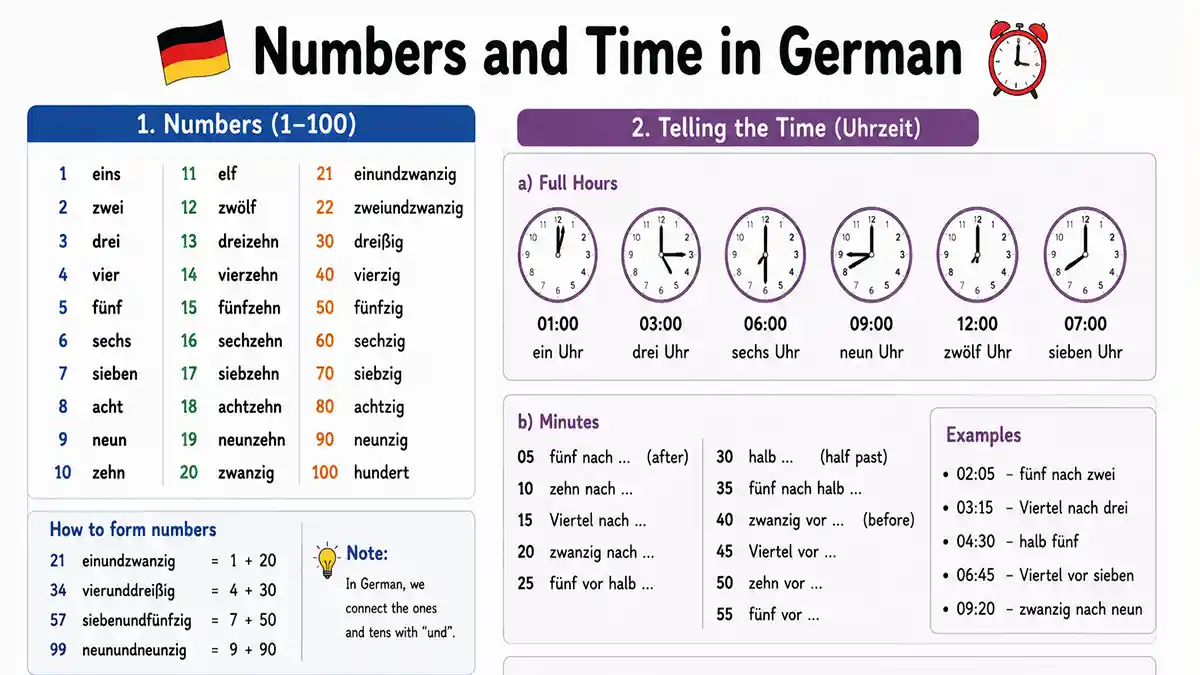
Prepositions help pin down exact schedules and time periods. For a complete guide on telling time and handling clock times, check our German Numbers and Time Guide:
5. Practical Dialogue: Message Exchange (Eine Nachricht)
Read and listen to a message exchange between friends utilizing past tense structures. For formal or informal letter-writing templates, see our German Letter Writing Guide:
Full Message Audio
Hallo, wie geht's dir?
Was hast du letzten Sonntag gemacht?
Liebe Grüße, Susa
Hallo Susa,
am Morgen habe ich lange geschlafen und spät gefrühstückt.
Danach habe ich eingekauft.
Frequently Asked Questions (FAQ)
What is the sentence structure of the present perfect tense (Das Perfekt) in German?
The sentence follows a sandwich structure (Zangenstruktur): the auxiliary verb (haben or sein) is conjugated in Position 2, while the past participle (Partizip II) rests at the very end of the sentence.
How is the past participle (Partizip II) formed for regular verbs (Regelmäßige Verben)?
By adding the prefix 'ge-' to the verb stem and replacing the ending '-en' with '-t' (e.g., machen -> gemacht).
How is the past participle (Partizip II) formed for irregular verbs (Unregelmäßige Verben)?
By adding the prefix 'ge-' while keeping the ending '-en', often accompanied by a stem vowel change (e.g., lesen -> gelesen).
What is the rule for verbs ending in '-ieren' in the perfect tense?
They never take the prefix 'ge-' at the beginning; instead, they simply replace '-en' with '-t' at the end (e.g., telefonieren -> telefoniert).
How do separable verbs form their past participle?
The prefix 'ge-' is inserted right in the middle, between the separable prefix and the verb root (e.g., einkaufen -> eingekauft).
When do we use the temporal preposition 'um'?
It is used exclusively to refer to specific clock times (e.g., um 16 Uhr).
When do we use the temporal preposition 'am'?
It is used with days of the week and parts of the day (e.g., am Montag, am Morgen).
What is the difference between 'von ... bis' and 'ab'?
'von ... bis' defines a complete time frame with both a start and an end point, while 'ab' indicates a starting point for an ongoing future event.
References & Educational Resources
Approved Textbooks & Curriculum Materials
This lesson has been structured and verified using 6 certified German learning references:
- Momente A1 (Kursbuch & Arbeitsbuch) - Hueber Verlag
- Schritte International Neu (A1.1) - Hueber Verlag
- Netzwerk neu A1.1 - Klett Sprachen
- Begegnungen A1+ - Schubert-Verlag
- Grammatik aktiv A1-B1 - Cornelsen Verlag
- Studio [21] A1 - Cornelsen Verlag
Related A1.1 Lessons & Guides