Lesson 10: Reise, Verkehr und Trennbare Verben
Travel & Station Vocabulary, Transportation Methods, Separable & Inseparable Verbs, and Sentence Structure
Every vocabulary word and dialog line in this curriculum supports high-definition interactive pronunciation. Please make sure to open this lesson inside Google Chrome browser to fully and properly experience the audio pronunciation system.
1. Travel & Station Vocabulary (Reisen und Verkehr)
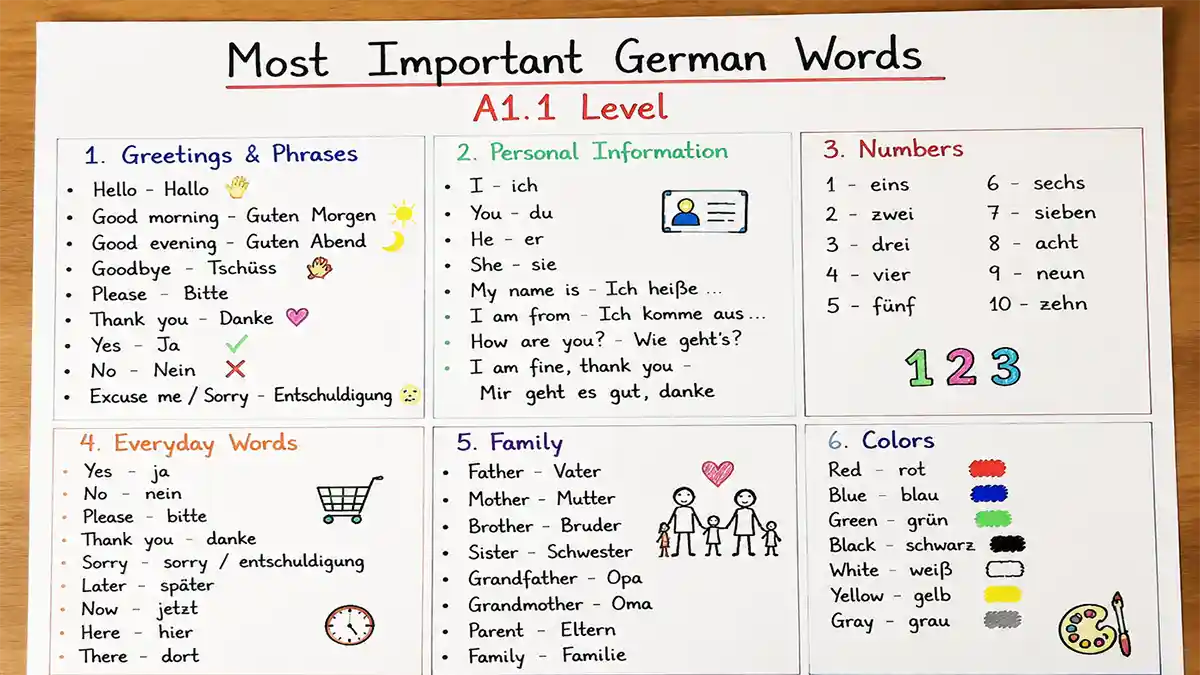
We begin with essential terms for airports, train stations, and travelers on the go. You can also explore our Key A1.1 Vocabulary Guide for additional words:
| German Term (Listen) | English Translation |
|---|---|
|
der Flughafen
|
the airport |
|
der Bahnhof
|
the train station |
|
das Gleis
|
the track / platform |
|
der Koffer
|
the suitcase |
2. Transportation Methods (Verkehrsmittel)
To express traveling by transportation, use either the verb nehmen (taking an accusative direct object) or the preposition mit (taking the dative case). Read our lesson on Important Accusative Verbs to master direct objects.
💡 Usage Examples:
- Ich nehme den Bus. (I take the bus - masculine accusative)
- Ich komme mit dem Zug. (I am coming by train - dative case)
3. Separable Verbs (Trennbare Verben)
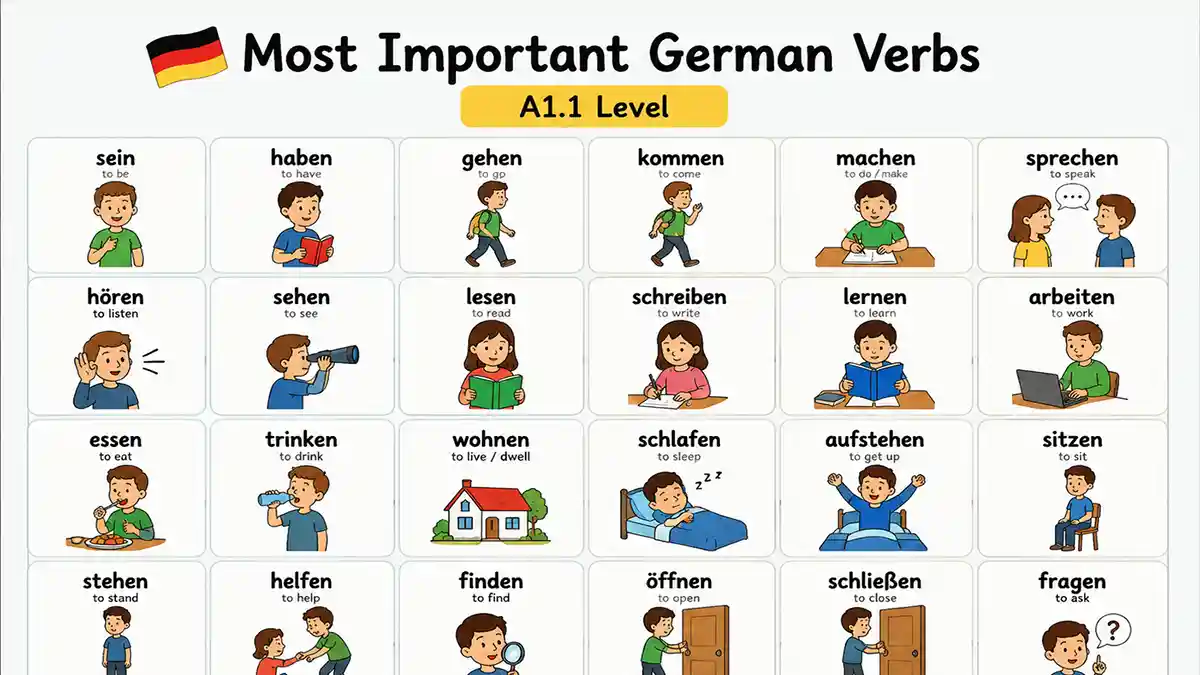
Separable verbs feature a root verb and a prefix. When conjugated in a standard clause, the prefix splits entirely and goes to the very end of the sentence! Check our Essential Verbs Guide or practice with our Verb Conjugation Tool.
Common Separable Prefixes:
ab- | an- | auf- | aus- | ein- | mit- | um- | zu-
Example in a Sentence:
Verb: ankommen (to arrive)
⚠️ Modal Verb Exception:
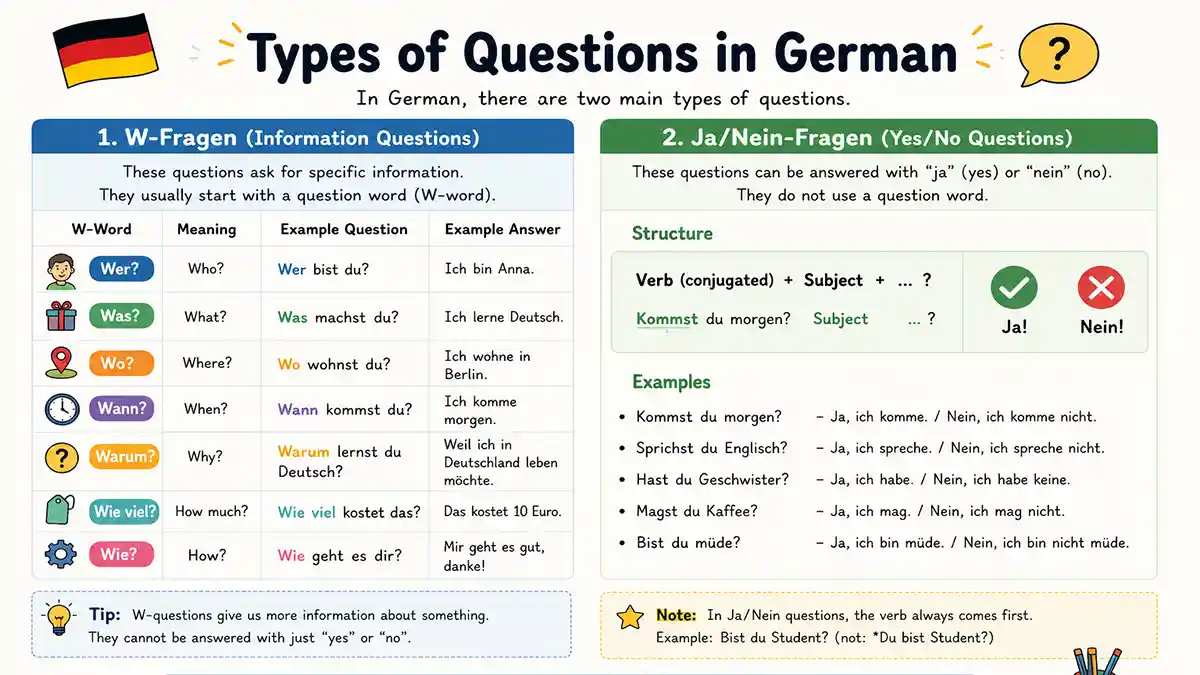
When a modal verb like können is used with a separable verb, the prefix reattaches to the root at the end of the clause in infinitive form (e.g., Kannst du mich abholen?). Learn more about sentence structures in our Question Formats Guide.
4. Inseparable Verbs (Untrennbare Verben)
Unlike separable verbs, inseparable prefixes remain permanently attached to the verb root under all conditions: be-, ver-, ent-, zer-.
| Inseparable Verb | English Translation | Example Clause |
|---|---|---|
| bekommen | to receive / get | Ich bekomme ein Ticket. |
| verstehen | to understand | Ich verstehe das. |
💬 5. Practical Dialogue (Am Flughafen)
Listen to a telephone conversation regarding flight delays, arrival times, and airport pickups. You can also explore Practical Dialogue Exercises for more practice.
Phone Conversation Dialogue
Hallo Lisa. Der Flug hat Verspätung.
Oh nein. Wann landest du?
Ich komme um 19 Uhr in Frankfurt an. Kannst du mich abholen?
Natürlich hole ich dich ab.
Frequently Asked Questions (FAQ)
How do separable verbs (Trennbare Verben) function in a German sentence?
Separable verbs consist of a main verb root that is conjugated in Position 2 of the clause, while the prefix (Präfix) splits entirely and moves to the very end of the sentence.
What is the difference between separable and inseparable verbs?
Separable verbs split their prefix during conjugation (e.g., ankommen -> ich komme an), whereas inseparable verbs (such as bekommen or verstehen) keep their prefix attached at all times.
How do you express using public transportation with 'nehmen' and 'mit'?
You can say "Ich nehme den Bus" (using the accusative case for masculine nouns) or "Ich komme mit dem Bus" (using the dative case with the preposition 'mit').
What happens to separable verbs when a modal verb is present in the sentence?
A strong modal verb forces the separable verb to reattach its prefix and move to the end of the clause in its infinitive form (e.g., "Kannst du mich abholen?").
What are some of the most common separable prefixes?
Common examples include: ab-, an-, auf-, aus-, ein-, mit-, um-, and zu-.
What are some of the most common inseparable prefixes?
Common examples include: be-, emp-, ent-, er-, ge-, miss-, ver-, and zer-.
What does the verb 'ankommen' mean and how is it used?
It means 'to arrive'. When used, the root verb 'komme' stays in Position 2 and 'an' moves to the sentence end (e.g., "Ich komme um 19 Uhr an").
Does the neutral article 'das' change when describing transport with 'mit'?
Yes, the neutral article das shifts to dem in the dative case when preceded by the preposition mit (e.g., mit dem Flugzeug).
References & Educational Resources
Approved Textbooks & Curriculum Materials
This lesson has been structured and verified using certified German learning references:
- Momente A1 (Kursbuch & Arbeitsbuch) - Hueber Verlag
- Schritte International Neu (A1.1) - Hueber Verlag
- Netzwerk neu A1.1 - Klett Sprachen
- Begegnungen A1+ - Schubert-Verlag
- Grammatik aktiv A1-B1 - Cornelsen Verlag
- Studio [21] A1 - Cornelsen Verlag
Related A1.1 Lessons & Guides