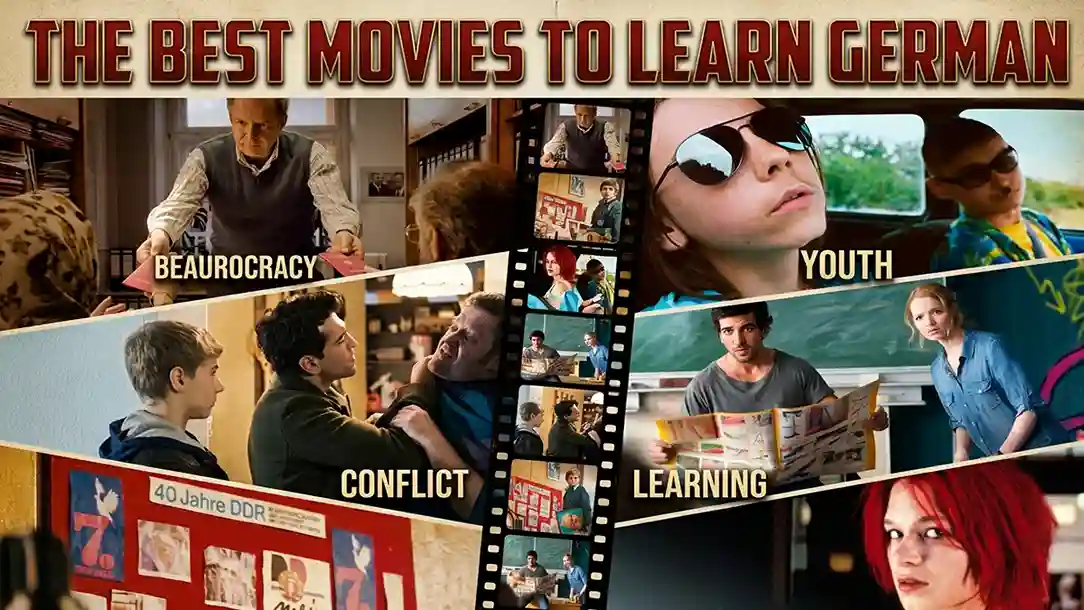
Top 10 German Movies to Learn German in 2026
| German movie | Suggested level | Main learning benefit |
|---|---|---|
| A1–A2 | Everyday vocabulary and relatively clear dialogue | |
| A2–B1 | Family, sport, and daily life | |
| A2–B1 | Feelings, friendship, and communication | |
| A2–B1 | Youth conversations and everyday expressions | |
| A2–B1 | Family, culture, and life in Germany | |
| A2–B1 | Family dialogue and comedy | |
| B1–B2 | Everyday expressions and cultural context | |
| A2–B2 | Short sentences and fast expressions | |
| B1–B2 | Slang and school vocabulary | |
| B2 | Advanced listening and formal language |
1. Die Schule der magischen Tiere
Die Schule der magischen Tiere, meaning "The School of Magical Animals", is a good choice if you want to start watching German films without jumping straight into complex political or historical stories.
The film follows a group of children at a school who meet magical animals that help them in different situations. It combines adventure, friendship, and school problems, which makes it a good fit for learning everyday vocabulary.
Why we recommend it
Children's and family films help you connect words to what you see on screen. When a character talks about school, friendship, or fear, the scene helps you understand the meaning even if you don't know every word. Vocabulary to review while watching:
| Word / expression | Meaning |
|---|---|
die Schule | school |
der Freund / die Freundin | friend (male / female) |
das Tier | animal |
helfen | to help |
zusammen | together |
Angst haben | to be afraid |
You can also note down short sentences like:
This doesn't mean every dialogue in the film is easy, but its visual context and family story can make it easier to follow than a film built on abstract topics.
2. Das Wunder von Bern
Das Wunder von Bern was released in 2003. It is set in Germany after World War II and focuses on a German family living through hard social conditions, and on the 1954 football World Cup, which the German national team won.
The film combines family life, the return to normality after the war, and a love of football, so it offers useful vocabulary for understanding how Germans talk about family, sport, and society.
What can you learn from it?
If you like football, you will find recurring words from that field, such as:
| Word / expression | Meaning |
|---|---|
der Fußball | football (soccer) |
die Mannschaft | team |
das Spiel | match or game |
gewinnen | to win |
verlieren | to lose |
der Vater | father |
die Familie | family |
And sentences you can use in conversation:
The film also introduces you to German culture, not just the language. Keep in mind that some dialogue is tied to the historical period in which the story takes place.
3. Dieses bescheuerte Herz
Dieses bescheuerte Herz, which can be translated as "This Stupid Heart", is a German comedy-drama released in 2017. It tells the story of a young man living a privileged life and a teenager with a serious illness, and how their relationship changes the way each of them sees life.
The film presents human situations about friendship, family, responsibility, and hope, and it suits anyone who wants to learn expressions used to talk about feelings and personal relationships.
Key vocabulary and expressions
| Word / expression | Meaning |
|---|---|
das Herz | heart |
die Gesundheit | health |
krank | sick |
gesund | healthy |
hoffen | to hope |
sich freuen | to be happy / to look forward |
Angst haben | to be afraid |
Zeit verbringen | to spend time |
It helps to learn words inside full sentences instead of memorizing them on their own:
Some dialogue may be fast or emotional, so it's better not to try to understand every word the first time. Focus on the general idea, then replay the important scenes to note new expressions.
4. Tschick
Tschick was released in 2016 and is based on a well-known German novel by Wolfgang Herrndorf. It tells the story of two teenagers who set off on an unconventional road trip across Germany, which turns into an experience full of unexpected situations and personal change.
The film suits learners who want to move from the sentences in textbooks to the language young people use in everyday situations.
What makes it special linguistically?
The dialogue includes expressions about travel, friendship, decisions, and everyday problems, along with some youth slang you won't find in beginner books. Useful vocabulary:
| Word / expression | Meaning |
|---|---|
die Reise | trip, journey |
unterwegs | on the way |
losfahren | to set off, to start driving |
der Freund | friend |
der Plan | plan |
keine Ahnung | no idea |
And expressions worth memorizing:
Note that the film is not a perfect model of formal language; some characters speak in a casual, youthful way. That is exactly what makes it useful when you want to improve your understanding of informal conversation.
5. Almanya – Willkommen in Deutschland
Almanya – Willkommen in Deutschland was released in 2011. It tells the story of a family of Turkish origin living in Germany, going back to the grandfather's migration to the country and how that experience affected different generations.
The film mixes comedy and drama and raises questions about identity, belonging, language, family, and life between two cultures.
Why is it worth watching?
One of its main strengths is that it introduces topics from modern German society, especially migration, integration, and relationships between generations. You can focus on words such as:
| Word / expression | Meaning |
|---|---|
die Heimat | homeland, or the place where you feel you belong |
die Herkunft | origin, background |
die Sprache | language |
die Kultur | culture |
die Familie | family |
die Erinnerung | memory |
sich erinnern an | to remember |
And sentences you can practice:
You may run into words about culture and history, or expressions that vary by speaker and situation, but the story itself gives you context that helps you follow along.
If you're thinking of traveling to Germany or working there in the future, the film can introduce you to some social issues that appear in daily life, though the story should not be taken as representing every migrant's experience.
6. Türkisch für Anfänger
Türkisch für Anfänger, meaning "Turkish for Beginners", was released in 2012. It is a comedy inspired by the German TV series of the same name.
The story follows a group of young characters and their families, with differences in viewpoints, customs, and expectations that lead to a series of comic situations. Although the title refers to the Turkish language, the film contains a lot of German dialogue you can learn from.
What will you learn?
This film suits anyone who wants to hear German in family and social situations, such as disagreements between parents and children, getting to know people, expressing opinions, and handling embarrassing moments. Important words and expressions:
| Word / expression | Meaning |
|---|---|
die Eltern | parents |
die Kinder | children |
die Beziehung | relationship |
streiten | to argue |
verstehen | to understand |
einverstanden sein | to agree |
Das ist doch klar! | That's obvious! |
Was meinst du? | What do you think? |
You can use the dialogue to practice giving your opinion, an important skill in everyday conversation and language exams. Some jokes and youth expressions can be harder than the basic vocabulary, so I recommend watching it once you have a reasonable amount of A2 vocabulary.
7. Good Bye, Lenin!
Good Bye, Lenin!, released in 2003, is one of the best-known modern German films. It is set in East Germany during the political changes before and after the fall of the Berlin Wall.
A mother wakes up after a long coma, and her son tries to hide the huge political and social changes the country has gone through, fearing for her health. The story mixes comedy and drama and shows the changes German society lived through in that period.
How does it help you learn German?
You'll find family conversations and vocabulary related to daily life, work, the media, and social change, along with expressions that require understanding the historical context. Vocabulary to review:
| Word / expression | Meaning |
|---|---|
die Wohnung | apartment |
die Arbeit | work |
die Nachrichten | the news |
die Veränderung | change |
die Erinnerung | memory |
erzählen | to tell |
glauben | to believe |
And sentences to practice:
Some scenes may require knowledge of Germany's historical background, so don't make understanding the historical details your first goal. Focus on the dialogue, sentence structure, and the expressions used in everyday situations.
8. Lola rennt
Lola rennt was released in 1998 and is known in English as Run Lola Run. It tells the story of a young woman who tries to get a sum of money within a short time to save her boyfriend from a dangerous situation.
The film is known for its fast pace and for repeating events along different paths, which makes it a different cinematic experience from traditional films.
Is it suitable for learning the language?
It can suit learners who want to practice understanding short sentences and expressions related to time, movement, and urgent decisions, but it is not necessarily an easy film for beginners because of the speed of events and the way the dialogue is delivered. Focus on these words:
Personal introduction is a crucial step in any exam or job interview, so it is important to practice how to introduce yourself in German professionally and engagingly.
| Word / expression | Meaning |
|---|---|
schnell | quickly |
sofort | immediately |
laufen | to run |
warten | to wait |
die Zeit | time |
das Geld | money |
schaffen | to manage to do something |
Practice sentences like:
One of the best ways to benefit from it is to pick a short scene and listen to it again, trying to catch the verbs and how they are pronounced. If you're at A2, it's fine to rely on the visual context more than on understanding every word.
9. Fack ju Göhte
Fack ju Göhte was released in 2013. It is a comedy about a man who ends up working as an unconventional teacher in a school full of unruly students. The film was a huge popular success in Germany and gives a comic picture of school life and of relationships between teachers and students.
What is the language benefit?
If you want to understand how young people talk in some everyday situations, you may find the film rich in colloquial expressions and quick comebacks. Useful words:
| Word / expression | Meaning |
|---|---|
der Lehrer / die Lehrerin | teacher (male / female) |
der Schüler / die Schülerin | student (male / female) |
die Prüfung | exam |
lernen | to learn, to study |
bestehen | to pass an exam |
durchfallen | to fail an exam |
sich benehmen | to behave |
And teaching sentences:
10. Das Leben der Anderen
Das Leben der Anderen was released in 2006 and is set in East Germany in the 1980s. It tells the story of a state security officer who spies on a playwright and his partner, and how his view of the people he is watching gradually changes.
The film is known for its serious dramatic atmosphere and for dialogue connected to politics, art, surveillance, power, and human relationships.
Why do we recommend it for advanced learners?
The film gives you a chance to listen to longer, more complex dialogue and to learn formal and abstract vocabulary that rarely appears in family comedies. Important vocabulary:
| Word / expression | Meaning |
|---|---|
die Überwachung | surveillance |
die Freiheit | freedom |
die Entscheidung | decision |
die Verantwortung | responsibility |
die Wahrheit | truth |
beobachten | to observe |
verändern | to change |
überzeugen | to convince |
And sentences you can analyze:
You may need to replay some scenes to understand long sentences and implied meanings. That is why I recommend it for learners who can already follow a moderately difficult German conversation and want to progress toward B2.
If you want to improve your fluency and speaking skills, you can use a list of daily German conversations to overcome the fear of speaking and communicate with confidence in various situations.
How do you choose the right movie for your German level?
If you're at A1
Start with a family film like Die Schule der magischen Tiere. You can also watch short clips from children's films instead of trying to follow a whole feature-length movie. At this stage, don't worry if you only understand a small part of the dialogue. The goal is to get used to the sounds, the rhythm, and how words are pronounced.
If you're at A2
Try Das Wunder von Bern, Dieses bescheuerte Herz, or Almanya – Willkommen in Deutschland. Choose a film whose general story you understand, even if you miss some words. Focus on recurring expressions and try to form new sentences with the vocabulary you've learned.
If you're at B1
You can move on to Tschick, Türkisch für Anfänger, and Good Bye, Lenin!. At this stage, start relying on German subtitles instead of Arabic for parts of the viewing, and try to summarize what happened in each scene in simple German sentences.
If you're at B2
Try Das Leben der Anderen, or rewatch the earlier films without Arabic subtitles. Focus on idiomatic expressions, how sentences are linked, and the words speakers use to express opinions and feelings.
The best way to learn German from movies in 2026
1. Watch the scene first to get the general meaning
Pick a scene of three to five minutes and watch it without stopping at every word you don't understand. Try to answer three questions:
- Who are the characters speaking?
- What problem or topic are they discussing?
- What happened at the end of the scene?
You don't need to understand every word to understand the main idea.
2. Replay the scene with German subtitles
Turn on German subtitles if available, and compare the words you hear with the words on the screen. This step matters because some German words are hard to tell apart the first time you hear them, especially when people speak fast or run words together.
If German subtitles are too hard, you can start with subtitles in your own language to grasp the context, then replay the scene in German.
3. Pick only five words or expressions
Don't try to memorize dozens of words after each scene. Choose five words or phrases you can use in your daily life. For example:
Write each expression inside a sentence and note its meaning and how it's used. Ideally, choose expressions you actually heard in the film, when possible.
4. Use the shadowing technique to improve pronunciation
Shadowing means listening to a speaker and then trying to repeat what they say, either immediately or after a short delay. Choose a short sentence, listen to it several times, then try to imitate the pronunciation of the words, the rhythm, and how they connect.
Your pronunciation doesn't have to be perfect from the start. What matters is practicing regularly, listening to German sounds and producing them.
5. Summarize the scene out loud
After watching, try to summarize what happened in three to five German sentences. For example:
These sentences are simple, but they help you move from passive listening to using the language yourself.
Is it better to watch with Arabic or German subtitles?
| How to watch | When to use it | Main benefit |
|---|---|---|
| German audio + Arabic subtitles | When the story is hard for you to follow | Understanding the plot and context |
| German audio + German subtitles | When you know the basics of the language | Linking pronunciation to spelling |
| German audio, no subtitles | When reviewing a scene you already know | Direct listening practice |
| Replaying the scene repeatedly | When learning new expressions | Better pronunciation and retention |
If you're at A1 or A2, there's no need to ban Arabic subtitles completely. It's better to reduce your reliance on them gradually as your level improves.
And if the platform offers German subtitles synced with the German audio, make the most of them. But remember that audio and subtitle options vary by film, platform, and region.
To ensure consistency and daily practice wherever you are, we recommend installing the best apps to learn German to practice grammar and expand your vocabulary.
Where can you watch German movies?
1. Goethe-Institut – Goethe on Demand
A service that offers a selection of German films online, including a variety of cinematic works. Check the viewing terms and regional availability before choosing a film.
Goethe on Demand ←
2. The Goethe-Institut educational film portal
An educational portal with materials linked to German films, including activities and ideas that can be used for learning or teaching the language. It's useful for finding films suited to different levels.
Educational film portal ←
If you prefer direct, interactive academic learning, we have put together a comprehensive review of the best German language centers in Egypt.
3. Netflix
You can search for German films in Netflix's library and check the audio and subtitle options available for each title. A German film being on the platform in one country doesn't necessarily mean it's available in Egypt or everywhere.
German films on Netflix ←
Frequently asked questions about learning German from movies
What is the best German movie for beginners?
Can you learn German from movies without studying grammar?
How many movies should I watch per week to improve?
Is watching movies with Arabic subtitles useful?
Are German movies suitable for preparing for the Goethe exam?
Conclusion: which German movie should you watch first?
Your best film is not necessarily the most famous or the highest rated, but the one that combines enjoyment with a language level you can handle. If you're a beginner, start with a family film. If you're at A2 or B1, choose something about family, friendship, or everyday life, like Almanya or Dieses bescheuerte Herz. And if you're at B2, move on to more complex films like Das Leben der Anderen.
Remember that the goal is not to understand every word of the film, but to turn what you hear into words and expressions you can use yourself. Watch, listen, replay scenes, imitate the pronunciation, then try to speak German.
Deutsch lernen kann Spaß machen! — Learning German can be fun!
References
Academic and educational sources
- Goethe-Institut - the official curriculum frameworks for the CEFR levels.
- Goethe on Demand - a selection of German films online.
- Educational film portal - materials and activities linked to German films.