What is the Accusative Object (Akkusativ) in German?
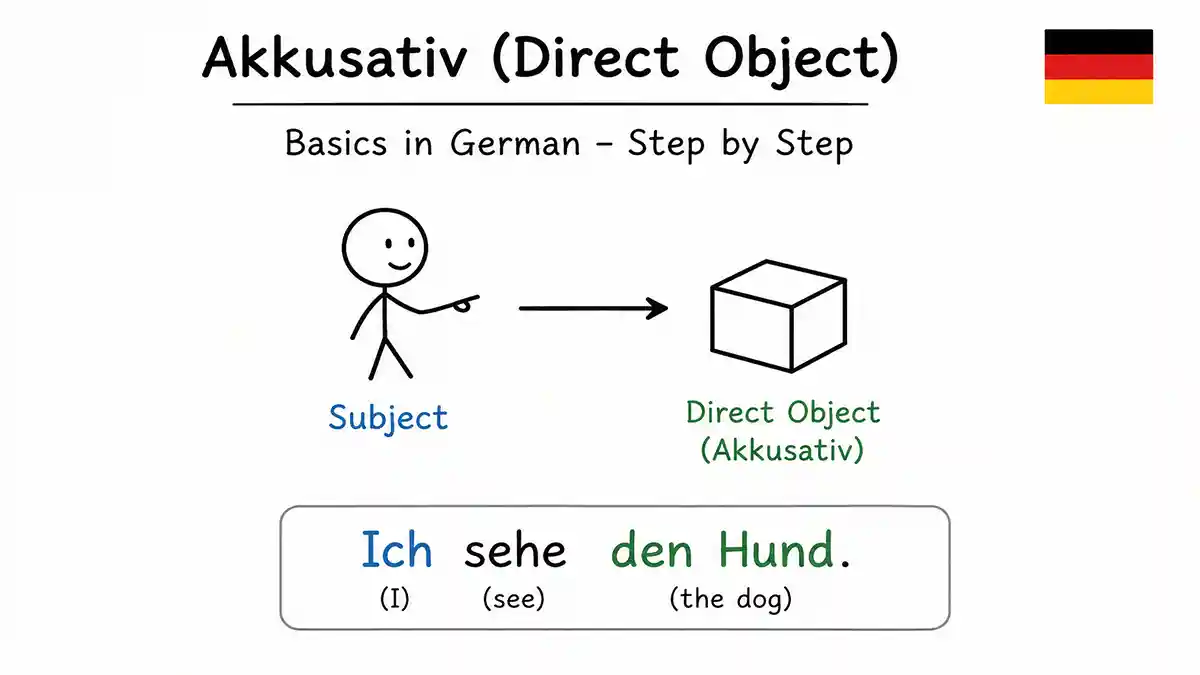
The accusative case, or Akkusativ , is the grammatical case used for the "direct object" in a sentence. Simply put, if a subject (person or thing) performs an action, the noun receiving that direct action is in the Akkusativ case.
For example, in English "I eat the apple", "I" is the subject, and "the apple" is the direct object. In German, the spelling and pronunciation of definite articles change depending on gender (masculine, feminine, neuter) and number. You can also learn more about constructing questions in our comprehensive guide on forming German questions.
Types of Objects in German (Akkusativobjekt & Dativobjekt)
To understand the accusative case more deeply, it is important to know that a German sentence can contain more than one object. Objects are generally divided into two main types:
1. Direct Object (Akkusativobjekt)
This is the person or thing directly affected by the action of the subject, and it is the primary focus of the Akkusativ case.
Ich kaufe den Computer.
der to den.
2. Indirect Object (Dativobjekt)
This is the recipient or person who receives something in the sentence, and it takes the Dativ case.
Ich gebe dem Mann das Buch.
How Articles Change (The Masculine Secret)
The biggest hurdle for German learners is remembering article shifts. The great news is that this change happens in one instance only: with masculine nouns Maskulin . All other articles remain identical to their nominative forms Nominativ .
- Der (Masculine article): Changes to Den (this is the only shift you need to memorize).
- Die (Feminine article): Remains Die.
- Das (Neuter article): Remains Das.
- Die (Plural article): Remains Die.
The same logic applies to indefinite and possessive articles, as explained in our overview of possessive pronouns in A1.1. The masculine ein becomes einen , while feminine eine and neuter ein stay unchanged.
German Object Pronouns (Akkusativ & Dative)
Just as definite articles change with the object, personal pronouns also change when they replace the object noun in a sentence.
1. Accusative Pronouns (Akkusativ-Pronomen)
We use these pronouns when the pronoun is the direct object in the sentence:
| Personal Pronoun | Object Pronoun (Akkusativ) | Meaning | Example |
|---|---|---|---|
| ich (I) |
mich
|
me |
Er sieht mich.
(He sees me)
|
| du (you) |
dich
|
you |
Ich liebe dich.
(I love you)
|
| er (he) |
ihn
|
him |
Ich kenne ihn.
(I know him)
|
| sie (she) |
sie
|
her |
Wir fragen sie.
(We ask her)
|
| es (it) |
es
|
it |
Ich habe es.
(I have it)
|
| wir (we) |
uns
|
us |
Er besucht uns.
(He is visiting us)
|
| ihr (you plural) |
euch
|
you (plural) |
Ich rufe euch an.
(I will call you)
|
| sie/Sie (they/You formal) |
sie / Sie
|
them / You (formal) |
Ich verstehe Sie.
(I understand you)
|
2. Dative Pronouns (Dativ-Pronomen) in Brief
If the verb requires a Dativ object (such as verbs like helfen or gehören), we use the following pronouns for the indirect object:
mir (me) - dir (you) - ihm (him/it) - ihr (her) - uns (us) - euch (you plural) - ihnen/Ihnen (them/You formal).
Example: Das Buch gehört mir. (This book belongs to me)
Practical Examples in Sentences
To grasp this rule better, let's compare a subject sentence (Nominative) with a direct object sentence (Accusative):
- Nominative (Dog as subject): Der Hund ist groß. (The dog is big).
- Accusative (Dog as direct object): Ich sehe den Hund. (I see the dog) - here you are the subject, and the dog receives the action of seeing.
Feminine and neuter nouns remain unchanged. You can practice food and drink vocabulary in accusative sentences using our interactive German food & drinks game:
- Ich kaufe die Blume. (I buy the flower - feminine, unchanged).
- Wir trinken das Wasser. (We drink the water - neuter, unchanged).
Common Verbs Requiring the Accusative Case
In German, certain verbs automatically demand that the noun following them be in the accusative case. For an extended list with audio examples, check out our full article on important Accusative verbs (Akkusativ Verben). Essential daily verbs include:
- Haben (to have): Ich habe einen Bruder. (I have a brother).
- Brauchen (to need): Er braucht den Stift. (He needs the pen).
- Suchen (to search for): Wir suchen den Bahnhof. (We are looking for the train station).
- Trinken (to drink): Sie trinkt einen Kaffee. (She is drinking a coffee).
- Essen (to eat): Ich esse einen Apfel. (I am eating an apple).
To master verb conjugations across various tenses, you can use our dedicated German verb conjugation tool.
Verbs of Movement and Placement with Akkusativ
In addition to regular transitive verbs, the Akkusativ case is always used with movement and placement verbs that express a change of location or direction, answering the question Wohin? (Where to?):
Accusative Prepositions (DOGFU)
Alongside verbs, certain prepositions always force the accusative case on any following noun. Read our detailed guide on Accusative prepositions in German for more examples. These are easily remembered via the acronym DOGFU:
- Für (for): Das Geschenk ist für den Vater. (The gift is for the father).
- Ohne (without): Ich trinke Tee ohne Zucker. (I drink tea without sugar).
- Gegen (against / towards): Das Auto fährt gegen den Baum. (The car crashes against the tree).
- Durch (through / across): Wir gehen durch den Park. (We walk through the park).