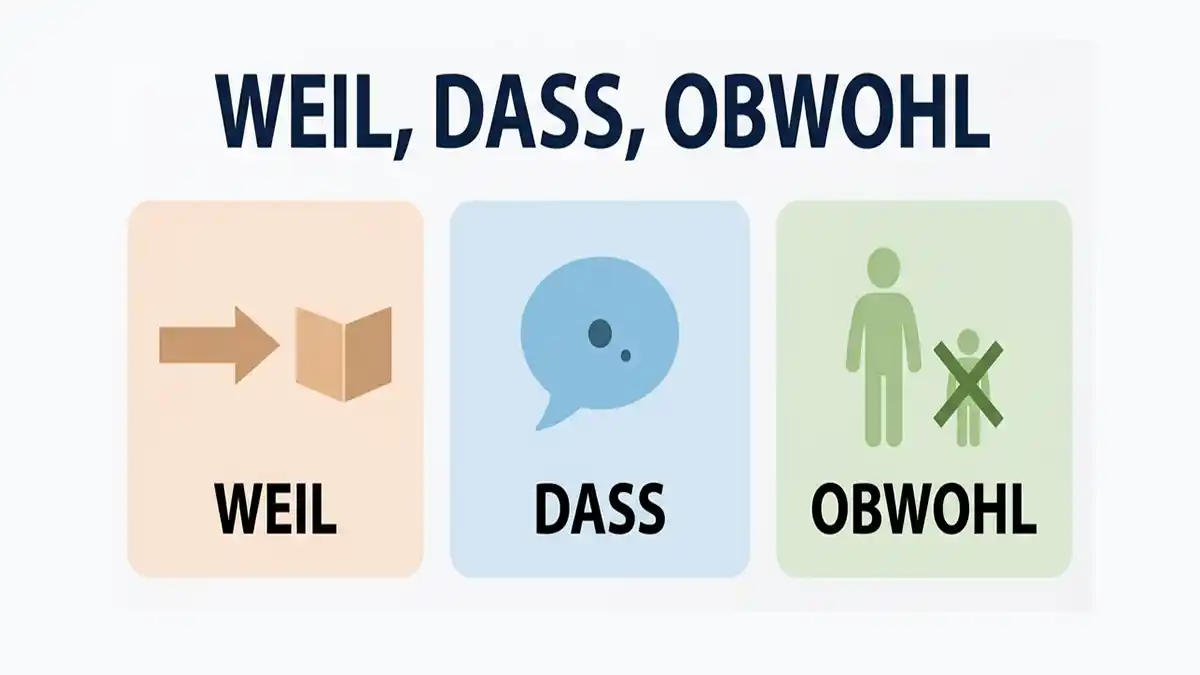
Do you write “Ich bleibe zu Hause, weil ich bin krank” and get corrected? That is the problem of weil, dass and obwohl: three connectors, each with its own meaning, sharing one rule that flips the sentence order: the verb goes to the end.
In this guide we explain each connector with a table and examples, distinguish das from dass and subordinating connectors from adverbs such as deshalb and trotzdem, then show common mistakes and exercises with answers.
Note: click the sound icon next to any German sentence to hear it pronounced.
The examples and explanations are our own, based on the references listed at the end.
Weil, Dass and Obwohl at a Glance
Three connectors that open a subordinate clause, each with a different meaning.
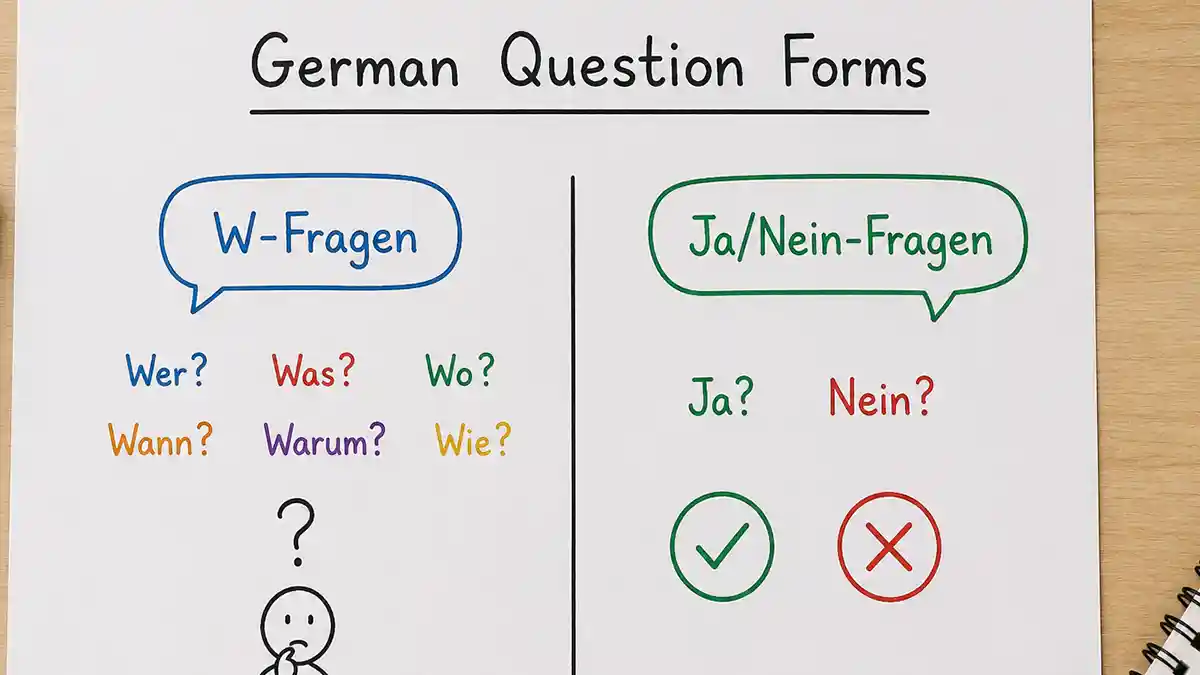
weil, dass and obwohl are subordinating conjunctions that share one rule: the conjugated verb goes to the end of the subordinate clause. But their meanings differ: weil gives the reason and answers “why?”, dass passes on what is said, thought or known, and obwohl expresses something that happens despite expectation. To answer “Warum?” questions, review how to form questions in German.
Connector
Function
In Arabic
Example
weil
Reason
«لأن» (because)
Ich bleibe zu Hause, weil ich krank bin.
dass
Content of speech, opinion or knowledge
«أنّ / أن» (that)
Ich glaube, dass er heute kommt.
obwohl
Contrast with what is expected
«رغم أن / مع أن» (although)
Ich gehe zur Arbeit, obwohl ich krank bin.
Weil: The Reason
The answer to the question “why?”.
weil opens a subordinate clause that gives the reason for what is in the main clause. The verb goes to the end and a comma precedes the subordinate clause. You can also start with the subordinate clause, in which case the main-clause verb comes right after the comma. It also works as a short answer to a question: Warum lernst du Deutsch? — Weil ich in Deutschland arbeiten möchte.
Order
Example
Meaning
Main then weil
Ich bleibe zu Hause, weil ich krank bin.
I stay at home because I am ill.
weil first (inversion)
Weil ich krank bin, bleibe ich zu Hause.
Because I am ill, I stay at home.
A short answer
Warum lernst du Deutsch? Weil ich hier arbeiten will.
Why do you learn German? Because I want to work here.
weil, denn, da or deshalb?
There is more than one way to express a reason, but verb position differs:
Word
Type
Verb position
Example
weil
Subordinating
At the end
Ich bleibe, weil ich müde bin.
da
Subordinating (more formal)
At the end
Da ich müde bin, bleibe ich.
denn
Coordinating
Position 2 as usual
Ich bleibe, denn ich bin müde.
deshalb
Adverb of result
Position 2 after it
Ich bin müde, deshalb bleibe ich.
📌Note: in everyday speech you may hear weil followed by a verb in second position, but writing and exams require the verb at the end. Stick to the standard rule.
Dass: Reporting Speech, Opinion and Knowledge
The connector that matches Arabic «أنّ».
dass expresses neither reason nor contrast; it introduces what is said, believed or known. It comes after verbs such as sagen, glauben, denken, wissen, hoffen and meinen, and after expressions such as Es ist wichtig and Ich freue mich. A grammar reference notes that dass and ob introduce a subordinate clause without expressing a specific relation of meaning.
After what?
Example
Meaning
A verb of saying
Sie sagt, dass sie später kommt.
She says that she will come later.
A verb of opinion
Ich glaube, dass er heute kommt.
I think that he is coming today.
A verb of hope
Er hofft, dass er die Stelle bekommt.
He hopes that he gets the job.
An expression
Es ist wichtig, dass du pünktlich bist.
It is important that you are on time.
A feeling
Ich freue mich, dass du da bist.
I am glad that you are here.
The Difference Between das and dass
The best-known spelling mistake is confusing das and dass. das is an article (review the definite and indefinite articles in German) or a demonstrative or relative pronoun, while dass is a connector that opens a subordinate clause. A quick test: try replacing it with “dies” or “welches”; if that works it is das, otherwise it is dass.
Word
Type
Example
das
Article
Das Buch ist gut.
das
Relative pronoun
Das Buch, das ich lese, ist gut.
dass
Connector
Ich weiß, dass das Buch gut ist.
Obwohl: Contrast with What Is Expected
Something happens despite what would prevent it.
obwohl expresses that something happens despite something that would be expected to prevent it. A sick person is not expected to go to work, yet goes. Its order matches weil: verb at the end, and if you start with it, the verb follows the comma directly. A teaching resource contrasts it with weil: the first goes against expectation, the second gives a reason.
Order
Example
Meaning
Main then obwohl
Ich gehe zur Arbeit, obwohl ich krank bin.
I go to work although I am ill.
obwohl first (inversion)
Obwohl es regnet, gehen wir spazieren.
Although it is raining, we go for a walk.
With the past
Er ging spazieren, obwohl es regnete.
He went for a walk although it was raining.
Word Order: The Verb Goes to the End
One rule governs all three.
After weil, dass and obwohl the conjugated verb goes to the end of the subordinate clause, and a comma is written before it. If you start with the subordinate clause, the verb of the main clause comes right after the comma. With separable verbs the prefix rejoins the verb, so review separable verbs in German.
Case
Example
A normal verb
Ich bleibe zu Hause, weil ich krank bin.
A separable verb
Ich weiß, dass er mich morgen anruft.
Perfekt
Ich bleibe zu Hause, weil ich gestern viel gearbeitet habe.
A modal verb
Ich lerne Deutsch, weil ich in Deutschland arbeiten will.
Subordinate clause first
Weil ich krank bin, bleibe ich zu Hause.
Conjunctions or Adverbs: weil or deshalb? obwohl or trotzdem?
Words with close meanings but a different verb position.
Meaning
Subordinating (verb at the end)
Adverb or coordinator (verb second)
Reason → result
weil: Ich bleibe, weil ich krank bin.
deshalb: Ich bin krank, deshalb bleibe ich.
Contrast
obwohl: Ich gehe, obwohl ich krank bin.
trotzdem: Ich bin krank. Trotzdem gehe ich.
Simple contrast
—
aber: Ich bin krank, aber ich gehe.
A teaching resource gives a quick test: if the conjugated verb is at the end of the clause, the word is a subordinating conjunction; if it is in second position right after it, it is an adverb. Also compare with other connectors such as wann, wenn and als in the difference between Wann, Wenn and Als.
All Three in One Sentence
Sentence
Meaning
Ich glaube, dass er kommt, weil er es versprochen hat.
I think he will come because he promised it.
Er kommt nicht, obwohl er gesagt hat, dass er kommt.
He does not come although he said he would.
Why Do Arabic Speakers Make Mistakes?
Arabic does not change word order after «لأن» and «أن».
In Arabic
In German
Example
«لأن» (because)
weil / denn / da
Ich lerne Deutsch, weil ich in Deutschland arbeiten möchte.
«أنّ / أن» (that)
dass
Er sagt, dass er müde ist.
«رغم أن / مع أن» (although)
obwohl
Obwohl er müde ist, arbeitet er.
«لذلك» (therefore)
deshalb / deswegen
Er ist müde, deshalb geht er früh ins Bett.
«ومع ذلك» (nevertheless)
trotzdem
Er ist müde. Trotzdem arbeitet er.
In Arabic the sentence order stays the same after «لأن» and «أن», so learners write “weil ich bin krank” in the same order. German moves the verb to the end.
Common Mistakes
Each of these mistakes is made by many learners.
Mistake
Correct
Reason
Ich bleibe zu Hause, weil ich bin krank.
Ich bleibe zu Hause, weil ich krank bin.
verb at the end of the subordinate clause
Weil ich krank bin, ich bleibe zu Hause.
Weil ich krank bin, bleibe ich zu Hause.
inversion in the main clause
Ich denke das er kommt.
Ich denke, dass er kommt.
the connector dass with a comma
Obwohl ich krank bin, aber ich gehe.
Obwohl ich krank bin, gehe ich.
no aber after obwohl
Ich gehe, trotzdem ich krank bin.
Ich gehe, obwohl ich krank bin.
trotzdem is an adverb; the conjunction is obwohl
Ich bin müde, deshalb ich gehe heim.
Ich bin müde, deshalb gehe ich heim.
deshalb is an adverb followed directly by the verb
Ich weiß, das er kommt.
Ich weiß, dass er kommt.
dass is a connector, not an article
Exercises with Answers
Fill in the blank with the right word.
#
Sentence
1
Ich bleibe zu Hause, ___ ich krank bin.
2
Ich glaube, ___ er heute kommt.
3
Ich gehe zur Arbeit, ___ ich müde bin.
4
Das Buch, ___ ich lese, ist gut.
5
___ es regnet, bleibe ich zu Hause.
6
Sie sagt, ___ sie später kommt.
7
___ er krank ist, geht er zur Schule.
8
Ich bin müde, ___ gehe ich früh ins Bett.
9
Ich bin krank. ___ gehe ich zur Arbeit.
10
Ich weiß, ___ er nicht kommt, ___ er keine Zeit hat.
Click to show the answers
1) weil (reason). 2) dass (opinion). 3) obwohl (contrast). 4) das (relative pronoun). 5) Weil or Da (reason). 6) dass (speech). 7) Obwohl (contrast). 8) deshalb (adverb, followed by the verb). 9) Trotzdem (adverb, followed by the verb). 10) dass ... weil.
Tips to Remember the Difference
Simple habits that lock the rule in.
Ask yourself: am I giving a reason (weil), reporting speech or an opinion (dass), or stating a contrast (obwohl)?
Put the verb at the end after any subordinating connector, and write the comma before it.
Tell the connector from the adverb: if the verb comes directly after the word, it is an adverb such as deshalb or trotzdem.
Conclusion: How to Choose Between Weil, Dass and Obwohl
A quick summary.
weil is for reason, dass for reporting speech, opinion and knowledge, and obwohl for contrast with expectation. After all three the verb goes to the end of the subordinate clause, preceded by a comma. And remember that deshalb and trotzdem are adverbs followed directly by the verb.
Practising full sentences is more useful than memorizing the bare rule.
Frequently Asked Questions About Weil, Dass and Obwohl
What is the difference between weil, dass and obwohl?
weil is for reason, dass for what is said, thought or known, and obwohl for contrast with expectation. All three move the verb to the end of the subordinate clause.
Where does the verb go after weil?
To the end of the subordinate clause: Ich bleibe zu Hause, weil ich krank bin.
What is the difference between weil and denn?
weil is subordinating and puts the verb at the end, while denn is coordinating and keeps the verb in second position: Ich bleibe, denn ich bin müde.
What is the difference between das and dass?
das is an article or pronoun, and dass is a connector that opens a subordinate clause: Ich weiß, dass das Buch gut ist.
Do I put a comma before dass, weil and obwohl?
Yes, a comma is written before the subordinate clause: Ich denke, dass es gut ist.
What is the difference between obwohl and trotzdem?
obwohl is subordinating and puts the verb at the end, while trotzdem is an adverb followed directly by the verb: Trotzdem gehe ich.
Do I use aber with obwohl?
No. Obwohl and aber both express contrast, so they do not appear together in the same sentence.
What does weil with a second-position verb mean in everyday speech?
It is sometimes heard in everyday speech, but it is not accepted in writing and exams. Use the verb at the end.
How do I practise these connectors?
Answer “Warum?” questions with weil, make opinion sentences with dass and contrast sentences with obwohl, and review your mistakes weekly.
References and Sources
Sources
🛡️We relied on educational grammar materials, and follow our editorial and sources policy. The examples and explanations are written in our own words.