What Are Definite and Indefinite Articles in German?
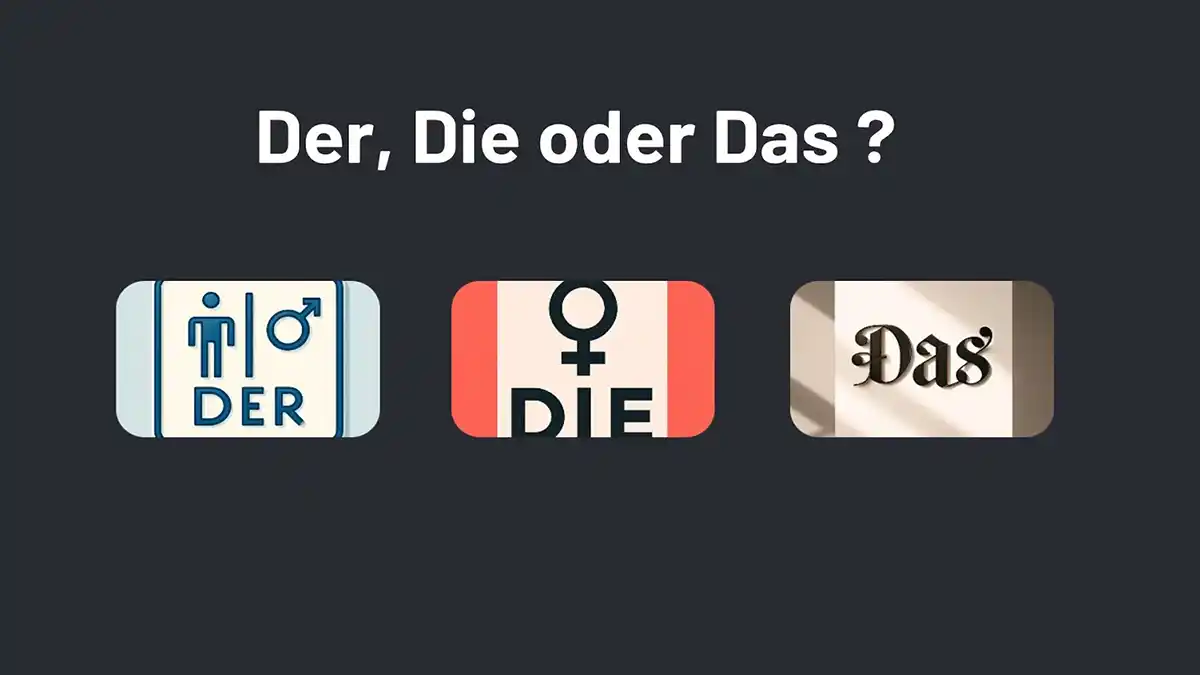
In German it is not enough to memorize a noun on its own: every noun has a gender (masculine, feminine, neuter) and an article that changes with the case and the number. There are three types of articles:
| Type | German term | Articles | English equivalent | Example |
|---|---|---|---|---|
| Definite article | bestimmter Artikel | der, die, das | the | der Tisch |
| Indefinite article | unbestimmter Artikel | ein, eine | a / an | ein Tisch |
| No article | Nullartikel | — | general or uncountable noun | Ich trinke Wasser. |
If you are at the beginning of your journey, this lesson is part of the A1 basics, and you can find your full learning map in German language levels from A1 to C2.
The Three Genders: der, die and das
| Gender | Definite article | Indefinite article | Color on our site | Examples |
|---|---|---|---|---|
| masculine (maskulin) | der | ein | blue |
der Mann
der Tisch der Kaffee |
| feminine (feminin) | die | eine | red |
die Frau
die Lampe die Milch |
| neuter (neutral) | das | ein | green |
das Kind
das Buch das Wasser |
| plural | die | — (no indefinite article; we use keine in negatives) | red |
die Kinder
die Bücher die Tische |
Declension of Articles in the Four Cases
Definite article (der / die / das)
| Case | Masculine (m) | Feminine (f) | Neuter (n) | Plural (pl) |
|---|---|---|---|---|
| Nominativ | der | die | das | die |
| Akkusativ | den | die | das | die |
| Dativ | dem | der | dem | den (+n) |
| Genitiv | des (+s/es) | der | des (+s/es) | der |
Indefinite article (ein / eine)
| Case | Masculine (m) | Feminine (f) | Neuter (n) | Plural (pl) |
|---|---|---|---|---|
| Nominativ | ein | eine | ein | — |
| Akkusativ | einen | eine | ein | — |
| Dativ | einem | einer | einem | — |
| Genitiv | eines (+s/es) | einer | eines (+s/es) | — |
Negative article (kein)
Kein is declined exactly like ein, with one difference: it has a plural: keine in the nominative and accusative, keinen in the dative and keiner in the genitive.
| Case | Masculine (m) | Feminine (f) | Neuter (n) | Plural (pl) |
|---|---|---|---|---|
| Nominativ | kein | keine | kein | keine |
| Akkusativ | keinen | keine | kein | keine |
| Dativ | keinem | keiner | keinem | keinen |
| Genitiv | keines (+s/es) | keiner | keines (+s/es) | keiner |
The same sentence in the four cases
| Case | Masculine | Feminine | Neuter | Plural |
|---|---|---|---|---|
| Nominativ (who / what?) | Der Mann kommt. | Die Frau kommt. | Das Kind kommt. | Die Kinder kommen. |
| Akkusativ (whom / what?) | Ich sehe den Mann. | Ich sehe die Frau. | Ich sehe das Kind. | Ich sehe die Kinder. |
| Dativ (to / for whom?) | Ich helfe dem Mann. | Ich helfe der Frau. | Ich helfe dem Kind. | Ich helfe den Kindern. |
| Genitiv (whose?) | Das Auto des Mannes | Das Auto der Frau | Das Spielzeug des Kindes | Das Spielzeug der Kinder |
Notice the -n added to the noun in the dative plural (den Kindern), unless the plural already ends in -n or -s, and the -s / -es added to masculine and neuter nouns in the genitive (des Mannes).
When Do We Use Each Case?
| Case | Question | Function | Example |
|---|---|---|---|
| Nominativ | Wer? Was? | the subject, and the complement after sein | Der Lehrer ist nett. |
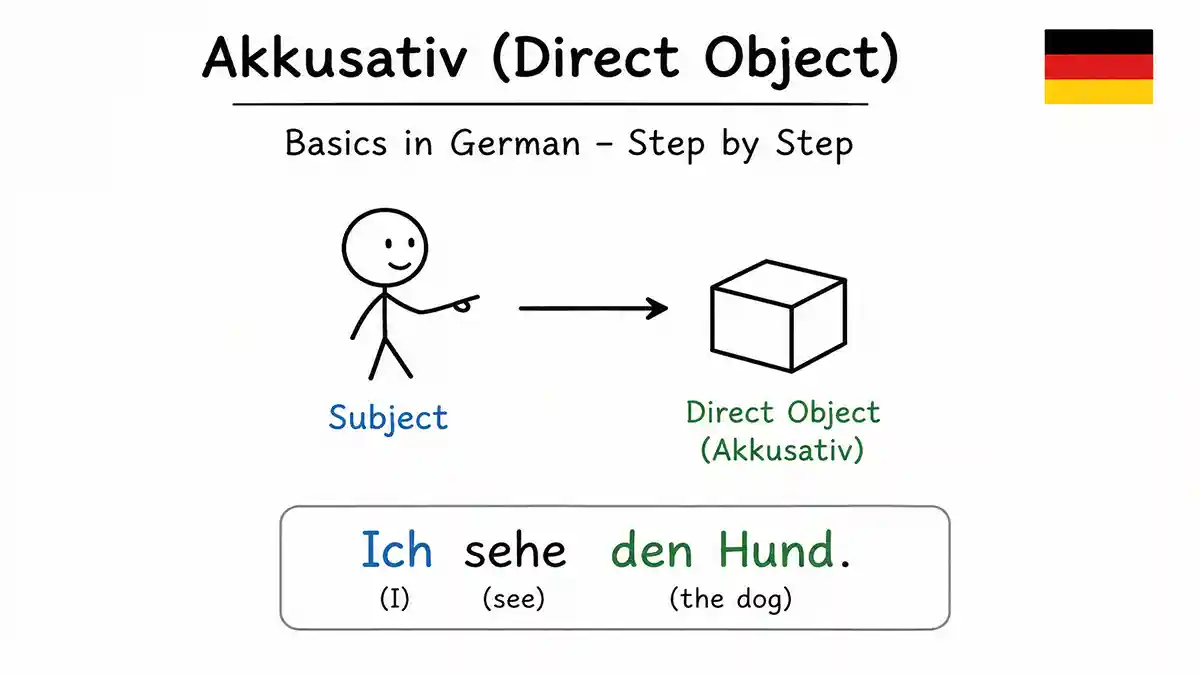
| Akkusativ | Wen? Was? | the direct object | Ich kaufe einen Apfel. |
| Dativ | Wem? | the indirect object | Ich gebe dem Kind einen Apfel. |
| Genitiv | Wessen? | possession | Das ist das Buch des Lehrers. |
Verbs that take the accusative and verbs that take the dative
| Verb | Takes | Example |
|---|---|---|
| sehen / haben / kaufen / essen / trinken | Akkusativ | Ich trinke einen Tee. |
| helfen / danken / gehören / gefallen / antworten | Dativ | Ich helfe dem Kind. |
| geben / schenken / zeigen / schicken | Dativ + Akkusativ | Ich gebe dem Mann das Buch. |
Prepositions and their cases
| Case | Prepositions | Memory hint |
|---|---|---|
| Always accusative | durch, für, gegen, ohne, um, bis | durch für gegen ohne um |
| Always dative | aus, bei, mit, nach, seit, von, zu, gegenüber | aus bei mit nach seit von zu |
| Accusative or dative | an, auf, hinter, in, neben, über, unter, vor, zwischen | Wo? → dative | Wohin? → accusative |
| Genitive | wegen, trotz, während, statt | used mostly in writing |
You will find mit dem Bus explained in detail in our lesson on transportation in German, and dative articles also appear when asking about places in directions in German, such as zum Bahnhof and zur Apotheke.
When Do We Use the Definite vs. the Indefinite Article?
| Use | Article | Example |
|---|---|---|
| mentioning something for the first time | ein / eine | Ich habe einen Hund. |
| referring to the same thing again | der / die / das | Der Hund ist klein. |
| something unique that everyone knows | der / die / das | Die Sonne scheint. |
| a specific thing in the situation | der / die / das | Gib mir bitte das Buch. |
| describing or classifying (one of a group) | ein / eine | Das ist ein Auto. |
When do we use no article? (Nullartikel)
| Situation | Example | Meaning |
|---|---|---|
| professions and nationalities (after sein) | Ich bin Lehrer. | I am a teacher. |
| languages after lernen / sprechen | Ich lerne Deutsch. | I’m learning German. |
| uncountable things in general | Ich trinke Wasser. | I drink water. |
| indefinite plurals in general | Ich esse Äpfel. | I eat apples. |
| most countries and cities | Ich komme aus Ägypten. | I come from Egypt. |
| fixed expressions | Ich habe Hunger / Durst / Angst. | I’m hungry / thirsty / afraid. |
Notice that uncountable drinks usually come without an article (Ich trinke Kaffee) but with one when ordering (Ich möchte einen Kaffee); the details are in our lesson on drinks in German. The same applies to food, so see German food vocabulary.
Countries: usually no article, sometimes with one
| Country | In German | Example with aus |
|---|---|---|
| Egypt / Syria / Morocco / Tunisia | Ägypten, Syrien, Marokko, Tunesien | Ich komme aus Ägypten. |
| Lebanon | der Libanon | Ich komme aus dem Libanon. |
| Iraq | der Irak | Ich komme aus dem Irak. |
| Turkey | die Türkei | Ich komme aus der Türkei. |
| Switzerland | die Schweiz | Ich komme aus der Schweiz. |
| United States | die USA (plural) | Ich komme aus den USA. |
How Can You Know a German Noun’s Gender?
Masculine (der)
| Ending / category | Example | Note |
|---|---|---|
| -er (agent or profession) | der Lehrer, der Computer | mostly masculine |
| -ling | der Frühling, der Lehrling | always masculine |
| -ismus | der Tourismus | always masculine |
| -ist | der Tourist | always masculine |
| -or | der Motor | mostly masculine |
| days, months and seasons | der Montag, der Januar, der Sommer | always masculine |
| compass points | der Norden, der Süden | always masculine |
| weather phenomena | der Regen, der Schnee, der Wind | mostly masculine |
| alcoholic drinks (except beer) | der Wein, der Wodka | beer: das Bier |
To practice the days of the week with their articles (der Montag, am Montag), see our lesson on days of the week in German.
Feminine (die)
| Ending / category | Example | Note |
|---|---|---|
| -ung | die Zeitung, die Wohnung | always feminine |
| -heit / -keit | die Freiheit, die Möglichkeit | always feminine |
| -schaft | die Freundschaft | always feminine |
| -ion | die Nation, die Information | always feminine |
| -tät | die Universität, die Qualität | always feminine |
| -ei | die Bäckerei, die Polizei | exception: das Ei |
| -ie | die Familie, die Biologie | exception: das Genie |
| -ik / -ur | die Musik, die Kultur | mostly feminine |
| -in (female professions) | die Lehrerin, die Ärztin | always feminine |
| -e (most nouns) | die Lampe, die Nase, die Tasche | exceptions: der Name, das Auge |
Neuter (das)
| Ending / category | Example | Note |
|---|---|---|
| -chen / -lein (diminutives) | das Mädchen, das Fräulein | always neuter |
| -um | das Museum, das Zentrum | mostly neuter |
| -ment | das Dokument, das Instrument | exceptions: der Moment, der Zement |
| -nis | das Ergebnis, das Geheimnis | some are feminine: die Erlaubnis |
| -tum | das Eigentum | exceptions: der Reichtum, der Irrtum |
| verbs used as nouns | das Essen, das Lernen | always neuter |
| young people and animals | das Kind, das Baby | mostly neuter |
| metals and elements | das Gold, das Silber, das Eisen | mostly neuter |
| colors as nouns | das Rot, das Blau | always neuter |
Compound nouns
A compound noun takes the gender of its last word:
| Compound noun | Made of | Gender |
|---|---|---|
| der Apfelsaft | der Apfel + der Saft | masculine (Saft) |
| die Handtasche | die Hand + die Tasche | feminine (Tasche) |
| das Wasserglas | das Wasser + das Glas | neuter (Glas) |
| die Kopfschmerzen | der Kopf + die Schmerzen | plural (Schmerzen) |
You will find many examples of compound nouns and their genders in our lesson on body parts in German with plurals, such as der Fingernagel and die Fußsohle, and in German food vocabulary, such as das Frühstück.
Articles Merged with Prepositions (zum, im, am, zur)
| Merged word | Made of | Meaning | Example |
|---|---|---|---|
| im | in + dem | in (masculine / neuter) | Ich wohne im Haus. |
| am | an + dem | at / on (day or time) | Am Montag arbeite ich. |
| zum | zu + dem | to (masculine / neuter) | Ich gehe zum Bahnhof. |
| zur | zu + der | to (feminine) | Ich gehe zur Schule. |
| vom | von + dem | from / of | Das ist ein Geschenk vom Lehrer. |
| beim | bei + dem | at | Ich bin beim Arzt. |
| ins | in + das | into (neuter) | Wir gehen ins Kino. |
| ans / aufs / fürs | an / auf / für + das | preposition + das | Ich gehe ans Fenster. |
You will use zum and zur every day when asking for directions, so practice them in directions in German.
Articles and Adjective Endings: der große Mann vs. ein großer Mann
When we put an adjective between the article and the noun, the adjective’s ending changes. These are the most important patterns (nominative, accusative and dative):
| Case | Masculine | Feminine | Neuter | Plural |
|---|---|---|---|---|
| definite, Nominativ | der gute Wein | die gute Milch | das gute Bier | die guten Weine |
| definite, Akkusativ | den guten Wein | die gute Milch | das gute Bier | die guten Weine |
| definite, Dativ | dem guten Wein | der guten Milch | dem guten Bier | den guten Weinen |
| indefinite, Nominativ | ein guter Wein | eine gute Milch | ein gutes Bier | gute Weine |
| indefinite, Akkusativ | einen guten Wein | eine gute Milch | ein gutes Bier | gute Weine |
| indefinite, Dativ | einem guten Wein | einer guten Milch | einem guten Bier | guten Weinen |
To master the color names that appear with these articles (der rote Apfel, die blaue Jacke), see our lesson on colors in German.
Words That Work Like Articles: mein, dieser, kein and jeder
| Type | Words | Declined like | Example |
|---|---|---|---|
| possessives | mein, dein, sein, ihr, unser, euer, ihr, Ihr | ein | Das ist mein Kopf. |
| negation | kein / keine | ein | Ich habe keinen Hunger. |
| demonstratives | dieser, diese, dieses | der | Dieses Buch ist neu. |
| question words | welcher, welche, welches | der | Welcher Kaffee ist das? |
| quantifiers | jeder, alle, manche | der | Jeder Tag ist anders. |
| Gender | mein | dieser | Note |
|---|---|---|---|
| masculine Nominativ | mein Bruder | dieser Bruder | mein has no ending, dieser ends in -er |
| masculine Akkusativ | meinen Bruder | diesen Bruder | -en appears |
| feminine | meine Schwester | diese Schwester | ending -e |
| neuter | mein Kind | dieses Kind | mein has no ending, dieser ends in -es |
| plural | meine Kinder | diese Kinder | ending -e |
Possessives often appear with body parts, as in mein Kopf and meine Hände, but German often prefers the article with the pronoun mir, as in Ich wasche mir die Hände, which is explained in our guide to body parts in German with plurals.
Nouns Whose Meaning Changes with Gender
| Word | with der | with die | with das |
|---|---|---|---|
| See | der See = lake | die See = sea | — |
| Leiter | der Leiter = leader / manager | die Leiter = ladder | — |
| Band | der Band = volume (of a book) | die Band = music band | das Band = ribbon / tape |
| Kiefer | der Kiefer = jaw | die Kiefer = pine tree | — |
| Tor | der Tor = fool (old-fashioned) | — | das Tor = gate / goal |
| Steuer | — | die Steuer = tax | das Steuer = steering wheel |
These words are understood from context and their article, which is why memorizing a noun with its article is not a luxury but a necessity for understanding meaning.
How to Memorize German Noun Articles
- Always memorize the noun with its article and plural: der Tisch – die Tische.
- Use colors: write masculine in blue, feminine in red and neuter in green on your flashcards.
- Memorize endings: every noun ending in -ung, -heit, -keit or -tät is feminine, and every noun ending in -chen is neuter.
- Learn thematic groups: all days of the week are masculine, and alcoholic drinks are mostly masculine.
- Memorize sentences, not single words: such as Ich trinke einen Kaffee and Mir tut der Kopf weh.
- Review regularly: five minutes a day beats two hours a week.
Short Dialogues Applying the Articles
Dialogue 1: At the store
Dialogue 2: In the classroom
Combine these dialogues with everyday German conversations and expressions to build complete conversations with confidence.
Common Mistakes with German Articles
- Memorizing the noun without its article: always learn Tisch as der Tisch.
- Forgetting der → den in the masculine accusative: say Ich sehe den Mann, not Ich sehe der Mann.
- Forgetting -n in the dative plural: say mit den Kindern, not mit den Kinder.
- Using an article with a profession: say Ich bin Lehrer, not Ich bin ein Lehrer, when you only state the profession.
- Mixing up einen and einem: einen is for the masculine direct object, einem for the indirect object.
- Mixing up grammatical and real gender: das Mädchen is neuter even though it means girl.
- Using a singular article with a plural: the plural is always die, and there is no indefinite article for the plural.
Practice Exercises on German Articles
Exercise 1: Choose the correct answer
- 1. What is the definite article of Mädchen?
- 2. Ich sehe ___ Mann.
- 3. Ich helfe ___ Frau.
- 4. Ich habe ___ Apfel.
- 5. What is the gender of Zeitung?
- 6. What is the definite article for the plural?
- 7. How do you say “I am a teacher”?
- 8. What does zum stand for?
Exercise 2: Fill in the blank
- ___ Buch ist neu.
- Ich trinke ___ Kaffee.
- Wir haben ___ Zeit.
- Ich fahre mit ___ Bus.
- Das ist das Auto ___ Frau.
- Siehst du ___ Kinder?
- Ich gebe ___ Mann das Buch.
- Sie hat ___ Tasche.
Word bank (some words are used twice): Das – einen – keine – dem – der – die – eine
Answers
Exercise 1: 1-c, 2-b, 3-b, 4-b, 5-b, 6-c, 7-a, 8-b.
Exercise 2: 1. Das — 2. einen — 3. keine — 4. dem — 5. der — 6. die — 7. dem — 8. eine
Summary: A Plan to Master German Articles
Start by memorizing the three genders and the plural (der, die, das, die), then learn the accusative because it is used most (den and einen for the masculine only), then the dative with the prepositions mit, zu, bei, von, aus, nach. After that, add the genitive gradually.
Apply what you learn to everyday topics: start with German food vocabulary, drinks in German and body parts in German with plurals to memorize nouns with their articles in context. To find your next step, read about the German language levels from A1 to C2.
Complete Guide from DeutschPlayLearn German From Scratch for Free: Complete A1 to Advanced GuideStarting your journey and need a clear, free roadmap? Explore proficiency levels from A1 to advanced, along with top methods, resources, and tips to start with confidence.Frequently Asked Questions About German Articles
What are the definite articles in German?
What are the indefinite articles in German?
How can I know the gender of a German noun?
Why does der change to den, dem and des?
When do we use no article before a noun?
Why is Mädchen neuter even though it means girl?
What is the definite article for the plural?
References
Sources
- Duden dictionary - to confirm noun gender, plurals and declension rules.
- DWDS German dictionary - to check genders, meanings and usage.
- PONS German–English dictionary - to look up vocabulary and translations.
- DW Learn German - free lessons and exercises on articles and cases.