Prepositions with the Accusative Case (Akkusativpräpositionen) in German
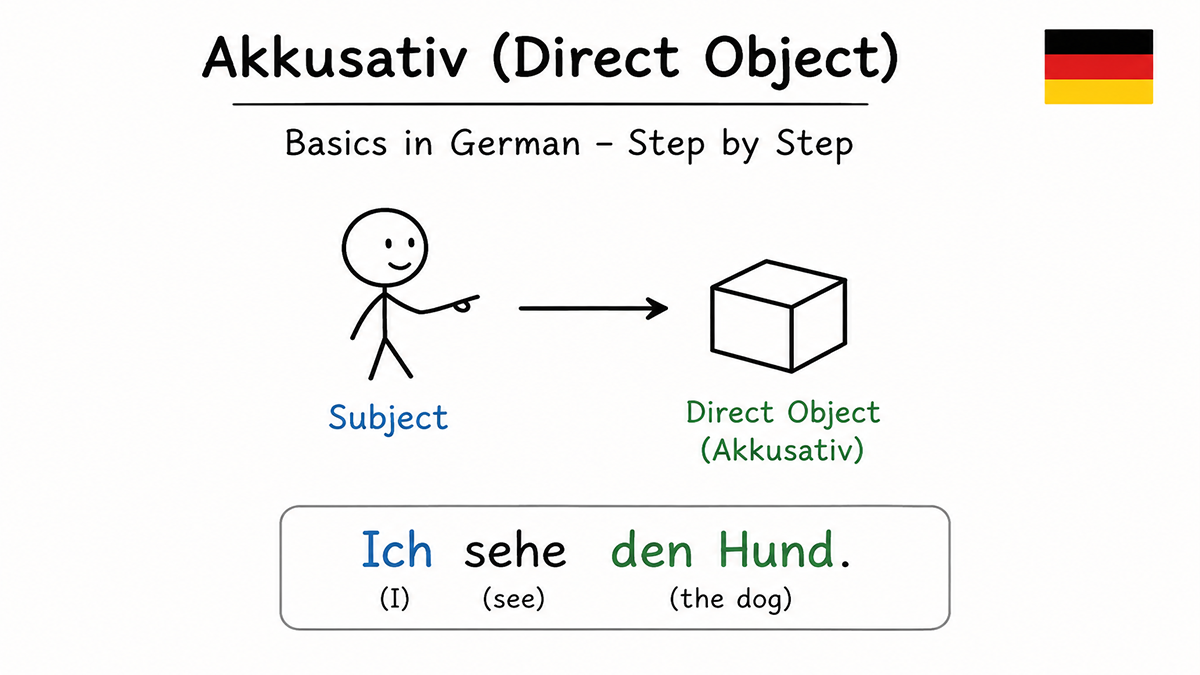
On your journey to mastering German, you will quickly discover that prepositions play a crucial role in connecting words and precisely determining their grammatical case. Before memorizing prepositions, it is recommended to review the Basics of the Accusative Object (Akkusativ) to understand article changes. In this article, we will highlight a very important group for beginners: "Prepositions with the Accusative Case", known as (Akkusativpräpositionen).
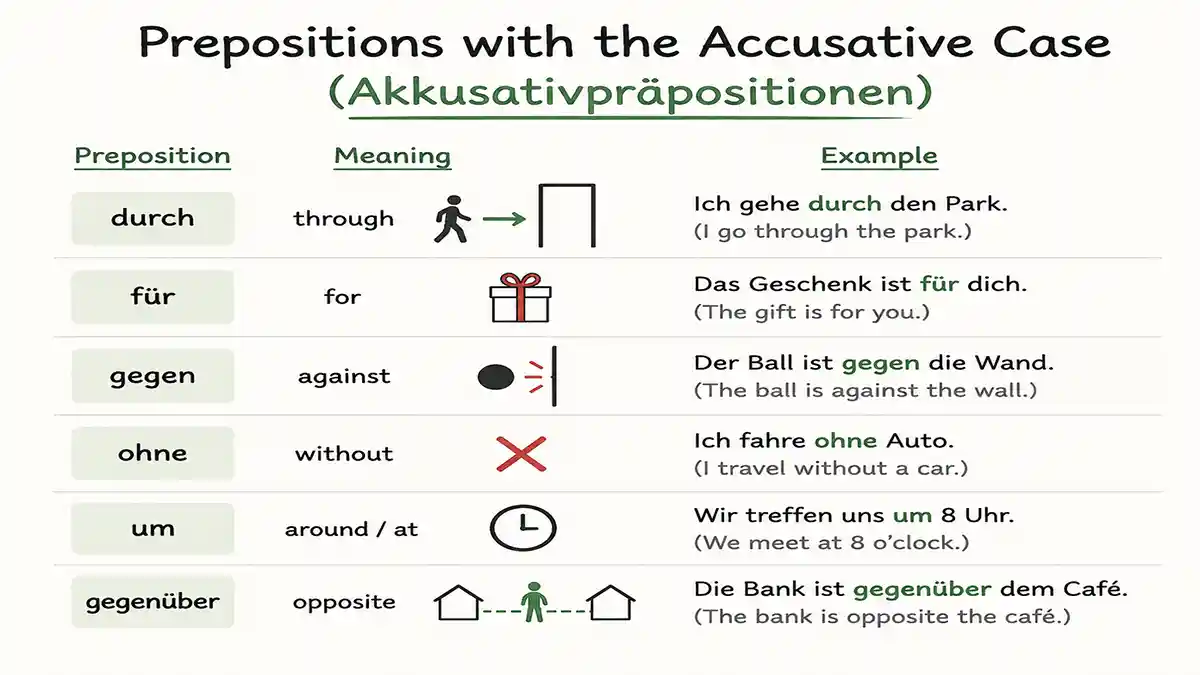
There are five fundamental prepositions in German. As soon as you see them in a sentence, you must put the noun immediately following them into the accusative case (direct object). To make them easy to remember, they can be grouped into the acronym (DOGFU). Let's explore them in detail with practical examples and interactive audio pronunciation.
How Do German Prepositions Work with Grammatical Cases?
When studying German prepositions, it is important to understand that the preposition itself dictates the grammatical case of the noun that directly follows it, not the verb. In the Akkusativ case, only masculine definite and indefinite articles change (der changes to den and ein to einen), while feminine, neuter, and plural articles remain completely unchanged.
All sentences and examples in this article support high-quality interactive audio pronunciation. Click the speaker icon on any card to listen to correct German pronunciation.
1. Preposition (durch) - Through / Across
2. Preposition (ohne) - Without
3. Preposition (gegen) - Against / Towards
4. Preposition (für) - For
5. Preposition (um) - Around / At (Clock Time)
Smart DOGFU Shortcut to Always Remember Prepositions
To make it easy to memorize the five accusative prepositions without forgetting, you can rely on a single mnemonic word combining their initial letters:
- D -
durch(through / by) - O -
ohne(without) - G -
gegen(against / towards) - F -
für(for / on behalf of) - U -
um(around / at [time])
Frequently Asked Questions (FAQ)
Do feminine and neuter articles change after accusative prepositions?
No, the change is restricted to masculine nouns only (where der changes to den). Feminine (die), neuter (das), and plural (die) articles remain unchanged.
How can I easily memorize these prepositions?
You can use the famous mnemonic acronym DOGFU (Durch, Ohne, Gegen, Für, Um) to recall these five fundamental prepositions that always require the accusative case.
Are there other prepositions requiring the Akkusativ?
Yes, there are prepositions like "bis" (until) and "entlang" (along), but they are usually used in specific contexts or paired with other prepositions. The five listed prepositions (DOGFU) are the most important and frequently used for beginners. To explore beginner vocabulary further, visit the Level A1.1 Keywords Page and our Essential Verbs Guide for Beginners.
What happens to personal pronouns after these prepositions?
Personal pronouns also change into their accusative form. For example, ich becomes mich, du becomes dich, er becomes ihn, and so on.
Can the preposition entlang come before the noun?
The preposition entlang usually follows the noun when taking the accusative case (e.g., den Fluss entlang). If placed before the noun, it typically requires the genitive or dative case.
What is the main difference between DOGFU prepositions and two-way prepositions (Wechselpräpositionen)?
DOGFU prepositions always require the accusative case regardless of movement or location, whereas two-way prepositions alternate between accusative (for direction/movement) and dative (for location/position).
Do indefinite articles (ein/eine) change with these prepositions?
Yes, the masculine indefinite article ein changes to einen in the accusative case, while feminine (eine) and neuter (ein) remain unchanged.
Which preposition is most commonly used for specific clock times?
The preposition um is always used when specifying exact clock times, such as Um 8 Uhr (at 8 o'clock sharp).
Are there other German prepositions that take the accusative case (Akkusativ)?
Yes! Besides the fixed accusative prepositions (DOGFU), there is a second group known as Wechselpräpositionen (dual prepositions, such as: in, an, auf, unter, über, vor, hinter, neben, zwischen).
These prepositions take the Akkusativ case only when the sentence expresses directional movement or a change of location (Movement / Direction) and answers the question Wohin? (Where to?).
Textbooks & Academic Curricula (References)
Certified Academic & Linguistic Sources
Accusative preposition rules have been gathered and documented based on standardized German learning sources and linguistic databases:
- Duden Online Wörterbuch - Primary standard reference for German grammar and usage.
- DWDS (Digitales Wörterbuch der deutschen Sprache) - Comprehensive German language dictionary database.
- Menschen A1 Kursbuch - Accredited German language curriculum by Hueber Verlag.
- Netzwerk neu A1 - German as a foreign language series by Klett Sprachen.
- Goethe-Institut Educational Materials - Curriculum frameworks approved by the Goethe-Institut for CEFR levels.