Part One: How to Choose the Right Platform Before You Apply
Before opening any platform, decide which profession you are aiming for. If you haven't settled yet, look at the most in-demand Ausbildung specializations in Germany to see where the opportunities are widest and which language level each profession needs.
Then ask yourself three questions before relying on any platform:
- Is it official or commercial? Official platforms, such as those run by the Federal Employment Agency and the chambers, publish listings from registered companies. Commercial platforms offer an easier search experience and more information about each profession.
- Does it offer the filters you need? Look for filtering by profession, city and start date. Those three filters save you half your search time.
- Does it suit an applicant from abroad? Some platforms are clearly aimed at foreign skilled workers, while others assume you already live in Germany.
Always remember that any Ausbildung site is only an intermediary. You sign the contract with the company or institution itself, and no platform has the right to sell you a promise of a training place.
As for timing, most training contracts start in August or September, and many companies announce their places about a full year ahead. As for pay, the legal minimum for Ausbildung 2026 is €724 in the first year, €854 in the second and €977 in the third, and these figures rise in many sectors under collective agreements, nursing among them.
Part Two: The 10 Best Ausbildung Websites, Explained One by One

1. The Federal Employment Agency's training search
This is the largest official source of training listings in Germany, run by the Federal Employment Agency (Bundesagentur für Arbeit). It holds listings from companies in every state, and you can search by profession and city. Its address is arbeitsagentur.de/ausbildungsplatzsuche.
Tip: make it your first stop, then compare what you find with the other platforms, since companies often post the same listing in more than one place.
2. AzubiWelt: the Agency's app on your phone
This is a free app from the Federal Employment Agency that gathers its offers for training seekers in one place. You create a profile, save professions, listings and searches, and can contact the training company or a career adviser from inside the app. Its interface is in German, so it suits anyone whose language level lets them read listings comfortably.
Tip: keep a short list of the professions that interest you in AzubiWelt so you never lose a listing you liked.
3. Make it in Germany: the government portal for foreigners
This portal shows a job list sourced from the Federal Employment Agency. The employers appearing there agreed to publish their listings on it and welcome applications from skilled workers abroad. You can filter results by type of offer and choose «Apprenticeship», and you will find examples of nursing, programming and trade places. The portal also runs an advice hotline on +49 30 1815-1111 and explains visa types and requirements.
Note: most listings appear in the language the company wrote them in, which is usually German.
4. Ausbildung.de: a detailed page for every profession
One of the best-known commercial platforms, with a full page for each profession covering the work, pay, entry requirements and reports from former trainees. Its city and profession pages, for example Pflegefachmann and Fachinformatiker, show the available places and when each one starts, which helps you compare professions before applying.
5. Azubiyo: broad coverage of training and dual study
The chambers of industry and commerce list it alongside Ausbildung.de, AUBI-plus and StepStone among the leading portals where companies publish their places. Its search covers both vocational training and dual study (Duales Studium). Use it as a complementary platform to reach companies that haven't posted anywhere else.
6. AUBI-plus: the «last-minute» exchange for latecomers
This platform has been connecting companies with trainees and dual students since 1997. In 2023 the company announced that more than 30,000 training sites publish their vacancies on it. It offers a «last-minute» exchange (Last-Minute-Börse) for those who missed the main application window, plus an interest test and application tips.
7. IHK-Lehrstellenbörse: places at chamber-approved companies
This is the joint training exchange of the chambers of industry and commerce. It is free and lists thousands of offers from approved training companies. You can search your region or all of Germany and create a personal profile to be notified of suitable offers. It is useful if you are aiming at commercial and technical professions, because their exams are held before the chamber, including the Fachinformatiker exam.
Note: some chambers use regional platforms such as Ausbildung.NRW or a training atlas (Ausbildungsatlas), and several chambers stress that the atlas is not a list of current vacancies, so contact the company directly before applying.
8. Lehrstellen-Radar: the platform for crafts and trades
This is the platform of the crafts chambers (Handwerkskammern) for trade training places. Make it in Germany recommends it for anyone seeking craft training, and it is also available as an app. It suits professions such as Elektroniker, Anlagenmechaniker SHK and Kfz-Mechatroniker, which usually accept a lower language level than nursing.
9. StepStone: the closest fit for programming contracts
A general job platform, but with a wide training section where tech companies post Fachinformatiker für Anwendungsentwicklung and Systemintegration places. Some listings allow quick applications without a motivation letter, which is written in the listing itself. It is very useful if your goal is a programming contract, because software and services companies post their places there.
10. medi-karriere.de: the closest fit for nursing contracts
A job platform for the healthcare sector that lists Pflegefachfrau and Pflegefachmann training from university hospitals and care providers. It also shows «shortened training» offers that start in the second year, intended for those who meet its conditions. It is also worth visiting pflegeausbildung.net to find nursing schools in each state, since many of them advise you on training places.
Part Three: Which Platform Fits Your Goal? A Quick Comparison
Part Four: How to Get a Contract in Nursing Ausbildung
Since 2020 the nursing paths have been merged into one general three-year training ending in the title Pflegefachfrau or Pflegefachmann. It includes at least 2,100 hours of theory and 2,500 hours of practice, moving between hospital, care home and home care.
- Start with the right platforms: search medi-karriere.de and Make it in Germany with the training filter, then add Ausbildung.de to compare places and cities.
- Apply directly to the training provider: you usually apply to the hospital or care institution that will sign your contract, while the nursing school covers the theory side.
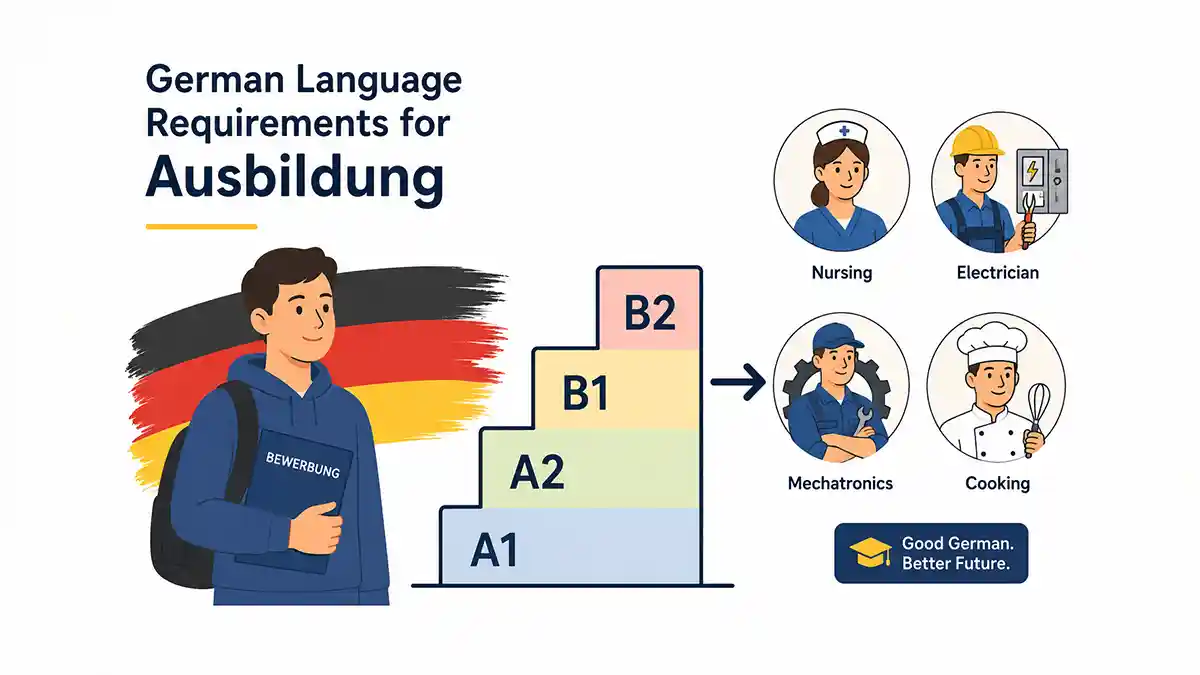
- Prepare linguistically: nursing usually asks for B2, because you will deal with patients and write reports. To prepare for nursing Ausbildung, start with our guide to German for the medical sector.
- Watch the start dates: nursing has several start dates, so some places begin in September and others in October, January or April.
Part Five: How to Get a Programming Training Contract
The profession in question is Fachinformatiker/in, where you choose between application development (Anwendungsentwicklung) and systems integration (Systemintegration), and newer tracks such as data and process analysis also exist. Training lasts three years and ends with a final exam before the chamber of industry and commerce, with an intermediate exam in the second year.
- Where to search: StepStone, IHK-Lehrstellenbörse and Ausbildung.de, plus the careers pages of software companies, banks and insurers.
- What tips the balance: personal projects, a GitHub account, good technical English and a tidy tabular CV.
- Language: companies usually ask for B1 to B2, and English does not make up for weak German in the interview.
To present your experience well to companies, learn the job titles in German and how to describe your work and goals.
Part Six: Ausbildung Registration Requirements and Documents
Ausbildung registration requirements differ from one company to another, but the basics are usually the same. If the system is new to you, first read what Ausbildung is, then prepare the following documents:
- A tabular CV (Tabellarischer Lebenslauf): in reverse chronological order with clear dates.
- A motivation letter (Anschreiben): written for that company and profession, never one copy sent to everyone.
- School certificates: translated, and recognised where needed. Start recognition early, because it can take months.
- A recognised language certificate: B1 is usually required for the training visa, and the company may ask for more. For details see the language levels required for Ausbildung.
- Proof of livelihood: for in-company training, your living costs count as secured if the pay reaches €1,048 gross or €822 net per month; otherwise you can cover the difference with a blocked account or a declaration of commitment.
To see what you actually pay and what you should never pay, read about free Ausbildung in Germany. Figures and conditions are updated every year, so confirm them on Make it in Germany or with the German embassy before depositing any money.
Part Seven: Common Mistakes When Searching Through Platforms
- Relying on a single Ausbildung site. A company may post its place on only one platform, so use at least three.
- Choosing a profession at random. Before applying, compare the Ausbildung specializations that match your language level with what you see in the listings.
- Applying to a listing without knowing its start date. Confirm the start date and that the place is still open, and write to the company directly if the listing looks old.
- Sending one letter to every company. Name the company and the profession, and explain why this particular place.
- Waiting until summer. Ausbildung 2026 contracts have already started, and applying now is for the next intake. Many companies close applications months before the start date, so begin at least six months ahead.