Do you want to say “the man who is standing there is my teacher” in German and get stuck at “who”? That is where relative clauses (Relativsätze) come in: subordinate clauses that give information about a noun and start with a relative pronoun that changes with gender, number and case.
In this guide we explain the relative pronoun table, the rule of gender from the noun and case from the function, clauses with prepositions, dessen and deren, was and wer, word order, common mistakes and exercises with answers.
Note: click the sound icon next to any German sentence to hear it pronounced.
The examples and explanations are our own, based on the references listed at the end.
Relative Clauses at a Glance
What is a relative clause and how is it built?
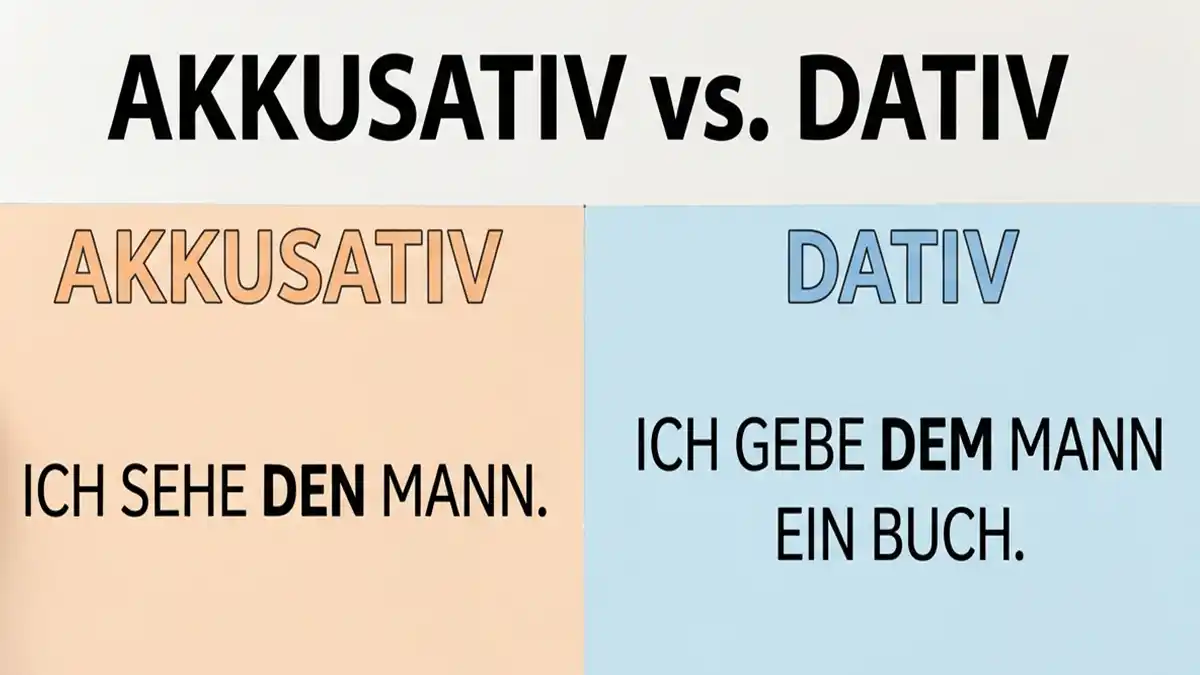
A relative clause (Relativsatz) is a subordinate clause that gives extra information about a noun that came before it, and it starts with a relative pronoun matching “who/which/that”. The noun it describes is called the Bezugswort. The central rule: gender and number come from the described noun, while case comes from the pronoun’s function inside the relative clause. To understand the cases themselves, review the difference between Akkusativ and Dativ.
The two sentences
The relative clause
Der Mann ist mein Lehrer. Er steht dort.
Der Mann, der dort steht, ist mein Lehrer.
Das Buch ist spannend. Ich lese es.
Das Buch, das ich lese, ist spannend.
Die Frau arbeitet hier. Ich kenne sie.
Die Frau, die ich kenne, arbeitet hier.
The Relative Pronoun Table (Relativpronomen)
One table to memorize that opens the door.
Case
Masculine
Feminine
Neuter
Plural
Nominativ
der
die
das
die
Akkusativ
den
die
das
die
Dativ
dem
der
dem
denen
Genitiv
dessen
deren
dessen
deren
You will notice that the table almost matches the definite-article table (review the definite and indefinite articles in German), and the differences are denen (Dativ plural) and the Genitiv forms. In formal writing these pronouns can be replaced by welcher, welche and welches, except in the Genitiv.
The Double Rule: Gender from the Noun, Case from the Function
This is what confuses learners, so understand it well.
Factor
Where does it come from?
Example
Gender and number
From the described noun (Bezugswort)
der Mann → masculine singular
Case
From the pronoun’s function inside the relative clause
Identify the described noun and its gender and number
der Film (m.)
2
Write the second sentence and ask about the noun’s function in it
Ich habe den Film gesehen → wen?
3
Decide the case from the question
wen? → Akkusativ
4
Pick the pronoun from the table: masculine + Akkusativ
den
5
Put the verb at the end and set it off with commas
Der Film, den ich gesehen habe, war gut.
Relative Clauses with Prepositions
The preposition always comes before the pronoun.
If the verb in the relative clause needs a preposition, the preposition comes directly before the relative pronoun and decides the pronoun’s case. If the preposition is a two-way one, the pronoun’s case follows Wo or Wohin; to go deeper, review the two-way prepositions (Wechselpräpositionen).
Preposition + case
Example
Meaning
mit + Dativ
Der Mann, mit dem ich spreche, ist mein Chef.
The man I am talking to is my boss.
für + Akkusativ
Die Frau, für die ich arbeite, ist nett.
The woman I work for is nice.
mit + Dativ (plural)
Die Freunde, mit denen ich reise, sind lustig.
The friends I travel with are fun.
in + Dativ (Wo?)
Das Haus, in dem ich wohne, ist alt.
The house I live in is old.
in + Akkusativ (Wohin?)
Das Haus, in das ich ziehe, ist neu.
The house I am moving into is new.
in + Dativ (Wo?)
Die Stadt, in der ich lebe, ist groß.
The city I live in is big.
Dessen and Deren: Relative Clauses of Possession
The hardest case, but its rule is simple.
To express possession (“whose car…”), we use dessen for masculine and neuter and deren for feminine and plural. No article follows dessen and deren before the noun that is possessed.
Described noun
Example
Meaning
Masculine
Der Mann, dessen Auto kaputt ist, ruft die Werkstatt an.
The man whose car is broken calls the garage.
Feminine
Die Frau, deren Tasche ich gefunden habe, heißt Anna.
The woman whose bag I found is called Anna.
Neuter
Das Kind, dessen Mutter Ärztin ist, ist acht.
The child whose mother is a doctor is eight.
Plural
Die Kinder, deren Eltern arbeiten, bleiben im Hort.
The children whose parents work stay at the after-school care.
Special Pronouns: was, wer and wo
When there is no specific noun before the relative clause.
A teaching resource says that was follows demonstratives such as das and dasselbe, and that wer clauses are shortened forms referring to unspecified persons. This is a summary of their uses:
Pronoun
After what?
Example
was
alles, nichts, etwas, vieles
Alles, was du sagst, stimmt.
was
A superlative (das Beste)
Das ist das Beste, was ich kenne.
was
das (demonstrative)
Das, was du sagst, ist wichtig.
was + preposition
a wo(r)- compound
Alles, worüber wir sprachen, war interessant.
wer
Unspecified persons
Wer viel liest, lernt viel.
wo
Places (in everyday speech)
Das ist die Stadt, wo ich wohne.
📌Warning: do not say “Alles, das du sagst”; after alles, nichts and etwas use was. With clear nouns use der/die/das.
Word Order and Punctuation
Verb at the end and commas around the clause.
A relative clause is a subordinate clause, so the conjugated verb goes to its end, and it is set off by a comma. It comes right after the noun it describes, so if that noun is in the middle of the main clause it is surrounded by two commas. With separable verbs the prefix rejoins the verb, so review separable verbs in German.
Case
Example
At the end of the sentence
Ich kenne den Mann, der dort steht.
In the middle (two commas)
Der Lehrer, der gestern krank war, ist heute da.
Separable verb and Perfekt
Ich kenne den Mann, der mich gestern angerufen hat.
A modal verb
Das ist der Kurs, den ich besuchen will.
Relative das or dass?
The words das and dass look alike, but the first is a relative pronoun referring back to a noun, and the second is a connector. For the connector in detail, review the difference between Weil, Dass and Obwohl.
Word
Type
Example
das
Relative pronoun (refers to Buch)
Das Buch, das ich lese, ist gut.
dass
Connector (opens a subordinate clause)
Ich weiß, dass das Buch gut ist.
Why Do Arabic Speakers Make Mistakes?
The Arabic relative pronoun works differently.
In Arabic
In German
The difference
«الذي / التي / اللذان / الذين»
der / die / das / die
German adds case (den, dem, denen) and has no dual
«الرجل الذي رأيتُه» (the man whom I saw him)
Der Mann, den ich gesehen habe
Arabic repeats a resumptive pronoun (ـه), but German does not
«رجلٌ رأيتُه» (no relative pronoun)
Ein Mann, den ich gesehen habe
German uses a relative pronoun even with an indefinite noun
«الذي سيارتُه» (whose car)
dessen Auto
In German dessen and deren express possession
Common Mistakes
Each of these mistakes is made by many learners.
Mistake
Correct
Reason
Der Mann, der ich kenne, ist nett.
Der Mann, den ich kenne, ist nett.
direct object → Akkusativ → den
Die Frau, der ich kenne, arbeitet hier.
Die Frau, die ich kenne, arbeitet hier.
feminine in Akkusativ stays die
Der Film, den ich ihn gesehen habe, war gut.
Der Film, den ich gesehen habe, war gut.
do not repeat the resumptive pronoun
Der Mann der dort steht ist mein Lehrer.
Der Mann, der dort steht, ist mein Lehrer.
two commas around the relative clause
Der Mann, der steht dort, ist mein Lehrer.
Der Mann, der dort steht, ist mein Lehrer.
verb at the end of the relative clause
Die Frau, die Auto ich sehe, heißt Anna.
Die Frau, deren Auto ich sehe, heißt Anna.
possession → deren
Alles, das du sagst, stimmt.
Alles, was du sagst, stimmt.
after alles we use was
Der Mann, dem mit ich spreche, ist nett.
Der Mann, mit dem ich spreche, ist nett.
the preposition comes before the pronoun
Exercises with Answers
Fill in the blank with the right relative pronoun.
#
Sentence
1
Der Mann, ___ dort steht, ist mein Lehrer.
2
Die Frau, ___ ich kenne, arbeitet hier.
3
Das Buch, ___ ich lese, ist spannend.
4
Der Freund, ___ ich helfe, ist krank.
5
Die Kinder, mit ___ ich spiele, sind laut.
6
Der Mann, ___ Auto kaputt ist, ruft an.
7
Die Frau, ___ Tasche ich gefunden habe, heißt Anna.
8
Das Haus, in ___ ich wohne, ist alt.
9
Alles, ___ du sagst, stimmt.
10
___ viel liest, lernt viel.
Click to show the answers
1) der (Nominativ masculine). 2) die (Akkusativ feminine). 3) das (Akkusativ neuter). 4) dem (Dativ after helfen). 5) denen (Dativ plural after mit). 6) dessen (possession, masculine). 7) deren (possession, feminine). 8) dem (Dativ after in for location). 9) was (after alles). 10) Wer (unspecified persons).
Tips to Master Relative Clauses
Simple habits that lock the rule in.
Memorize the table aloud until it becomes automatic.
Ask yourself: what is described (gender and number)? What is the pronoun’s function (case)?
Start simple: Nominativ and Akkusativ first, then Dativ and prepositions, then Genitiv.
Join two sentences from your day into a relative clause every day.
Conclusion: How to Build a Correct Relative Clause
A quick summary.
A relative clause is a subordinate clause that describes a noun before it. Gender and number come from the described noun, and case from the pronoun’s function in the relative clause. The preposition comes before the pronoun, the verb goes to the end, and commas set it off. For possession use dessen and deren, and after alles and nichts use was.
Practising full sentences is more useful than memorizing the table in isolation.
Frequently Asked Questions About Relative Clauses in German
What is a relative clause in German?
A subordinate clause that gives extra information about a noun before it, starting with a relative pronoun such as der, die or das, with the verb at the end.
How do I choose the right relative pronoun?
Gender and number come from the described noun, and case from the pronoun’s function inside the relative clause. Then pick the pronoun from the table.
When do I use denen?
denen is the relative pronoun for the Dativ plural: Die Freunde, denen ich schreibe, wohnen in Berlin.
When do I use dessen and deren?
For possession: dessen for masculine and neuter, deren for feminine and plural, with no article after them.
Where does the preposition go in a relative clause?
Directly before the relative pronoun, and it decides its case: Der Mann, mit dem ich spreche.
When do I use was instead of das?
After alles, nichts, etwas and vieles, after a superlative (das Beste) and after the demonstrative das.
Do I put a comma before the relative clause?
Yes, and if it comes in the middle of the sentence, enclose it between two commas.
What is the difference between das and dass?
das can be a relative pronoun referring to a noun, and dass is a connector that opens a subordinate clause: Ich weiß, dass das Buch gut ist.
Can der, die and das be replaced by welcher?
Yes in formal writing, except in the Genitiv where dessen and deren remain.
References and Sources
Sources
🛡️We relied on Hueber and Goethe-Institut materials and educational resources, and follow our editorial and sources policy. The examples and explanations are written in our own words.