Akkusativ vs Dativ at a Glance
German has four cases (Kasus): Nominativ for the subject, Akkusativ (accusative) for the direct object, Dativ (dative) for the indirect object, and Genitiv for possession. What confuses learners most is telling the two middle cases apart, because both come after the subject and the verb, and both change the article and the pronoun. This table sums up the difference before we explain it step by step:
| Comparison | Akkusativ | Dativ |
|---|---|---|
| Question | Wen? Was? (whom? what?) | Wem? (to whom? for whom?) |
| Role in the sentence | The person or thing the verb acts on directly | The recipient, beneficiary or person affected, usually a person |
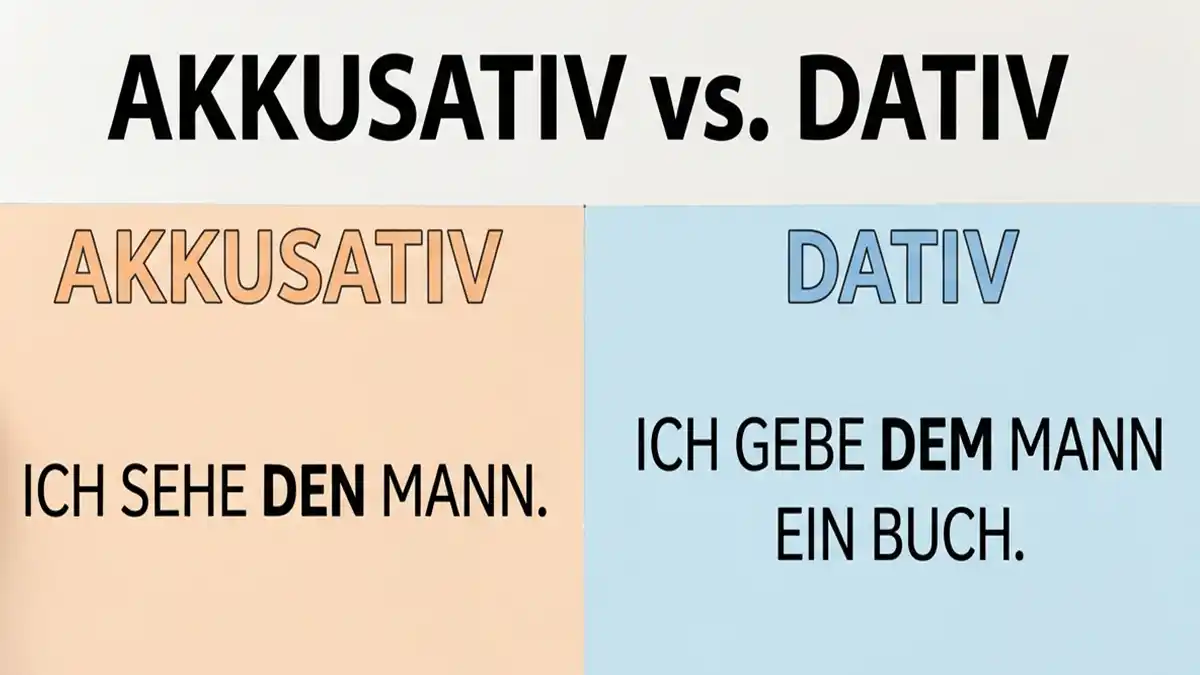
| Example | Ich sehe den Mann. | Ich helfe dem Mann. |
| What changes? | Masculine only (der → den) | Masculine, feminine, neuter and plural |
| Pronouns | mich, dich, ihn, sie, es, uns, euch, sie/Sie | mir, dir, ihm, ihr, ihm, uns, euch, ihnen/Ihnen |
| Prepositions | durch, für, gegen, ohne, um, bis, entlang | aus, bei, mit, nach, seit, von, zu, gegenüber, ab, außer |
| Common verbs | haben, kaufen, sehen, lesen, brauchen, besuchen | helfen, danken, gefallen, gehören, passen, antworten |
First: What Is an Object (Objekt) in a German Sentence?
Almost every German sentence revolves around a subject (Subjekt) that performs an action, and the verb may have one or more objects (Objekt). The subject is always in the Nominativ, and we ask about it with Wer? or Was?. The object appears in the Akkusativ or the Dativ depending on the verb and its role. Here is one sentence that contains all three roles:
| Sentence | Word | Case | Question |
|---|---|---|---|
| Der Lehrer gibt dem Schüler das Buch. | der Lehrer | Nominativ (subject) | Wer? (who?) |
| “The teacher gives the student the book.” | dem Schüler | Dativ (recipient) | Wem? (to whom?) |
| das Buch | Akkusativ (thing given) | Was? (what?) |
To go deeper into the idea of the object itself and how to spot it inside a sentence, start with the basics of the object in German. Understanding the Objekt is the foundation for everything else in this guide.
A rule of thumb that will help you a lot: the Dativ is usually a person who benefits from the action, and the Akkusativ is usually the thing the action is done to. In “I gave the child a ball”, the child is Dativ and the ball is Akkusativ. But this holds “usually”, not “always”: some verbs require the Dativ even for a person who is a direct object in English, as we will see later.
Declension Tables: How Articles and Pronouns Change
The real difference between the two cases shows in the article before the noun and in the pronoun. Start with the definite articles (bestimmter Artikel):
| Case | Masculine (der) | Feminine (die) | Neuter (das) | Plural (die) |
|---|---|---|---|---|
| Nominativ | der | die | das | die |
| Akkusativ | den | die | das | die |
| Dativ | dem | der | dem | den + n |
Next, the indefinite articles and the negation and possessive words (ein / kein / mein), which follow the same pattern:
| Case | Masculine | Feminine | Neuter | Plural |
|---|---|---|---|---|
| Nominativ | ein / mein | eine / meine | ein / mein | keine / meine |
| Akkusativ | einen / meinen | eine / meine | ein / mein | keine / meine |
| Dativ | einem / meinem | einer / meiner | einem / meinem | keinen / meinen + n |
Finally, the personal pronouns, the most used table in everyday speech:
| Nominativ | Akkusativ | Dativ | Example |
|---|---|---|---|
| ich (I) | mich | mir | Er sieht mich. Er hilft mir. |
| du (you) | dich | dir | Ich rufe dich an. Ich danke dir. |
| er (he) | ihn | ihm | Ich kenne ihn. Ich glaube ihm. |
| sie (she) | sie | ihr | Ich besuche sie. Ich antworte ihr. |
| es (it) | es | ihm | Ich sehe es. Ich gebe ihm Wasser. |
| wir (we) | uns | uns | Er fragt uns. Er hilft uns. |
| ihr (you all) | euch | euch | Ich sehe euch. Ich schreibe euch. |
| sie (they) | sie | ihnen | Ich lade sie ein. Ich folge ihnen. |
| Sie (formal you) | Sie | Ihnen | Ich höre Sie. Ich danke Ihnen. |
What do the tables tell us?
- In the Akkusativ only the masculine changes: der → den and ein → einen. Feminine, neuter and plural stay the same as in the Nominativ.
- In the Dativ everything changes: masculine and neuter take dem, feminine takes der, and the plural takes den.
- The Dativ plural adds an extra n: die Kinder → den Kindern, unless the plural already ends in n or s, as in den Frauen and den Autos.
- The pronouns uns and euch are identical in both cases, so you only need to learn one form for each.
- Masculine N-Deklination nouns such as der Student, der Junge, der Kollege and der Mensch take n or en in both the Akkusativ and the Dativ: den Studenten, dem Studenten.
When Do We Use the Akkusativ?
1. The direct object
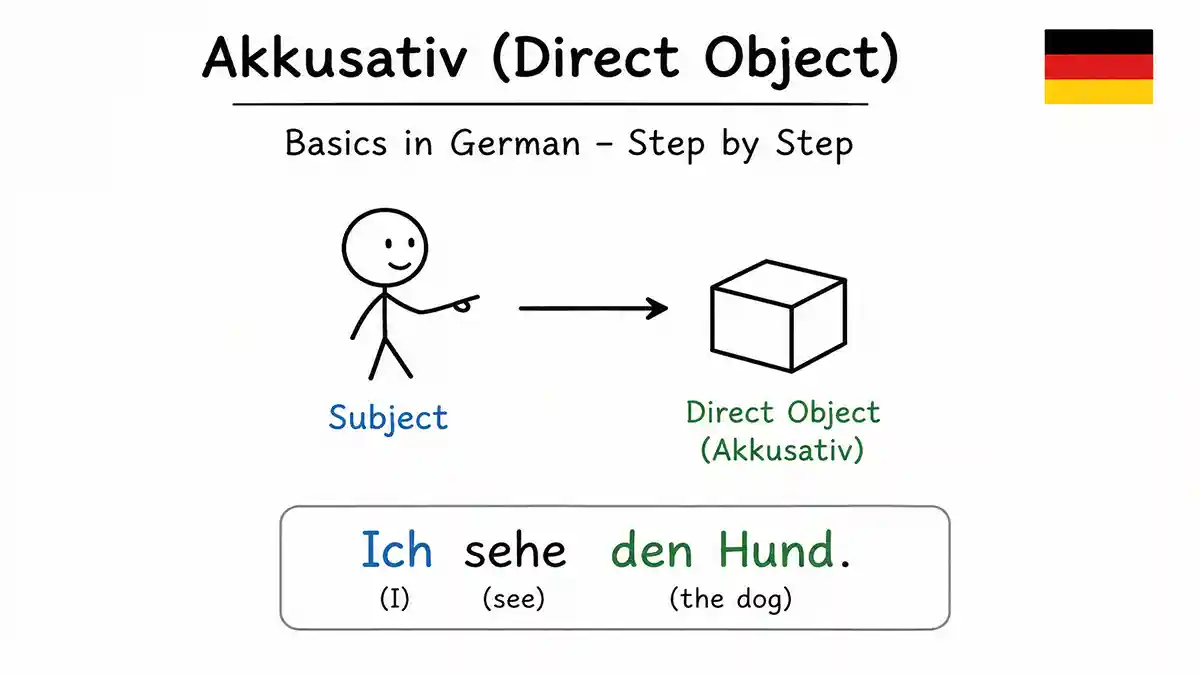
This is the clearest use: the person or thing the verb acts on directly. We ask Wen? for a person and Was? for a thing. In “Ich kaufe einen Apfel” we ask: what do I buy? An apple, so it is Akkusativ.
2. After verbs that take the Akkusativ
Most transitive verbs in German take the Akkusativ, including haben, kaufen, sehen, essen, trinken, lesen, brauchen, besuchen, suchen, finden, nehmen, machen, lieben, mögen, fragen and anrufen. For an organized list with meanings and examples, see the most important Akkusativ verbs and learn each verb with a full example sentence.
3. After certain prepositions
Some prepositions are always followed by the Akkusativ, such as für, durch, gegen, ohne and um. We give them a full section below.
4. Time and distance expressions
Some time expressions take the Akkusativ without a preposition. They answer questions such as “how long?”, “how often?” or “on which day?” in a general sense.
5. The expression Es gibt
After es gibt (there is / there are) we always use the Akkusativ, even though the noun looks like the “subject” of the English sentence.
| Use | German example | Meaning |
|---|---|---|
| Direct object | Ich lese ein Buch. | I am reading a book. |
| Direct object (person) | Sie besucht ihren Freund. | She visits her friend. |
| Verb that takes Akkusativ | Wir brauchen einen Termin. | We need an appointment. |
| Time | Ich lerne jeden Tag Deutsch. | I learn German every day. |
| Time (duration) | Er hat den ganzen Tag gearbeitet. | He worked all day. |
| Es gibt | Es gibt einen Park in der Nähe. | There is a park nearby. |
When Do We Use the Dativ?
1. The indirect object
The Dativ is the recipient or beneficiary: the person something is “given to”, “sent to” or “explained to”. We ask about it with Wem?. In “Ich schenke meiner Mutter Blumen” we ask: to whom do I give flowers? To my mother, so it is Dativ.
2. After verbs that always take the Dativ
Some verbs take only the Dativ and never the Akkusativ, and you should learn them together with their case from the start. The best known are helfen, danken, gefallen, gehören, schmecken, passen, fehlen, antworten, folgen, glauben and gratulieren. We collected a longer list in the most important Dativ verbs, which is worth reviewing twice a week.
| Verb | Meaning | Example |
|---|---|---|
| helfen | to help | Ich helfe meinem Bruder. |
| danken | to thank | Ich danke dir für deine Hilfe. |
| gefallen | to please / to like | Der Film gefällt mir. |
| gehören | to belong to | Das Auto gehört meinem Vater. |
| schmecken | to taste good to | Die Suppe schmeckt mir. |
| passen | to suit / to fit | Die Jacke passt dir. |
| fehlen | to be missing / to miss | Du fehlst mir. |
| antworten | to answer | Ich antworte dem Lehrer. |
| folgen | to follow | Der Hund folgt dem Kind. |
| glauben | to believe (someone) | Ich glaube dir. |
| zuhören | to listen to | Wir hören der Lehrerin zu. |
| gratulieren | to congratulate | Ich gratuliere dir zum Geburtstag. |
3. After certain prepositions
Likewise, some prepositions are always followed by the Dativ, such as mit, bei, nach, von, zu, aus and seit. We will see them in the prepositions table.
4. With certain adjectives and expressions
The Dativ is used with adjectives that describe how a person feels or what they think. The speaker is “affected” by the matter rather than acting directly on it:
| Expression | Meaning |
|---|---|
| Mir ist kalt. | I am cold. |
| Mir ist warm. | I am warm. |
| Es geht mir gut. | I am doing well. |
| Das ist mir wichtig. | That is important to me. |
| Das ist mir egal. | I do not care. |
| Das Kleid ist mir zu groß. | The dress is too big for me. |
5. With body parts and personal purchases (reflexive Dativ)
When a person does something for or to themselves, we use the reflexive Dativ pronoun mir / dir together with an object in the Akkusativ:
| Sentence | Meaning |
|---|---|
| Ich wasche mir die Hände. | I wash my hands. |
| Er putzt sich die Zähne. | He brushes his teeth. |
| Ich kaufe mir ein neues Handy. | I am buying myself a new phone. |
Prepositions: Which Case Does Each One Take?
The fastest way to avoid mistakes is to memorize prepositions together with their case. The first group is prepositions that take the accusative: seven common words that are always followed by the Akkusativ, whatever the meaning of the sentence:
| Preposition | Meaning | Example |
|---|---|---|
| bis | until / up to | Ich arbeite bis nächsten Freitag. |
| durch | through | Wir gehen durch den Park. |
| für | for | Das Geschenk ist für dich. |
| gegen | against / towards | Er spielt gegen den Torwart. |
| ohne | without | Ich trinke Kaffee ohne Zucker. |
| um | around / at (a time) | Wir treffen uns um acht Uhr. |
| entlang | along (after the noun) | Wir gehen den Fluss entlang. |
The second group is prepositions that are always followed by the Dativ. There are more of them, so give them more memorization time:
| Preposition | Meaning | Example |
|---|---|---|
| ab | starting from | Ab nächster Woche lerne ich Deutsch. |
| aus | from (origin) / out of | Ich komme aus Ägypten. |
| außer | except | Alle außer dem Lehrer sind da. |
| bei | at / with (someone) | Ich wohne bei meinen Eltern. |
| gegenüber | opposite | Die Bank ist gegenüber dem Bahnhof. |
| mit | with / by (means of) | Ich fahre mit dem Bus. |
| nach | after / to (a city) | Nach dem Essen gehen wir spazieren. |
| seit | since / for (duration) | Ich lerne seit einem Jahr Deutsch. |
| von | from / of | Das ist ein Geschenk von meiner Freundin. |
| zu | to (a person / place) | Ich gehe zum Arzt. |
Two-Way Prepositions (Wechselpräpositionen): Wo or Wohin?
Nine prepositions do not stick to one case: an, auf, hinter, in, neben, über, unter, vor, zwischen. Unlike the accusative-only prepositions, which never change, the deciding factor here is the question you ask:
- Wohin? (where to?) movement towards a new direction or a change of place → Akkusativ.
- Wo? (where?) a fixed position, or movement within the same place → Dativ.
| Wohin? → Akkusativ | Wo? → Dativ |
|---|---|
| Ich lege das Buch auf den Tisch. I put the book on the table. | Das Buch liegt auf dem Tisch. The book is lying on the table. |
| Er stellt die Flasche in den Kühlschrank. He puts the bottle in the fridge. | Die Flasche steht im Kühlschrank. The bottle is in the fridge. |
| Sie hängt das Bild an die Wand. She hangs the picture on the wall. | Das Bild hängt an der Wand. The picture is hanging on the wall. |
| Ich gehe in die Schule. I go to school. | Ich bin in der Schule. I am at school. |
| Das Kind setzt sich neben die Mutter. The child sits down next to the mother. | Das Kind sitzt neben der Mutter. The child is sitting next to the mother. |
Notice that the verbs themselves help you choose: legen / stellen / setzen / hängen describe putting something somewhere (movement) and take the Akkusativ, while liegen / stehen / sitzen / hängen describe being in a place (stillness) and take the Dativ.
Sentences with Both an Akkusativ and a Dativ
Some verbs take two objects in the same sentence: a Dativ for the person and an Akkusativ for the thing. The best known are geben (to give), schenken (to gift), zeigen (to show), schicken (to send), bringen (to bring), erklären (to explain), empfehlen (to recommend) and leihen (to lend). The verb geben, for example, puts the thing given in the Akkusativ, as you will notice if you compare verbs that take the accusative with Dativ verbs.
The order of the two objects follows a simple rule:
| Situation | Order | Example |
|---|---|---|
| Two nouns | Dativ then Akkusativ | Ich gebe dem Kind den Ball. |
| Dativ pronoun + Akkusativ noun | Dativ pronoun first | Ich gebe ihm den Ball. |
| Dativ noun + Akkusativ pronoun | Akkusativ pronoun first | Ich gebe ihn dem Kind. |
| Two pronouns | Akkusativ then Dativ | Ich gebe ihn ihm. |
The golden rule: a pronoun always comes before a noun, and if both are pronouns, the Akkusativ comes first.
A Five-Step Method to Choose the Right Case
Instead of guessing, follow these steps in order whenever you hesitate between the two cases:
| Step | What to do | Example |
|---|---|---|
| 1. Check the verb | Is it a known Dativ verb (helfen, danken, gefallen…)? If yes, the object is Dativ right away | Ich helfe der Frau. |
| 2. Look for a preposition | If there is a fixed preposition (mit, für…), the preposition decides the case | Ich fahre mit dem Zug. |
| 3. Ask the right question | Wen/Was → Akkusativ, Wem → Dativ | Wem gebe ich das Buch? → dem Schüler |
| 4. If the preposition is two-way | Ask Wo or Wohin: Wohin → Akkusativ, Wo → Dativ | Ich stelle den Stuhl an das Fenster. |
| 5. Pick the form from the table | Identify the gender (masculine / feminine / neuter / plural), then read the article from the table | masculine + Dativ = dem |
If the foundation still feels shaky, go back to how objects and their question words work and then reread these steps. The questions Wer / Wen / Wem are the tool that defines each word’s role.
Common Mistakes Between Akkusativ and Dativ
| Mistake | Correct | Reason |
|---|---|---|
| Ich helfe dich. | Ich helfe dir. | helfen takes the Dativ |
| Ich danke dich. | Ich danke dir. | danken takes the Dativ |
| Ich frage dir. | Ich frage dich. | fragen takes the Akkusativ |
| Ich besuche dem Freund. | Ich besuche den Freund. | besuchen takes the Akkusativ, and masculine becomes den |
| Ich fahre mit den Bus. | Ich fahre mit dem Bus. | mit always takes the Dativ |
| Das ist für dem Kind. | Das ist für das Kind. | für always takes the Akkusativ |
| Ich gehe in der Schule. | Ich gehe in die Schule. | movement towards a destination (Wohin) → Akkusativ |
| Ich spiele mit den Kinder. | Ich spiele mit den Kindern. | the Dativ plural takes an extra n |
Why do learners fall into these mistakes?
English has lost almost all case marking except in pronouns, so verbs like “help” and “thank” look as if they take a plain direct object (“help him”). Compare the English wording with the German verb:
| In English | In German | Case |
|---|---|---|
| help him | Ich helfe ihm. | Dativ |
| thank him | Ich danke ihm. | Dativ |
| answer him | Ich antworte ihm. | Dativ |
| follow him | Ich folge ihm. | Dativ |
| the film pleases me (I like the film) | Der Film gefällt mir. | Dativ for the person |
| ask him | Ich frage ihn. | Akkusativ |
The fix is not guessing but learning the verb together with its case from day one. Start with our list of Dativ verbs because they cause the most trouble, and memorize each verb in a full sentence rather than on its own.
Verbs with similar meanings but different cases
| Dativ | Akkusativ | Note |
|---|---|---|
| Der Film gefällt mir. | Ich mag den Film. | gefallen takes the Dativ but mögen takes the Akkusativ, with similar meaning |
| Ich antworte dir. | Ich frage dich. | answering is Dativ, asking is Akkusativ |
| Ich begegne dir. | Ich besuche dich. | begegnen (to meet by chance) is Dativ, besuchen (to visit) is Akkusativ |
| Ich helfe dir. | Ich unterstütze dich. | helfen is Dativ, unterstützen is Akkusativ |
Quick Exercises with Answers
| # | Sentence | What to fill in |
|---|---|---|
| 1 | Ich sehe ___ Mann. | the right form for der |
| 2 | Ich helfe ___ Frau. | the right form for die |
| 3 | Wir fahren mit ___ Bus. | the right form for der |
| 4 | Das Geschenk ist für ___ Kind. | the right form for das |
| 5 | Ich rufe ___ an. | the pronoun du |
| 6 | Der Film gefällt ___. | the pronoun ich |
| 7 | Sie legt das Buch auf ___ Tisch. | the right form for der |
| 8 | Das Buch liegt auf ___ Tisch. | the right form for der |
| 9 | Er gibt ___ Kindern ein Eis. | the right form for plural die |
| 10 | Ich antworte ___ Lehrer. | the right form for der |
Click to show the answers
Practical Tips to Master the Difference
- Learn the verb with its case: do not learn helfen alone, learn “jemandem helfen”, meaning to help someone (Dativ).
- Learn the noun with its article: der Tisch, not Tisch, because gender decides the form of the article in both cases.
- Start with the masculine: most Akkusativ mistakes happen with masculine nouns, so drill den first.
- Tie each case to a question: make Wen/Was and Wem part of your inner voice while speaking.
- Use colors: mark masculine, feminine and neuter nouns with three fixed colors in your notes.
- Practice full sentences: “Ich helfe dem Mann” is more useful than memorizing “helfen = Dativ” without context.
- Review your mistakes: write down every sentence you got wrong with the correct version beside it, and reread it a few days later.
Conclusion: How to Tell Akkusativ from Dativ
The difference between Akkusativ and Dativ comes down to one sentence: the Akkusativ is who or what the action falls on directly (Wen? Was?), and the Dativ is who benefits from or is affected by the action (Wem?). Three things settle the choice, in this order: the verb first, then the preposition if there is one, then the question. If the preposition is a two-way one, the test is Wo or Wohin.
Do not try to memorize all the tables in one day. Start with the definite article table, then add the common Dativ verbs, then the prepositions, and apply the five steps to every sentence you read or write. Regular repetition is what turns these rules into an automatic habit.
Complete Guide from DeutschPlayLearn German From Scratch for Free: Complete A1 to Advanced GuideStarting your journey and need a clear, free roadmap? Explore proficiency levels from A1 to advanced, along with top methods, resources, and tips to start with confidence.Frequently Asked Questions About Akkusativ vs Dativ
What is the main difference between Akkusativ and Dativ?
How do I know whether a verb takes the Akkusativ or the Dativ?
When do prepositions take the Akkusativ and when the Dativ?
What do Wo and Wohin mean for two-way prepositions?
What is the difference between mich and mir?
Why is an n added to plural nouns in the Dativ?
How do I order the Akkusativ and the Dativ when both are in one sentence?
Why do learners confuse the two cases so often?
What is the best way to practice the difference between Akkusativ and Dativ?
References and Sources
Sources
- Studyflix: Dativ oder Akkusativ? - a video explanation of how to tell the Dativ from the Akkusativ.
- StudySmarter: Akkusativ - the Wem/Wen questions, the Wo and Wohin rule, and example sentences with two objects.
- EasyDeutsch: Der Dativ (PDF) - Dativ uses with verbs, adjectives and prepositions, and the Dativ plural n.
- ÖIF: Wortschatz und Grammatik (PDF) - exercises on mir/mich, the verbs gefallen and helfen, and für + Akkusativ.
- Schule BW: grammar topic list - a classification of prepositions into Dativ, Akkusativ and two-way (Wo? Dativ - Wohin? Akkusativ).