The German Alphabet at a Glance
| Fact | Details |
|---|---|
| Basic letters | 26 letters of the Latin alphabet, the same shapes as English but with different names and sounds |
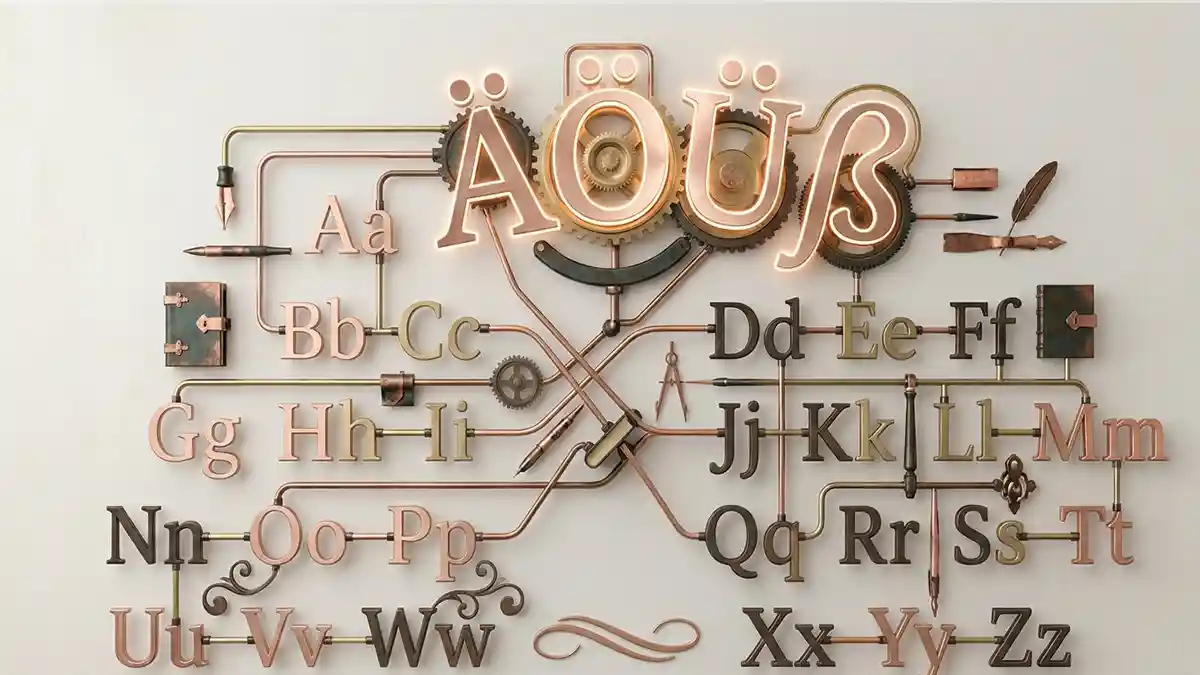
| Special letters | ä, ö, ü (umlauts) and ß (Eszett), giving 30 if you count them as separate letters |
| Capital ẞ | Made official on 29 June 2017, but rarely used; SS is often written in all capitals |
| Regular pronunciation | German is fairly regular: learn a few rules and you can read most new words |
| Where it is used | Germany, Austria, Switzerland, Liechtenstein and Luxembourg, although Switzerland writes ss instead of ß |
| Sounds that need practice | ö, ü, ch and r, plus telling ei from ie and w from v |
The German Alphabet: 26 Letters and 4 Special Letters
Table of the 26 Letters with Examples and Pronunciation
| Letter | German name | Name in IPA | Example and meaning | Pronunciation note |
|---|---|---|---|---|
| A a | ah | /aː/ | Apfel (apple) | long in Name, short in Mann |
| B b | beh | /beː/ | Buch (book) | at the end of a syllable it sounds like p, as in Urlaub |
| C c | tseh | /tseː/ | Computer (computer) | rare on its own; k in foreign words, ts in Cent |
| D d | deh | /deː/ | Danke (thanks) | at the end of a word it sounds like t, as in Hund |
| E e | eh | /eː/ | Leben (life) | long in Leben, short in Bett, a weak schwa at the end of Danke |
| F f | ef | /ɛf/ | Freund (friend) | like English f |
| G g | geh | /ɡeː/ | Gut (good) | hard g as in game; k at the end of a word, as in Tag |
| H h | hah | /haː/ | Haus (house) | pronounced at the start of a syllable, silent after a vowel as in gehen |
| I i | ih | /iː/ | Igel (hedgehog) | short in Insel, long in Igel |
| J j | jot | /jɔt/ | Jahr (year) | sounds like English y in yes, not j |
| K k | kah | /kaː/ | Kind (child) | like k with a light puff of air |
| L l | el | /ɛl/ | Licht (light) | a light l, tongue tip behind the upper teeth |
| M m | em | /ɛm/ | Mutter (mother) | like English m |
| N n | en | /ɛn/ | Nacht (night) | like English n |
| O o | oh | /oː/ | Brot (bread) | long in Brot, short in Sonne |
| P p | peh | /peː/ | Park (park) | like p with a puff of air |
| Q q | kuh | /kuː/ | Quelle (spring (water source)) | always with u and sounds like kv |
| R r | er | /ɛʁ/ | Rot (red) | a throaty r; after a vowel at the end of a word it softens to a short a, as in Vater |
| S s | es | /ɛs/ | Sonne (sun) | z before a vowel, s at the end of a word as in Haus |
| T t | teh | /teː/ | Tisch (table) | like t with a puff of air |
| U u | uh | /uː/ | Uhr (clock, watch) | long in Uhr, short in Mutter |
| V v | fau | /faʊ/ | Vater (father) | usually f as in Vater, v in Vase |
| W w | weh | /veː/ | Wasser (water) | sounds like English v, not w |
| X x | ix | /ɪks/ | Taxi (taxi) | sounds like ks |
| Y y | Ypsilon | /ˈʏpsilɔn/ | Typ (type) | in words of Greek origin it sounds like ü, as in Typ |
| Z z | tset | /tsɛt/ | Zeit (time) | always sounds like ts |
The Special Letters: ä, ö, ü and ß
| Letter | How to say it | Tip | Examples |
|---|---|---|---|
| Ä ä | close to the “e” in bed, sometimes longer | open your mouth a little wider than for a plain e | Äpfel (apples) Käse (cheese) Mädchen (girl) |
| Ö ö | put your tongue in the position for “ay” and round your lips as if saying “oh” | it is neither “o” nor “e”, but a sound in between | schön (beautiful) hören (to hear) Löffel (spoon) |
| Ü ü | tongue in the position for “ee”, lips rounded as for “oo” | say “ee” and slowly round your lips without moving your tongue | Tür (door) müde (tired) über (over) |
| ß | a voiceless s sound (/s/), called Eszett or scharfes S | written after a long vowel or diphthong; after a short vowel write ss | Straße (street) heiß (hot) Fluss (river) |
Umlauts are not a cosmetic detail; they change the meaning. Practise the following pairs, because the ear does not distinguish them at first:
| Word | Meaning | Contrasting word | Meaning |
|---|---|---|---|
| Bar | bar | Bär | bear |
| schon | already | schön | beautiful |
| mochte | liked | möchte | would like |
| Stuhl | chair | Stühle | chairs |
| Ofen | oven | Öfen | ovens |
Umlauts also appear in plurals and many inflections: Mutter → Mütter, Vater → Väter, Buch → Bücher, so learning to pronounce them means you have also learned part of the grammar. As for ß, remember the rule: after a long vowel or diphthong you write ß, after a short one you write ss. Since 29 June 2017 the letter has an officially recognised capital form ẞ, but it is rarely used and SS is usually written in all capitals.
Vowels: When Are They Long and When Short?
| Rule | Example | Sound |
|---|---|---|
| Vowel + one consonant: usually long | Tag (day) | the vowel is stretched: “tahk” |
| Vowel + two consonants: usually short | Mutter (mother) | the vowel is short: “MOO-ter” |
| Doubled vowel (aa, ee, oo): always long | Staat (state) | one long sound, not two |
| h after a vowel lengthens it and is silent | Zahl (number) | “tsahl” with a long a |
| ie: almost always a long ee | Liebe (love) | “LEE-beh” with a long ee |
| Exception: short common words | mit (with) | stay short, like mit, in, an and das |
The best exercise for vowel length is to compare contrasting pairs aloud:
| Vowel | Short | Long |
|---|---|---|
| a | Stadt (city) | Staat (state) |
| i | Mitte (middle) | Miete (rent) |
| o | Sonne (sun) | Sohn (son) |
| u | Mutter (mother) | Uhr (clock) |
Vowel Combinations: ei, ie, eu and au
| Combination | Sound | Examples |
|---|---|---|
| ei | like English “eye” (ai), not “ee” | Eis (ice / ice cream) Zeit (time) mein (my) |
| ie | a long “ee”, not “eye” | Liebe (love) Brief (letter) Tier (animal) |
| eu / äu | like English “oy” in boy | Euro (euro) neu (new) Häuser (houses) |
| au | like English “ow” in cow | Haus (house) Baum (tree) auch (also) |
To remember: ei ends in the “ee” of “eye” and is said “eye”, while ie is one single long i. Do not rely on the order of the two letters the way you would when reading English.
Common Letter Combinations
| Combination | Sound | Examples |
|---|---|---|
| sch | “sh” /ʃ/ | Schule (school) Fisch (fish) |
| ch after a, o, u, au (ach) | a throaty sound like the ch in Scottish “loch” | Buch (book) Nacht (night) auch (also) |
| ch after e, i, ä, ö, ü and after l, n, r (ich) | a soft hissing sound like the h in “huge” | ich (I) Milch (milk) Kirche (church) |
| -chen at the end | always the soft ich sound | Mädchen (girl) Brötchen (bread roll) |
| ck | a short “k” that shortens the vowel before it | Jacke (jacket) backen (to bake) |
| tsch | “ch” as in chair /tʃ/ | Deutsch (German) Tschüss (bye) |
| pf | p and f said together, quickly | Pferd (horse) Apfel (apple) |
| ng / nk | “ng” as in singer, with no g sound; nk adds a k | lang (long) Bank (bank / bench) danke (thanks) |
| ph | “f” | Phase (phase) Philosophie (philosophy) |
| th | “t”, not the English th | Theater (theatre) Thema (topic) |
| chs | “ks” /ks/ | sechs (six) Wachs (wax) |
| tz | “ts” /ts/ | Platz (place / square) Katze (cat) |
| dt | “t” /t/ | Stadt (city) Verwandte (relatives) |
| qu | “kv” /kv/ | Quelle (spring) Qualität (quality) |
| sp / st at the start of a syllable | “shp” and “sht” /ʃp/ /ʃt/ | Sprache (language) Stein (stone) Student (student) |
Rules That Change How Letters Sound
| Rule | Example and sound |
|---|---|
| s before a vowel sounds like z | Sonne (sun) → “ZON-neh” lesen (to read) → “LAY-zen” |
| s at the end of a word, and ss/ß, sound like s | Haus (house) → “hows” Fluss (river) |
| z always sounds like ts | Zeit (time) → “tsite” Zahl (number) |
| w always sounds like English v | Wasser (water) → “VAS-ser” wir (we) |
| v is usually f, and v in foreign words | Vater (father) → “FAH-ter” Vase (vase) → “VAH-zeh” |
| j sounds like English y | Ja (yes) → “yah” Juni (June) |
| final devoicing: b, d, g sound like p, t, k at the end of a syllable | Hand (hand) → “hant” Tag (day) → “tahk” Urlaub (vacation) → “OOR-lowp” |
| r is throaty, and after a vowel at the end of a word it softens to a short a | Rot (red) Vater (father) Lehrer (teacher) |
| unstressed final e is a weak schwa | Danke (thanks) → “DAN-keh” Name (name) |
| -ig at the end is usually said with the soft ich sound in standard German | wichtig (important) richtig (correct) |
Word Stress: Which Syllable Do You Emphasise?
| Rule | Example |
|---|---|
| Native German words: usually stressed on the first syllable | Arbeit (work) Lehrer (teacher) |
| The prefixes be-, ge-, er-, ver-, zer-, ent-, emp- are not stressed | verstehen (to understand) → stress on stehen bekommen (to get) |
| Separable prefixes (an-, auf-, ab-) are stressed | anfangen (to begin) → AN-fangen aufstehen (to get up) |
| Foreign words are often stressed on the last syllable | Student (student) Universität (university) Information (information) |
Spelling Names and Words in German
When someone asks for your name you say the letters with their German names, and if the line is poor you use a spelling table that gives each letter a word. In May 2022 an update of the standard DIN 5009 introduced city names in place of the older personal names (Anton, Berta, Cäsar), and the new table took effect in the June 2022 edition. The old table is still common in daily life, and the words differ in Austria and Switzerland. Here is the new table used in Germany:
| Letter | Word | Letter | Word |
|---|---|---|---|
| A | Aachen | N | Nürnberg |
| B | Berlin | O | Offenbach |
| C | Chemnitz | P | Potsdam |
| D | Düsseldorf | Q | Quickborn |
| E | Essen | R | Rostock |
| F | Frankfurt | S | Salzwedel |
| G | Goslar | T | Tübingen |
| H | Hamburg | U | Unna |
| I | Ingelheim | V | Völklingen |
| J | Jena | W | Wuppertal |
| K | Köln | X | Xanten |
| L | Leipzig | Y | Ypsilon |
| M | München | Z | Zwickau |
| Special letter | Word in the new table |
|---|---|
| Ä | Umlaut Aachen |
| Ö | Umlaut Offenbach |
| Ü | Umlaut Unna |
| ß | Eszett |
And here are useful phrases for asking for or giving a spelling:
| Phrase | Meaning |
|---|---|
| Wie schreibt man das? | How do you spell that? |
| Können Sie das bitte buchstabieren? | Could you please spell that? |
| Wie heißt das auf Deutsch? | What is that called in German? |
Common Mistakes Learners Make
| Common mistake | Correct | Example |
|---|---|---|
| reading ei as “ee” | like “eye” (ai) | Eis (ice) |
| reading ie as “eye” | a long “ee” | Liebe (love) |
| saying w as English w | like English v | Wasser (water) |
| saying z as English z | ts | Zeit (time) |
| saying s before a vowel as s | z | Sonne (sun) |
| saying j as English j | y as in yes | Jahr (year) |
| saying ü as “oo” | ü with rounded lips | Tür (door) |
| saying every ch as k or as in church | depends on the sound before it | ich (I) / Buch (book) |
| saying sp/st as “sp/st” at the start of a syllable | “shp / sht” | Sprache (language) |
| keeping b, d, g voiced at the end of a word | p, t, k | Tag (day) |
Shadowing
Listen to a short sentence and repeat it right after the speaker with the same rhythm, without waiting for the sentence to end. This trains your mouth on the new sounds and on sentence rhythm together.
Record and compare
Record yourself reading the table words, then listen to the original and compare. You do not hear yourself as others do, and a recording reveals mistakes you do not notice.
Use a mirror and your lips
For ö and ü your lips decide the sound, so watch them in a mirror: rounding the lips while the tongue stays in the “ee” position is the secret of these two sounds.
Start with contrasting pairs
Pairs such as schon/schön and Bar/Bär teach your ear that the difference between two sounds changes the meaning, which is the fastest way to lock in the umlauts.
A Seven-Day Plan to Master Basic Pronunciation
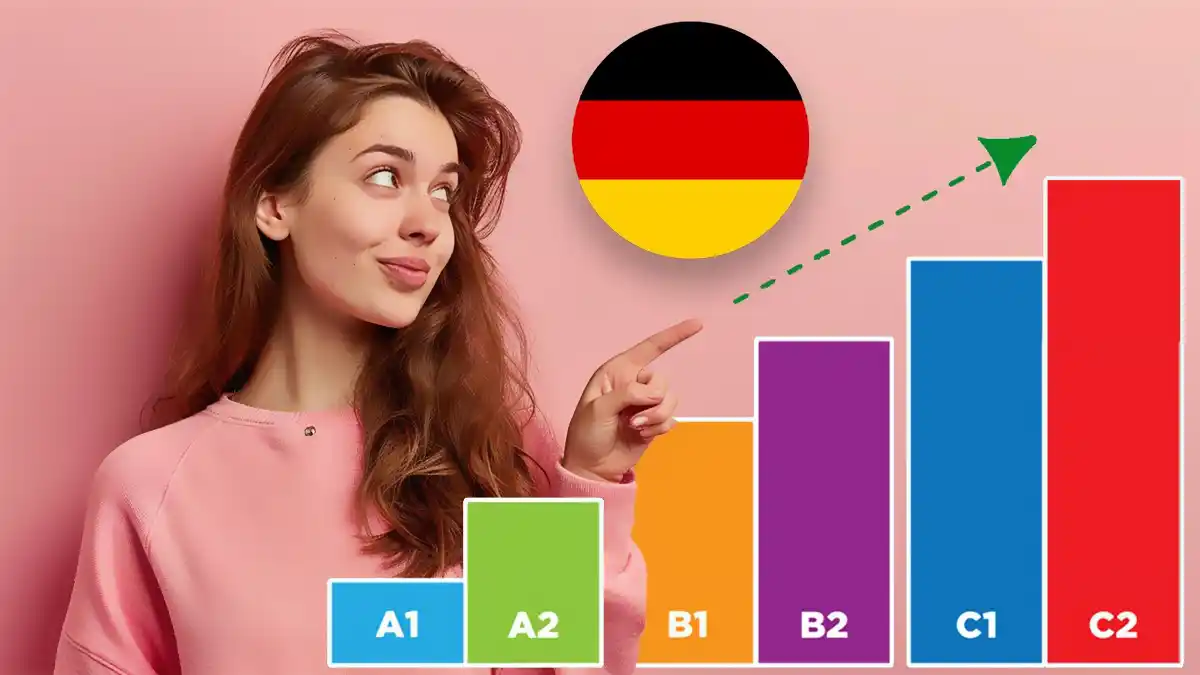
Pronunciation is built by short, daily repetition, not by rare long sessions. This seven-day plan puts you on the right track, and it is a core part of the first steps of level A1. If you want to see where these steps sit among the German language levels, read the full explanation.
| Day | Goal | Suggested exercise |
|---|---|---|
| 1 | The alphabet and letter names | Repeat the 26 letter names three times with the audio, then spell your name and your city |
| 2 | Vowels and umlauts | Practise the pairs Bar/Bär, schon/schön and Stuhl/Stühle in front of a mirror to watch your lips |
| 3 | ei, ie, eu, au, plus sch and ch | Read the table words aloud, record yourself and compare with the audio |
| 4 | The rules for s, z, w, v, j and final devoicing | Write ten words for each rule and say them without looking at the table |
| 5 | Stress and basic words | Apply what you learned to the key words in German, saying each aloud |
| 6 | Names and information | Practise saying countries and nationalities in German, then numbers and time in German |
| 7 | Putting it all together | Learn introducing yourself in German and record a short clip in which you present yourself |
After your first week, move on to full sentences; the ready dialogues in daily conversations and expressions in German let you put your pronunciation to work. Repeat the same dialogue for several days until you can say it smoothly.
German Terms About Letters and Pronunciation
| German term | Meaning |
|---|---|
| das Alphabet | alphabet |
| der Buchstabe | letter |
| der Laut | sound |
| die Aussprache | pronunciation |
| der Vokal | vowel |
| der Konsonant | consonant |
| der Umlaut | umlaut (ä ö ü) |
| die Betonung | stress |
| buchstabieren | to spell |
| lang und kurz | long and short |
Conclusion: How to Start Pronouncing German with Confidence
German pronunciation is regular once you know its keys: thirty letters, umlauts that need lip rounding, combinations such as ei, ie, sch and ch that follow fixed rules, and a simple rule for long and short vowels. Master these foundations in a week or two and the rest of the journey gets much easier, because you will read new words correctly the first time.
Remember that the eye is not enough: listen, repeat, record yourself and start by spelling your own name. Every word you pronounce correctly today saves you a painful correction later.
Complete Guide from DeutschPlayLearn German From Scratch for Free: Complete A1 to Advanced GuideStarting your journey and need a clear, free roadmap? Explore proficiency levels from A1 to advanced, along with top methods, resources, and tips to start with confidence.Frequently Asked Questions About the German Alphabet and Pronunciation
How many letters does the German alphabet have?
Is German pronounced the way it is written?
Which German sounds are hardest for learners?
What is the difference between ei and ie?
When is ch a throaty sound and when is it soft?
What does the letter ß mean and when do I use it?
How do I spell my name in German?
Does pronunciation differ between Germany, Austria and Switzerland?
How long does it take to learn basic pronunciation?
Do I need the International Phonetic Alphabet (IPA)?
References and Sources
Sources
- Wikipedia: German orthography - Explains the special letters, the letter count and the 2017 recognition of ẞ.
- Wikipedia: German alphabet - Letter names, the writing of ß and capital letters.
- Wikipedia: DIN 5009 - The old and new telephone spelling tables.
- Wiktionary: German spelling alphabet - Spelling tables for Germany, Austria and Switzerland.
- Hueber: Miteinander A2 – the new table - A teaching text on the new spelling table since June 2022.