German Word Order at a Glance
Most German learners go wrong not in vocabulary but in word order, because the German sentence follows neither Arabic nor English order. The good news is that sentence structure rests on one idea that repeats: verb position. Once you know where the conjugated verb stands in each type of sentence, the rest falls roughly into place. In this guide we build the full picture from A1 to C2 with tables, examples and exercises, and highlight the mistakes that Arabic speakers make in particular.
| Rule | The idea | Level | Example |
|---|---|---|---|
| 1 | Verb second in statements | A1 | Mein Bruder wohnt in Köln. |
| 2 | Verb first in yes/no questions and commands | A1 | Kommst du heute? |
| 3 | Only one element before the verb (inversion) | A1–A2 | Heute Abend kommt mein Bruder. |
| 4 | The second verb part at the end (the bracket) | A2 | Ich muss morgen früh aufstehen. |
| 5 | Time before place in the middle | A2 | Wir fahren morgen nach Hamburg. |
| 6 | Conjugated verb last in a subordinate clause | B1 | Ich glaube, dass er kommt. |
| 7 | Auxiliary before the infinitives with the modal Perfekt | B2 | ..., weil er hat gehen müssen. |
| 8 | Reported speech with verb second and no dass | C1 | Er sagte, er sei müde. |
The Field Model: A Map of the German Sentence
German grammar books, including the Duden approach and education-ministry resources, use the field model (Feldermodell) to picture the sentence. The conjugated verb and its second part form a bracket (Satzklammer) that divides the sentence into three fields: Vorfeld (before the bracket), Mittelfeld (inside the bracket) and Nachfeld (after the bracket). Once you learn these five slots, you can place any sentence in the table:
| Vorfeld | Left bracket (conjugated verb) | Mittelfeld | Right bracket (second verb part) | Nachfeld |
|---|---|---|---|---|
| Meine Schwester | wohnt | seit Jahren in Köln | — | — |
| Morgen | will | ich früh | aufstehen | — |
| Die Kinder | haben | im Park Fußball | gespielt | — |
| Wir | rufen | dich heute Abend | an | — |
| Sie | hat | mir gestern | erzählt | , dass sie umzieht |
| — (weil) | weil | ich heute früh | aufstehen muss | — |
Notice three things: the left bracket carries the conjugated verb in an independent clause, and carries the conjunction (weil, dass) in a subordinate clause; the right bracket collects the second verb part (infinitive, participle or separable prefix) and is mandatory in a subordinate clause; and the Vorfeld usually holds only one element. Teaching resources note that the Vorfeld stays empty in yes/no questions and in commands.
A1: The Statement and the Verb in Second Position
In an independent statement the conjugated verb always stands in second position, where second means “second element”, not “second word”, because the first element may be one word or several words doing one job. The simplest structure: subject, then verb, then the rest of the sentence.
| First element | Verb (second) | The rest | Meaning |
|---|---|---|---|
| Ich | lerne | jeden Abend Deutsch. | I learn German every evening. |
| Mein Vater | arbeitet | in einem Krankenhaus. | My father works in a hospital. |
| Der neue Kollege aus Syrien | spricht | schon gut Deutsch. | The new colleague from Syria already speaks good German. |
Look at the third example: the first element “Der neue Kollege aus Syrien” is five words, but it is one element (the subject), so the verb comes right after it. This rule means a German sentence does not accept “Mein Vater in einem Krankenhaus arbeitet”.
A1: Questions and Commands
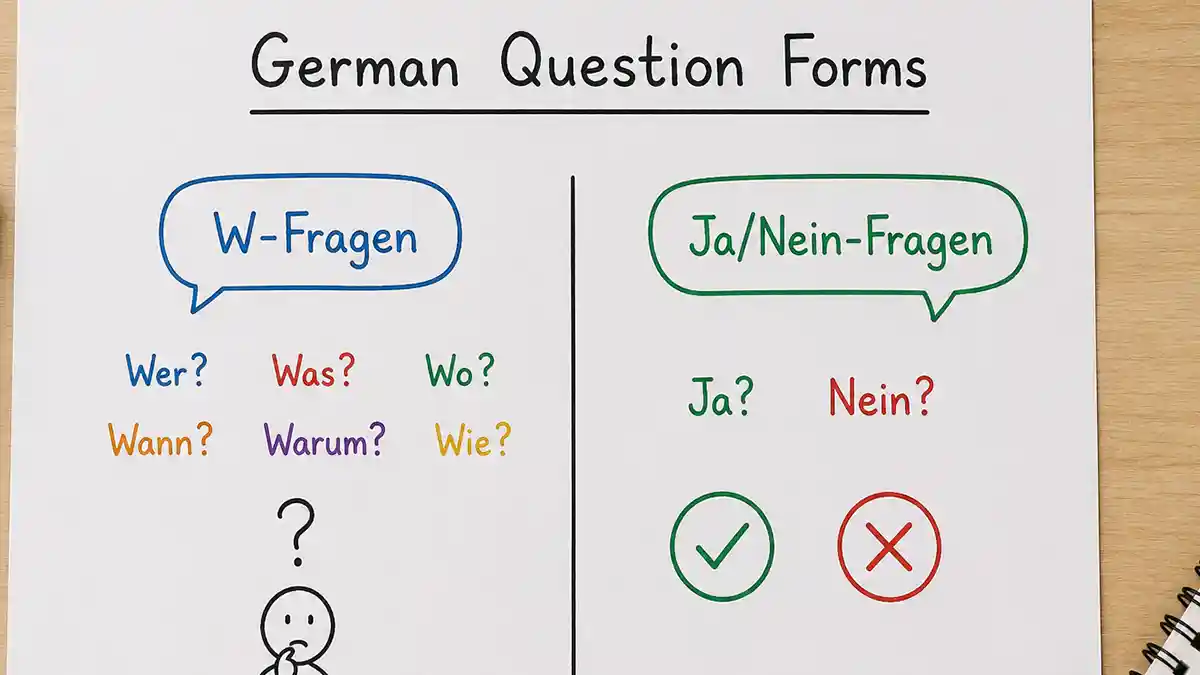
There are three forms: a question with a question word (verb second after it), a yes/no question (verb first), and a command (verb first). For question words and their meanings, review how to form questions in German.
| Type | Structure | Example |
|---|---|---|
| Question word | Word + verb + subject | Wann beginnt der Kurs? |
| Yes/no question | Verb + subject + ... | Hast du heute Zeit? |
| Command | Verb + ... | Mach bitte das Fenster zu! |
| Indirect question (studied at B1) | Main clause + ob/question word + verb at the end | Ich frage mich, wann der Kurs beginnt. |
A1–A2: Inversion and Changing the Starting Point
German lets you put any element you want to emphasize in the first position: a time, a place, an object or a reason. When you do so, the verb stays second and the subject moves after it. This is not a new rule but the direct result of the verb-second rule.
| Normal order | After inversion | What we emphasized |
|---|---|---|
| Wir treffen uns am Freitag im Café. | Am Freitag treffen wir uns im Café. | The time |
| Ich verstehe diese Regel nicht. | Diese Regel verstehe ich nicht. | The object |
| Die Prüfung war leider sehr schwer. | Leider war die Prüfung sehr schwer. | The speaker’s attitude |
| Er hat das Buch nie gelesen. | Gelesen hat er das Buch nie. | The verb itself (style) |
A2: The Verb Bracket (Satzklammer): Auxiliary, Infinitive and Prefix
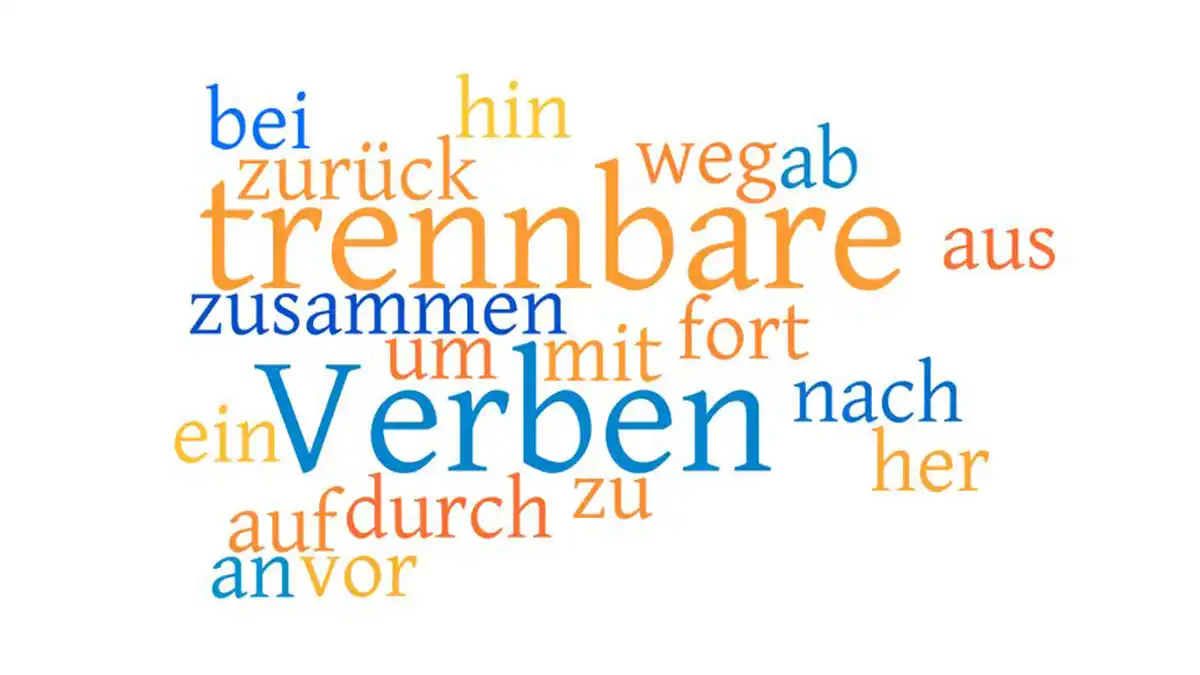
When the verb has two parts, the conjugated part stays in second position and the other part goes to the end of the sentence. This applies to modal verbs, compound tenses and separable verbs. For separable verbs in detail, review separable verbs in German.
| Case | Part 1 (second) | Part 2 (at the end) | Example |
|---|---|---|---|
| Modal verb | kann / muss / will | infinitive | Ich muss heute früh nach Hause gehen. |
| Perfekt | habe / ist | participle | Wir haben gestern lange gearbeitet. |
| Futur | werde / wirst | infinitive | Er wird nächste Woche kommen. |
| Separable verb | stem | prefix | Der Zug fährt um acht Uhr ab. |
| Passive | wird / wurde | participle | Das Paket wird morgen geliefert. |
| Konjunktiv II | würde | infinitive | Ich würde dir gern helfen. |
The Mittelfeld between the two parts can hold any number of elements, which is why verb parts sometimes drift far apart in long sentences. German teachers advise keeping sentences short at first so the second verb part does not get “lost”.
A2: The Order of Elements Inside the Mittelfeld
The order of the Mittelfeld is more flexible than the second-position rule, but it has strong habits governed by practical rules. The first thing you need is to know the words’ functions, so review the basics of the object in German.
| Rule | Explanation | Example |
|---|---|---|
| Pronoun before noun | A pronoun comes before a noun | Ich gebe es dem Lehrer. |
| Two pronouns: Akkusativ then Dativ | The direct-object pronoun first | Ich gebe es ihm. |
| Two nouns: Dativ then Akkusativ | Usually the person before the thing | Ich gebe dem Lehrer das Heft. |
| Known before new | What you want to stress tends to sit late in the middle | Ich habe gestern meinen Chef angerufen. |
| The reflexive sich | Comes close after the verb or subject | Er hat sich gestern gut erholt. |
The cases of the nouns depend on the verb itself, so if you hesitate between Akkusativ and Dativ, review the difference between Akkusativ and Dativ.
The Order of Adverbials: Time, Reason, Manner, Place
| Order | Question | Example |
|---|---|---|
| 1. Time (temporal) | Wann? | gestern |
| 2. Reason (kausal) | Warum? | wegen des Regens |
| 3. Manner (modal) | Wie? | mit dem Bus |
| 4. Place (lokal) | Wo? / Wohin? | nach Hause |
| Sentence |
|---|
| Er ist gestern wegen des Regens mit dem Bus nach Hause gefahren. |
This rule is known by the acronym TeKaMoLo, and it is a general guide, not a strict law. If there is special emphasis you may break it, but it holds in most everyday sentences.
A2: Negation: nicht, kein and Their Position
We have two negators: kein for an indefinite noun (or one without an article) and nicht for everything else. Nicht’s position follows this rule: if you negate the whole sentence, put it near the end, before the second verb part, adjective or place phrase; if you negate one specific word, put it before that word.
| Case | Example | Meaning |
|---|---|---|
| Whole sentence (end) | Ich kenne ihn nicht. | I do not know him. |
| Before the second verb part | Ich kann heute nicht kommen. | I cannot come today. |
| Before an adjective | Der Film ist nicht gut. | The film is not good. |
| Before a place phrase | Er wohnt nicht in Berlin. | He does not live in Berlin. |
| One specific word | Wir treffen uns nicht heute, sondern morgen. | We meet tomorrow, not today. |
| kein with an indefinite noun | Ich habe keinen Hunger. | I am not hungry. |
A2: Coordinating Conjunctions: Position Zero
The conjunctions und, aber, oder, denn and sondern (which teachers sum up in the acronym ADUSO) stand in what some grammarians call “position zero”, that is, before the Vorfeld, so they do not occupy a place in the sentence and the verb stays second after them as usual.
| Conjunction | Meaning | Example |
|---|---|---|
| und | and | Ich koche, und mein Bruder wäscht ab. |
| aber | but | Es ist kalt, aber die Sonne scheint. |
| oder | or | Gehen wir ins Kino, oder bleiben wir hier? |
| denn | because (coordinating) | Ich bleibe zu Hause, denn ich habe Fieber. |
| sondern | but rather (after negation) | Er trinkt keinen Tee, sondern Kaffee. |
B1: Subordinate Clauses and the Verb at the End
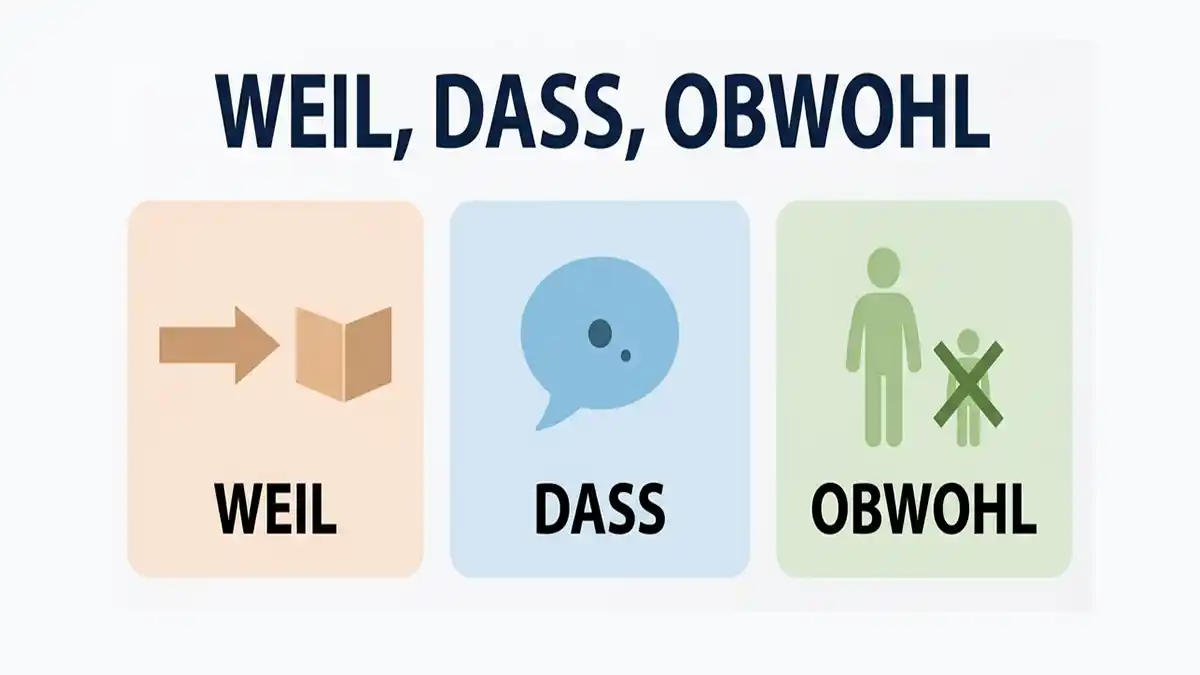
A subordinate clause starts with a subordinating conjunction (Subjunktion) such as weil, dass, wenn or obwohl, and the conjugated verb goes to its end. A comma is written before it. In the field model the conjunction occupies the left bracket and the verb gathers with its parts in the right bracket. To tell the three best-known connectors apart, review the difference between Weil, Dass and Obwohl, and for the temporal ones review the difference between Wann, Wenn and Als.
| Conjunction | Meaning | Example |
|---|---|---|
| weil / da | because | Ich nehme einen Schirm mit, weil es regnen könnte. |
| dass | that | Mein Lehrer sagt, dass ich viel Fortschritt mache. |
| ob | whether | Ich weiß nicht, ob der Laden schon geöffnet hat. |
| wenn / falls | if | Wenn du Hilfe brauchst, ruf mich an. |
| als | when (once in the past) | Als ich klein war, spielte ich viel draußen. |
| obwohl | although | Sie geht joggen, obwohl sie erkältet ist. |
| damit | so that | Ich schreibe es auf, damit ich es nicht vergesse. |
| bevor / nachdem | before / after | Nachdem er gegessen hatte, räumte er auf. |
| während / bis / seit(dem) | while / until / since | Ich warte, bis du fertig bist. |
| indem / sodass | by (means) / so that (result) | Er lernt Wörter, indem er viel liest. |
When You Start with the Subordinate Clause
If you start with the subordinate clause, it is the whole first element of the sentence, so the verb of the main clause comes directly after the comma. Two verbs then meet side by side, one at the end of the subordinate clause and one at the start of the main clause.
| Subordinate clause last | Subordinate clause first |
|---|---|
| Ich bleibe heute zu Hause, weil ich Kopfschmerzen habe. | Weil ich Kopfschmerzen habe, bleibe ich heute zu Hause. |
| Wir fahren los, sobald es hell wird. | Sobald es hell wird, fahren wir los. |
Multiple Verb Parts in a Subordinate Clause
At the end of a subordinate clause the verb parts gather, and the conjugated verb is usually the last. These are examples in order of difficulty:
| Pattern | Example |
|---|---|
| Simple verb | ..., weil er müde ist. |
| Perfekt | ..., weil er den ganzen Tag gearbeitet hat. |
| Modal verb | ..., dass sie morgen kommen kann. |
| Passive | ..., dass die Straße gesperrt worden ist. |
| Separable verb | ..., wenn der Zug ankommt. |
| Konjunktiv II | ..., dass ich dir gern helfen würde. |
B1: Relative Clauses and Indirect Questions
The relative clause and the indirect question are subordinate clauses, so the verb goes to the end in both. For the relative pronouns and their cases, review relative clauses in German (Relativsätze).
| Type | Example | Note |
|---|---|---|
| Relative clause | Das ist die Frau, die ich gestern getroffen habe. | Verb at the end and a comma before it |
| Relative clause in the middle | Der Mann, der dort steht, ist mein Nachbar. | Surrounded by two commas |
| Indirect question (ob) | Er fragt, ob du morgen Zeit hast. | For yes/no questions |
| Indirect question (question word) | Sie möchte wissen, wo du arbeitest. | The question word acts as the connector |
B1: Connecting Adverbs and Sentence Adverbs
Words such as deshalb, trotzdem, dann and außerdem are adverbs that occupy the Vorfeld (first element), so the verb comes directly after them (inversion). The key difference from subordinating conjunctions is that the verb does not go to the end. Sentence adverbs such as leider, vielleicht and hoffentlich express the speaker’s attitude, and stand at the start of the sentence (so the verb follows) or right after the verb.
| Type | Example | Verb position |
|---|---|---|
| Connecting adverb | Es regnet. Deshalb bleiben wir drinnen. | Right after the adverb |
| Connecting adverb | Ich war krank. Trotzdem bin ich gekommen. | Right after the adverb |
| Sentence adverb first | Leider habe ich keine Zeit. | Right after the adverb |
| Sentence adverb after the verb | Ich habe leider keine Zeit. | Second as usual |
B1–B2: Infinitive Clauses with zu: um...zu and ohne...zu
An infinitive clause has no subject and no conjugated verb; it ends with an infinitive preceded by zu, and is usually set off by a comma. If the verb is separable, zu goes between the prefix and the stem and the word is written as one.
| Pattern | Example | Meaning |
|---|---|---|
| um ... zu | Ich lerne Deutsch, um in Deutschland zu arbeiten. | I learn German in order to work in Germany. |
| ohne ... zu | Er ging weg, ohne sich zu verabschieden. | He left without saying goodbye. |
| (an)statt ... zu | Sie sah fern, anstatt zu lernen. | She watched TV instead of studying. |
| zu with a separable verb | Es ist wichtig, früh aufzustehen. | It is important to get up early. |
| After a verb | Ich habe vergessen, dich anzurufen. | I forgot to call you. |
B2: Difficult Verb Complexes
At B2 you deal with sentences that have more than one verb part at the end. With the modal verbs in the Perfekt we use the “double infinitive” (Doppelinfinitiv), and in a subordinate clause the auxiliary haben moves ahead of the two infinitives instead of coming last. This is a case where even advanced learners slip.
| Pattern | Main clause | Subordinate clause |
|---|---|---|
| Modal Perfekt | Er hat gestern arbeiten müssen. | ..., weil er gestern hat arbeiten müssen. |
| Perfekt with sehen / hören | Ich habe ihn kommen sehen. | ..., dass ich ihn habe kommen sehen. |
| Passive + Perfekt | Das Haus ist gebaut worden. | ..., dass das Haus gebaut worden ist. |
In everyday speech Germans avoid these constructions by switching to the Präteritum of the modal: “weil er arbeiten musste”, which is easier and more common.
C1–C2: Style, Variation and Long Sentences
At the highest levels the rules do not change, but you learn stylistic control: when to front an element for emphasis, when to move a part to the Nachfeld to lighten a sentence, and when to use constructions of refined writing.
| Phenomenon | Example | The idea |
|---|---|---|
| Reported speech without dass | Sie sagte, sie habe keine Zeit. | Verb second in Konjunktiv I |
| je ... desto | Je mehr du liest, desto besser schreibst du. | Verb at the end after je, second after desto |
| A condition without wenn | Hätte ich Zeit, würde ich kommen. | The verb first replaces wenn |
| Stylistic fronting | Kennengelernt habe ich ihn vor Jahren. | The participle in the Vorfeld for emphasis |
| The extended attribute | der seit Jahren in Berlin lebende Autor | A compressed relative clause before the noun (C2) |
| A clause in the Nachfeld | Wir haben ein Haus gekauft, das einen Garten hat. | Lightens a long bracket |
When writing long sentences, follow this method: set the main clause first, then add subordinate clauses one by one, checking each one’s verb position and comma. If it looks complicated, split the sentence in two, since clarity matters more than length.
Why Do Arabic Speakers Struggle with Word Order?
| In Arabic | In German | The expected mistake |
|---|---|---|
| Verbal sentence: verb first (“ذهب الولد إلى المدرسة”) | Verb second after one element | Der Junge geht in die Schule. |
| A nominal sentence with no “to be” (“أنا طالب”) | A verb is required: sein | Ich bin Student. |
| The clause after «لأن» keeps its order | Verb to the end after weil | ..., weil ich müde bin. |
| The adjective after the noun (“بيت كبير”) | The adjective before the noun | ein großes Haus |
| Negation with «لا» and «ليس» before the verb | nicht usually after the verb | Ich verstehe nicht. |
| The subject may come after the verb | The subject follows the verb only with inversion | Heute lerne ich Deutsch. |
Common Word Order Mistakes
| Mistake | Correct | Reason |
|---|---|---|
| Ich gestern bin ins Kino gegangen. | Gestern bin ich ins Kino gegangen. | only one element before the verb |
| Mein Freund ein Auto hat. | Mein Freund hat ein Auto. | conjugated verb second |
| Du sprichst Deutsch? | Sprichst du Deutsch? | a yes/no question starts with the verb |
| ..., weil ich bin krank. | ..., weil ich krank bin. | verb at the end of the subordinate clause |
| Weil es regnet, ich bleibe hier. | Weil es regnet, bleibe ich hier. | inversion after the subordinate clause |
| Ich fahre im Garten heute. | Ich arbeite heute im Garten. | time before place |
| Ich habe nicht Geld. | Ich habe kein Geld. | kein with an indefinite noun |
| Ich rufe an dich. | Ich rufe dich an. | the separable prefix at the end |
| Deshalb ich bleibe zu Hause. | Deshalb bleibe ich zu Hause. | the adverb takes first position so the verb follows |
| Ich gebe dem Kind es. | Ich gebe es dem Kind. | pronoun before noun |
Exercises with Answers: Put the Words in Order
| # | Scrambled words | Level |
|---|---|---|
| 1 | Deutsch / ich / lerne / jeden Tag | A1 |
| 2 | du / heute / Zeit / hast / ? | A1 |
| 3 | am Wochenende / besucht / uns / meine Tante | A2 |
| 4 | will / morgen / ich / früh / aufstehen | A2 |
| 5 | ich / kein / Hunger / habe | A2 |
| 6 | Ich bleibe zu Hause, / müde / ich / weil / bin | B1 |
| 7 | Wenn / Zeit / ich / habe, / rufe / dich / ich / an | B1 |
| 8 | Es ist wichtig, / früh / aufzustehen | B1 |
| 9 | ..., dass / sie / hat / gehen / müssen | B2 |
| 10 | mehr / du / liest, / besser / schreibst / desto / du / Je | C1 |
Click to show the answers
A Six-Step Checklist for Any Sentence
| Step | Question | Action |
|---|---|---|
| 1 | What type of sentence is it? | Statement? Question? Command? Subordinate? |
| 2 | Where is the conjugated verb? | Second / first / last by type |
| 3 | Does the verb have a second part? | Put it at the end of the bracket |
| 4 | What is in the middle? | Pronoun before noun, then time, reason, manner, place |
| 5 | Am I negating? | kein for indefinites, nicht near the end or before the negated word |
| 6 | Are the commas right? | A comma before every subordinate and relative clause |
A Plan to Learn Word Order by Level
Do not try to learn everything at once. To identify your real level, review the German language levels from A1 to C2.
| Level | Goal | Daily practice (15 minutes) |
|---|---|---|
| A1 | Verb second and the yes/no question | Write 5 sentences about your day and turn each into a question |
| A2 | The bracket, the middle and negation | Write 5 modal sentences then convert them to the Perfekt |
| B1 | Subordinate and relative clauses | Join two sentences with weil, dass or wenn every day |
| B2 | Long verb complexes | Read a paragraph and mark every verb and its position |
| C1–C2 | Style and variation | Rewrite a paragraph in three different fronting variants |
For smart practice you can ask ChatGPT for scrambled sentences at your level and let it correct you, and you will find the method in our guide on learning German with ChatGPT.
Conclusion: How to Master Word Order
The German sentence revolves around verb position: second in a statement, first in a yes/no question and a command, and last in a subordinate clause. Then come the verb bracket for verb parts, the order of the middle (pronoun before noun, time before place), and the position of negation. Style follows at the higher levels.
Remember that practising full sentences daily is more useful than memorizing rules in isolation, and that mistakes in order are a natural part of learning.
Complete Guide from DeutschPlayLearn German From Scratch for Free: Complete A1 to Advanced GuideStarting your journey and need a clear, free roadmap? Explore proficiency levels from A1 to advanced, along with top methods, resources, and tips to start with confidence.Frequently Asked Questions About German Word Order
What is the basic rule of German word order?
What do Vorfeld, Mittelfeld and Nachfeld mean?
Why does the verb come at the end of a subordinate clause?
What is the difference between weil and denn in word order?
What does TeKaMoLo mean?
Where do I put nicht in a sentence?
When do I use kein instead of nicht?
How do I avoid carrying Arabic order into German?
Can word order change in a German sentence?
How do I practise word order?
References and Sources
Sources
- Landesbildungsserver Baden-Württemberg: Feldermodell (PDF) - Official teaching material on Satzklammer, Vorfeld, Mittelfeld and Nachfeld, referring to Duden: Die Grammatik.
- MIKA-D: Linguistische Grundlagen, Verbstellung (PDF) - An official Austrian teaching reference on verb position and inversion.
- University of Osijek: Wortstellung (PDF) - University material: position zero for coordinating conjunctions and the order of the middle field.
- Masaryk University: Nebensätze (PDF) - University material on the bracket and fields in subordinate clauses.
- University of Bern, Linguistik online: Der Erwerb von Verbzweitsätzen (PDF) - An academic study on the acquisition of verb-second sentences.
- Humboldt-Universität zu Berlin: Komplexe Prädikate (Stefan Müller, PDF) - University slides on the left and right brackets and complex predicates.
- University of Gothenburg: Satztypen V1, V2, VL (PDF) - A university study on sentence types by verb position.
- Olesen Tuition: German Word Order Explained - The reference article we drew coverage ideas from; we wrote our own text, examples and structure.