Before You Start: How Plurals Work with German Body Parts
Body-part nouns form their plurals in different ways, so we memorize word + article + plural together. These are the most common patterns:
| Pattern | Examples | Note |
|---|---|---|
| add -e, with or without an umlaut |
der Kopf → die Köpfe
die Hand → die Hände der Arm → die Arme |
many masculine nouns; some take an umlaut (ä, ö, ü) |
| add -n or -en |
die Nase → die Nasen
das Auge → die Augen das Ohr → die Ohren |
most feminine nouns ending in -e and some neuter nouns |
| no change |
der Finger → die Finger
der Daumen → die Daumen das Knie → die Knie |
often nouns ending in -er, -en or -el; the plural shows only in the article die |
| add -er, with an umlaut |
das Gesicht → die Gesichter
das Glied → die Glieder |
some neuter nouns |
| add -n after -el or -er |
die Schulter → die Schultern
der Muskel → die Muskeln |
feminine and some masculine nouns |
Head and Face in German (Kopf und Gesicht)
| German | Article | Plural | English | Approximate pronunciation |
|---|---|---|---|---|
| Kopf | der | die Köpfe | head | KOPF |
| Gesicht | das | die Gesichter | face | guh-ZIKHT |
| Haar | das | die Haare | hair | hahr |
| Stirn | die | die Stirnen | forehead | shtirn |
| Auge | das | die Augen | eye | OW-guh |
| Augenbraue | die | die Augenbrauen | eyebrow | OW-gen-brow-uh |
| Wimper | die | die Wimpern | eyelash | VIM-per |
| Ohr | das | die Ohren | ear | ohr |
| Nase | die | die Nasen | nose | NAH-zuh |
| Mund | der | die Münder | mouth | moont |
| Lippe | die | die Lippen | lip | LIP-uh |
| Zahn | der | die Zähne | tooth | tsahn |
| Zunge | die | die Zungen | tongue | TSOONG-uh |
| Wange | die | die Wangen | cheek | VAHNG-uh |
| Kinn | das | die Kinne | chin (plural is rare) | kin |
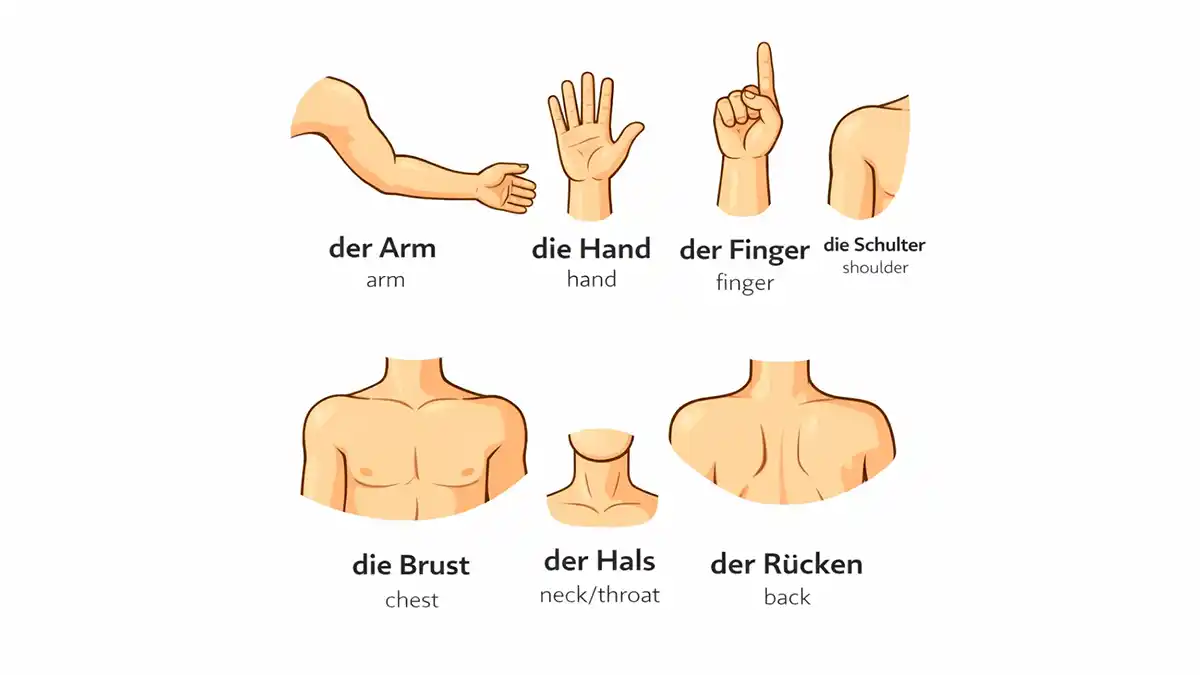
| Hals | der | die Hälse | neck / throat | hahls |
| Bart | der | die Bärte | beard | bahrt |
The Torso in German (Rumpf)
| German | Article | Plural | English | Approximate pronunciation |
|---|---|---|---|---|
| Körper | der | die Körper | body | KÖR-per |
| Rücken | der | die Rücken | back | RÜK-en |
| Brust | die | die Brüste | chest (usually used in the singular) | broost |
| Bauch | der | die Bäuche | belly / stomach | bowkh |
| Schulter | die | die Schultern | shoulder | SHOOL-ter |
| Nacken | der | die Nacken | back of the neck | NAHK-en |
| Taille | die | die Taillen | waist | TAHL-yuh |
| Hüfte | die | die Hüften | hip | HÜF-tuh |
Arms, Hands and Fingers in German
| German | Article | Plural | English | Approximate pronunciation |
|---|---|---|---|---|
| Arm | der | die Arme | arm | ahrm |
| Ellbogen | der | die Ellbogen | elbow | EL-boh-gen |
| Handgelenk | das | die Handgelenke | wrist | HAHNT-guh-lenk |
| Hand | die | die Hände | hand | hahnt |
| Handfläche | die | die Handflächen | palm | HAHNT-flekh-uh |
| Finger | der | die Finger | finger | FING-er |
| Daumen | der | die Daumen | thumb | DOW-men |
| Zeigefinger | der | die Zeigefinger | index finger | TSY-guh-fing-er |
| Mittelfinger | der | die Mittelfinger | middle finger | MIT-el-fing-er |
| Ringfinger | der | die Ringfinger | ring finger | RING-fing-er |
| kleiner Finger | der | die kleinen Finger | little finger | KLY-ner FING-er |
| Fingernagel | der | die Fingernägel | fingernail | FING-er-nah-gel |
Note the use of linke Hand (left hand) and rechte Hand (right hand). To go further with links and rechts and the other direction words, see our lesson on directions in German.
Legs and Feet in German
| German | Article | Plural | English | Approximate pronunciation |
|---|---|---|---|---|
| Bein | das | die Beine | leg | byne |
| Oberschenkel | der | die Oberschenkel | thigh | OH-ber-shen-kel |
| Knie | das | die Knie | knee | KNEE |
| Unterschenkel | der | die Unterschenkel | lower leg | OON-ter-shen-kel |
| Wade | die | die Waden | calf | VAH-duh |
| Knöchel | der | die Knöchel | ankle | KNÖKH-el |
| Fuß | der | die Füße | foot | foos |
| Ferse | die | die Fersen | heel | FAIR-zuh |
| Fußsohle | die | die Fußsohlen | sole of the foot | FOOS-zoh-luh |
| Zeh / Zehe | der / die | die Zehen | toe | TSAY |
| Zehennagel | der | die Zehennägel | toenail | TSAY-en-nah-gel |
Internal Organs in German (Innere Organe)
| German | Article | Plural | English | Approximate pronunciation |
|---|---|---|---|---|
| Herz | das | die Herzen | heart | hairts |
| Lunge | die | die Lungen | lung | LOONG-uh |
| Leber | die | die Lebern | liver | LAY-ber |
| Niere | die | die Nieren | kidney | NEE-ruh |
| Magen | der | die Mägen | stomach | MAH-gen |
| Darm | der | die Därme | intestine | dahrm |
| Gehirn | das | die Gehirne | brain | guh-HIRN |
| Milz | die | die Milzen | spleen | milts |
| Gallenblase | die | die Gallenblasen | gallbladder | GAHL-en-blah-zuh |
| Bauchspeicheldrüse | die | die Bauchspeicheldrüsen | pancreas | BOWKH-shpy-khel-drü-zuh |
| Schilddrüse | die | die Schilddrüsen | thyroid gland | SHILT-drü-zuh |
| Blase | die | die Blasen | bladder | BLAH-zuh |
| Speiseröhre | die | die Speiseröhren | esophagus | SHPY-zuh-rö-ruh |
| Luftröhre | die | die Luftröhren | windpipe / trachea | LOOFT-rö-ruh |
This vocabulary is the foundation of the language used in hospitals and clinics, and it is part of our German medical vocabulary guide, which also explains the requirements and paperwork for working in the German healthcare sector.
Skeleton, muscles and vessels
| German | Article | Plural | English | Approximate pronunciation |
|---|---|---|---|---|
| Skelett | das | die Skelette | skeleton | skeh-LET |
| Knochen | der | die Knochen | bone | KNOKH-en |
| Schädel | der | die Schädel | skull | SHAY-del |
| Wirbelsäule | die | die Wirbelsäulen | spine | VIR-bel-zoy-luh |
| Rippe | die | die Rippen | rib | RIP-uh |
| Gelenk | das | die Gelenke | joint | guh-LENK |
| Muskel | der | die Muskeln | muscle | MOOS-kel |
| Sehne | die | die Sehnen | tendon | ZAY-nuh |
| Nerv | der | die Nerven | nerve | nairf |
| Ader | die | die Adern | vein / blood vessel | AH-der |
| Vene | die | die Venen | vein | VAY-nuh |
| Arterie | die | die Arterien | artery | ar-TAY-ree-uh |
| Haut | die | die Häute | skin | howt |
Das Blut (blood) has no common plural in everyday use.
The Five Senses in German (Die fünf Sinne)
| Organ | Verb | Sentence | Meaning |
|---|---|---|---|
| das Auge | sehen | Ich sehe mit den Augen. | I see with my eyes. |
| das Ohr | hören | Ich höre mit den Ohren. | I hear with my ears. |
| die Nase | riechen | Ich rieche mit der Nase. | I smell with my nose. |
| die Zunge | schmecken | Ich schmecke mit der Zunge. | I taste with my tongue. |
| die Haut | fühlen / tasten | Ich fühle mit der Haut. | I feel with my skin. |
Common verbs with body parts
| German verb | Meaning | Example |
|---|---|---|
| nicken | to nod | Er nickt mit dem Kopf. |
| den Kopf schütteln | to shake one’s head | Sie schüttelt den Kopf. |
| winken | to wave | Das Kind winkt mit der Hand. |
| zeigen | to point | Er zeigt mit dem Finger auf das Haus. |
| lächeln | to smile | Sie lächelt mich an. |
| atmen | to breathe | Atmen Sie tief ein und aus! |
| schlucken | to swallow | Ich kann nicht schlucken. |
| berühren | to touch | Bitte nicht berühren! |
| sich waschen | to wash oneself | Ich wasche mir die Hände. |
| sich kämmen | to comb one’s hair | Er kämmt sich die Haare. |
Key Rule: mir and dir with Body Parts
When talking about your own body parts, German usually uses the definite article instead of a possessive, and adds a pronoun in the dative case (mir, dir, sich) to show whose body part it is:
| Sentence in German | Meaning | Note |
|---|---|---|
| Ich wasche mir die Hände. | I wash my hands. | mir + die Hände |
| Du putzt dir die Zähne. | You brush your teeth. | dir + die Zähne |
| Er kämmt sich die Haare. | He combs his hair. | sich for he / she / it |
| Ich habe mir das Bein gebrochen. | I broke my leg. | mir + das Bein |
| Sie hat sich den Arm verletzt. | She hurt her arm. | sich + den Arm |
How do we say “it hurts”? (weh tun)
| Sentence in German | Meaning | Note |
|---|---|---|
| Mir tut der Kopf weh. | My head hurts. | singular body part → tut |
| Mir tun die Augen weh. | My eyes hurt. | plural body part → tun |
| Mir tut der Rücken weh. | My back hurts. | singular → tut |
| Mir tun die Füße weh. | My feet hurt. | plural → tun |
| Wo tut es weh? | Where does it hurt? | the doctor’s question |
Compound pains (Schmerzen)
We form the word for a pain by adding -schmerzen to the body part. It is always plural, and we say Ich habe …schmerzen:
| German | Meaning | Example |
|---|---|---|
| die Kopfschmerzen | headache | Ich habe Kopfschmerzen. |
| die Bauchschmerzen | stomachache | Er hat Bauchschmerzen. |
| die Halsschmerzen | sore throat | Ich habe starke Halsschmerzen. |
| die Zahnschmerzen | toothache | Sie hat Zahnschmerzen. |
| die Rückenschmerzen | backache | Mein Vater hat oft Rückenschmerzen. |
| die Ohrenschmerzen | earache | Das Kind hat Ohrenschmerzen. |
| die Magenschmerzen | stomach pain | Ich habe Magenschmerzen. |
At the Doctor’s and in the Hospital: Phrases You Need
| Sentence in German | Meaning |
|---|---|
| Was fehlt Ihnen? | What’s wrong? |
| Wo tut es weh? | Where does it hurt? |
| Seit wann haben Sie die Schmerzen? | How long have you had the pain? |
| Machen Sie bitte den Mund auf. | Please open your mouth. |
| Atmen Sie bitte tief ein und aus. | Please breathe in and out deeply. |
| Strecken Sie den Arm aus. | Stretch out your arm. |
| Ich messe Ihren Blutdruck. | I’m going to measure your blood pressure. |
| Ich habe Fieber und Husten. | I have a fever and a cough. |
To go deeper into hospital language, the required paperwork and working in the healthcare sector, read our article on German for the medical sector in Germany.
Why body-part vocabulary matters for healthcare trainees
If you are thinking of working in healthcare in Germany through the vocational training system (Ausbildung), you will use this vocabulary every day in class and on the job, because you will talk to patients and doctors and write reports about symptoms. You can find a comparison of the most popular paths, including nursing, in our guide to the most in-demand Ausbildung specializations in Germany, which also covers the required language level, pay and application requirements.
| Profession in German | Meaning |
|---|---|
| Pflegefachfrau / Pflegefachmann | qualified nurse (female / male) |
| Medizinische/r Fachangestellte/r | medical assistant in clinics |
| Zahnmedizinische/r Fachangestellte/r | dental assistant |
| Physiotherapeut / Physiotherapeutin | physiotherapist (male / female) |
| der Patient / die Patientin | patient (male / female) |
| der Arzt / die Ärztin | doctor (male / female) |
Describing Appearance in German
| German | English |
|---|---|
| groß / klein | tall / short |
| lang / kurz | long / short (for hair) |
| lockig | curly |
| glatt | straight |
| blond | blond |
| braun | brown |
| schwarz | black |
| grau | gray |
| blau | blue |
| grün | green |
Notice that the adjective changes in the plural: blaue Augen and lange Haare end in -e when there is no article before them. You will find color names and their endings in our lesson on colors in German.
Famous German Idioms About Body Parts
| Idiom | Literal meaning | Figurative meaning |
|---|---|---|
| Ich drücke dir die Daumen. | I’m pressing my thumbs for you | I’m keeping my fingers crossed for you |
| Ich bin ganz Ohr. | I’m all ear | I’m listening attentively |
| Ich habe die Nase voll. | I have a full nose | I’ve had enough |
| Mir fällt ein Stein vom Herzen. | A stone falls from my heart | What a relief |
| Das geht mir auf die Nerven. | That goes on my nerves | That gets on my nerves |
| Hand und Fuß haben | to have hand and foot | to be well thought out |
| ein Auge zudrücken | to close one eye | to turn a blind eye |
| Kopf hoch! | Head up! | Chin up! |
| Hals- und Beinbruch! | Neck and leg break! | Good luck! (for exams or performances) |
Practical Dialogues About Body Parts in German
Dialogue 1: At the doctor’s
Dialogue 2: Describing a person
Dialogue 3: After sports
These dialogues are part of the everyday German conversations and expressions you need, so combine them with introductions, shopping and travel to build complete conversations with confidence.
Common Mistakes When Learning Body Parts in German
- Wrong plurals: say die Füße, die Hände and die Köpfe with an umlaut, not die Fuße or die Hands.
- Mixing up Bein and Fuß: Bein is the leg, Fuß is the foot.
- Using a possessive instead of the dative: in daily speech prefer Ich wasche mir die Hände to Ich wasche meine Hände.
- Mixing up tut and tun:Mir tut der Kopf weh with a singular part, Mir tun die Füße weh with a plural one.
- Using the singular for pain: say Ich habe Kopfschmerzen in the plural, not Kopfschmerz.
- Forgetting the article: learn das Auge, die Nase and der Mund with their articles, not the word alone.
Body Parts in German: Practice Exercises
Exercise 1: Choose the correct answer
- 1. What does die Hand mean?
- 2. What is the plural of der Fuß?
- 3. What is the plural of das Auge?
- 4. How do you say “My head hurts”?
- 5. What does die Lunge mean?
- 6. What is the plural of die Hand?
Exercise 2: Fill in the blank
- Ich wasche mir die ___.
- Der Mensch hat zwei ___.
- Mir ___ die Füße weh.
- Sie hat lange schwarze ___.
- Ein Fuß hat fünf ___.
Word bank: Hände – Augen – tun – Haare – Zehen
Answers
Exercise 1: 1-b, 2-b, 3-b, 4-a, 5-b, 6-a.
Exercise 2: 1. Hände — 2. Augen — 3. tun — 4. Haare — 5. Zehen
How to Memorize Body Parts in German
Start with the most useful visible parts: der Kopf, die Hand, das Auge, die Nase, der Fuß, das Herz, and memorize each word with its article and plural: der Kopf – die Köpfe. Then add the sentence Mir tut … weh and swap the body part.
Try a simple game: point to a part of your body and say its name and plural out loud, then write five sentences about your appearance and health. Over time you will talk to doctors and pharmacists with confidence. To plan your next step, read about the German language levels from A1 to C2.
Complete Guide from DeutschPlayLearn German From Scratch for Free: Complete A1 to Advanced GuideStarting your journey and need a clear, free roadmap? Explore proficiency levels from A1 to advanced, along with top methods, resources, and tips to start with confidence.Frequently Asked Questions About Body Parts in German
What are the names of body parts in German?
How do I form the plural of German body parts?
What is the difference between Bein and Fuß?
How do I say that something hurts in German?
Why do we say “Ich wasche mir die Hände”?
What is the difference between Körperteile and Organe?
References
Sources
- DWDS German dictionary - to check word meanings, usage and plural forms.
- PONS German–English dictionary - to look up vocabulary and translations.
- Duden dictionary - to confirm grammatical gender, plurals and spelling.
- gesund.bund.de portal - official health information from the Federal Ministry of Health, useful for organ and illness terms.