Cold and Non-Alcoholic Drinks in German
| German | Article | English | Approximate pronunciation |
|---|---|---|---|
| Wasser | das | water | dahs VAH-ser |
| Mineralwasser | das | mineral water | dahs min-er-AHL-vah-ser |
| Leitungswasser | das | tap water | dahs LY-toongs-vah-ser |
| Saft | der | juice | dair zahft |
| Orangensaft | der | orange juice | dair o-RAHN-zhen-zahft |
| Apfelsaft | der | apple juice | dair AHP-fel-zahft |
| Apfelschorle | die | apple juice mixed with sparkling water | dee AHP-fel-shor-luh |
| Limonade | die | lemonade / fruit soda | dee lee-mo-NAH-duh |
| Cola | die | cola | dee KOH-lah |
| Eistee | der | iced tea | dair YSE-tay |
| Energydrink | der | energy drink | dair EN-er-jee-drink |
| Smoothie | der | smoothie | dair SMOO-thee |
| Milch | die | milk | dee milkh |
| Kakao | der | cocoa | dair kah-KOW |
Types of water in restaurants
When you order water you will usually be asked whether you want it sparkling or still. These are the key phrases:
| German | English |
|---|---|
| Wasser mit Kohlensäure | sparkling water (also: mit Gas / Sprudel) |
| Wasser ohne Kohlensäure | still water |
| stilles Wasser | still water |
| Wasser medium | lightly sparkling water |
| eine Flasche Wasser | a bottle of water |
| ein Glas Leitungswasser | a glass of tap water |
When choosing a specific fruit juice you will need the fruit names themselves, which are part of our guide to foods and groceries in German.
Hot Drinks in German: Coffee and Tea
| German | Article | English | Approximate pronunciation |
|---|---|---|---|
| Kaffee | der | coffee | dair KAH-fay |
| Espresso | der | espresso | dair es-PRES-so |
| Cappuccino | der | cappuccino | dair kah-poo-CHEE-no |
| Latte macchiato | der | latte macchiato | dair LAH-tay mah-kee-AH-toh |
| Milchkaffee | der | coffee with milk | dair MILKH-kah-fay |
| Filterkaffee | der | filter coffee | dair FIL-ter-kah-fay |
| Tee | der | tea | dair tay |
| schwarzer Tee | der | black tea | dair SHVAHR-tser tay |
| grüner Tee | der | green tea | dair GRÜ-ner tay |
| Kräutertee | der | herbal tea | dair KROY-ter-tay |
| Pfefferminztee | der | peppermint tea | dair PFEF-er-mints-tay |
| Kamillentee | der | chamomile tea | dair kah-MIL-en-tay |
| Früchtetee | der | fruit tea | dair FRÜKH-tuh-tay |
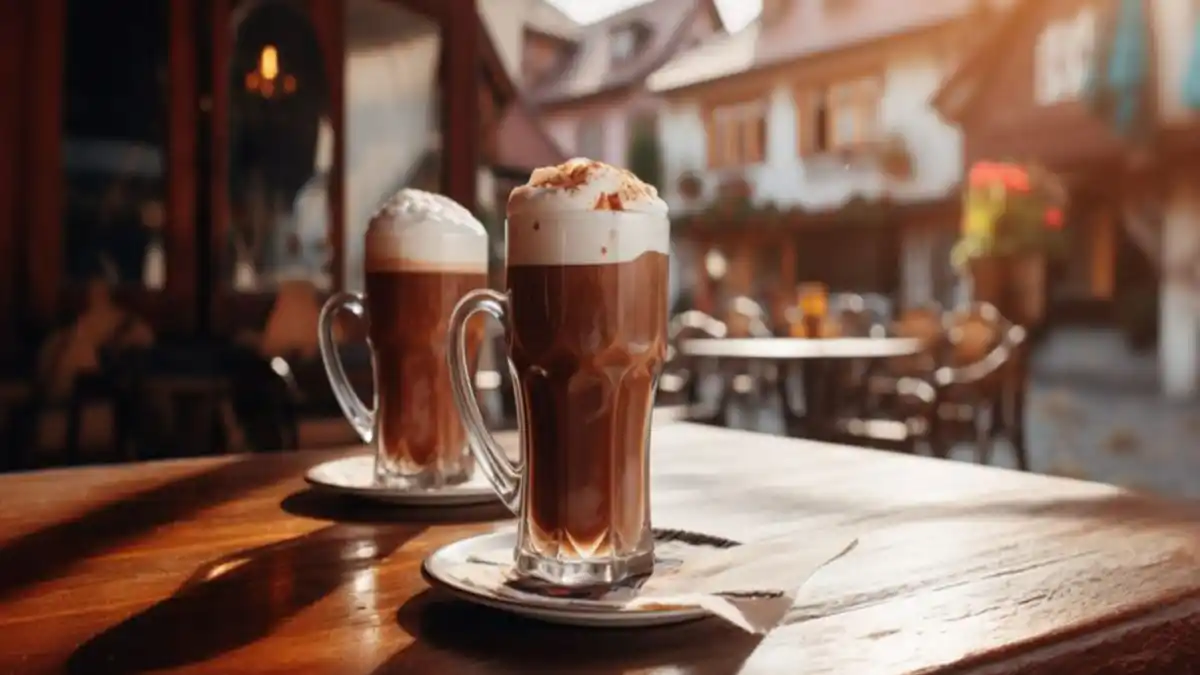
| heiße Schokolade | die | hot chocolate | dee HY-suh sho-ko-LAH-duh |
When you are unwell, many people recommend chamomile tea (Kamillentee) for the stomach and peppermint tea (Pfefferminztee) for digestion, as in Bei Bauchschmerzen trinke ich Kamillentee (I drink chamomile tea when I have a stomachache). For talking to a pharmacist or doctor about symptoms, see our German medical vocabulary lesson.
What do we add to coffee and tea?
| German | English |
|---|---|
| der Zucker | sugar |
| die Milch | milk |
| die Sahne | cream |
| der Honig | honey |
| die Zitrone | lemon |
| der Süßstoff | sweetener |
| mit Milch | with milk |
| ohne Zucker | without sugar |
| koffeinfrei | caffeine-free |
Alcoholic Drinks in German (to Understand Menus and Situations)
| German | Article | English | Approximate pronunciation |
|---|---|---|---|
| Bier | das | beer | dahs beer |
| Pils | das | pilsner (the most common type) | dahs pils |
| Weizenbier | das | wheat beer | dahs VY-tsen-beer |
| Kölsch | das | Cologne-style beer | dahs kölsh |
| Radler | das | beer mixed with lemonade (low alcohol) | dahs RAHD-ler |
| alkoholfreies Bier | das | non-alcoholic beer | AHL-ko-hohl-fry-es beer |
| Wein | der | wine | dair vine |
| Rotwein | der | red wine | dair ROHT-vine |
| Weißwein | der | white wine | dair VYSE-vine |
| Roséwein | der | rosé wine | dair ro-ZAY-vine |
| Sekt | der | German sparkling wine | dair zekt |
| Glühwein | der | mulled wine (at Christmas markets) | dair GLÜ-vine |
| Schnaps | der | strong spirit | dair shnahps |
| Likör | der | liqueur | dair lee-KÖR |
| Cocktail | der | cocktail | dair KOK-tayl |
Notice the color names in Rotwein, Weißwein and Roséwein: they are compounds of color + Wein. To go deeper into color names and how they change, see our lesson on colors in German.
Key phrases about alcohol
Articles with Drinks: der, die and das
There is no absolute rule, but these observations help:
- der with most common drinks: der Kaffee, der Tee, der Saft, der Wein, der Kakao, der Wodka, der Whisky.
- die with words ending in -e and some soft drinks: die Milch, die Cola, die Limonade, die Schorle, die Schokolade.
- das with das Wasser, das Bier, das Getränk (drink) and beer types like das Pils.
How do we say “I’d like a coffee”? The accusative case
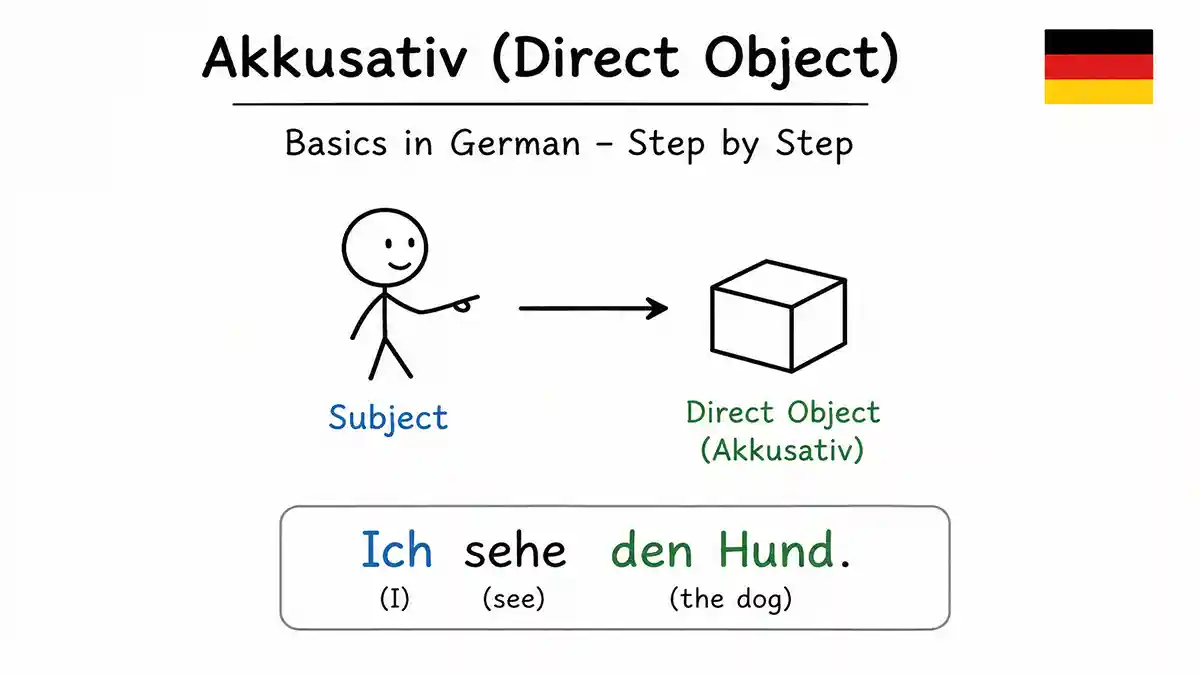
When ordering we use the accusative, so only the masculine indefinite article changes:
| Gender | Drink | Sentence |
|---|---|---|
| masculine | der Kaffee | Ich möchte einen Kaffee. |
| feminine | die Milch | Ich möchte eine Milch. |
| neuter | das Wasser | Ich möchte ein Wasser. |
When you order more than one, the noun usually stays the same after quantities: Zwei Kaffee, bitte (two coffees, please) and Drei Bier, bitte (three beers, please).
Containers, Measures and the Word Pfand
| German | English |
|---|---|
| das Glas | glass |
| die Tasse | cup |
| die Flasche | bottle |
| die Dose | can |
| der Becher | cup (paper or plastic) |
| die Kanne | pot / jug |
| das Kännchen | small pot |
| der Krug | large jug / stein |
| der Liter | liter |
| ein halber Liter | half a liter |
| die Kiste | crate |
| die Maß | one liter of beer at Bavarian festivals |
Pfand: the deposit on bottles and cans
In Germany you pay a small extra amount when you buy most bottles and cans, and you get it back when you return them to a store. You will see these words on receipts and machines:
| German | English |
|---|---|
| das Pfand | deposit (refundable) |
| die Pfandflasche | deposit bottle |
| der Pfandautomat | bottle return machine |
| die Mehrwegflasche | reusable bottle |
| die Einwegflasche | single-use bottle |
| der Pfandbon | deposit refund voucher |
Verbs for Drinking and Ordering in German
| German verb | Meaning | Example |
|---|---|---|
| trinken | to drink | Ich trinke Tee. |
| bestellen | to order | Ich bestelle einen Kaffee. |
| bezahlen / zahlen | to pay | Wir möchten zahlen. |
| nehmen | to take / choose | Ich nehme ein Wasser. |
| möchten | would like | Ich möchte einen Saft. |
| mögen | to like | Ich mag keinen Kaffee. |
| probieren | to try / taste | Möchtest du mal probieren? |
| einschenken | to pour | Darf ich dir Tee einschenken? |
| servieren | to serve | Der Kellner serviert die Getränke. |
| Durst haben | to be thirsty | Ich habe Durst. |
| bringen | to bring | Können Sie mir bitte die Rechnung bringen? |
Conjugating trinken in the present tense
| Pronoun | trinken | möchten | English |
|---|---|---|---|
| ich | trinke | möchte | I drink / I would like |
| du | trinkst | möchtest | you drink / would like |
| er / sie / es | trinkt | möchte | he / she / it drinks / would like |
| wir | trinken | möchten | we drink / would like |
| ihr | trinkt | möchtet | you (plural) drink / would like |
| sie / Sie | trinken | möchten | they / you (formal) drink / would like |
How to Order Drinks in German
What the waiter says (der Kellner / die Kellnerin)
| Sentence in German | Meaning |
|---|---|
| Was möchten Sie trinken? | What would you like to drink? |
| Was darf es sein? | What can I get you? |
| Mit oder ohne Kohlensäure? | Sparkling or still? |
| Möchten Sie noch etwas trinken? | Would you like anything else to drink? |
| Zusammen oder getrennt? | Together or separate bills? |
| Hier ist die Getränkekarte. | Here is the drinks menu. |
What the customer says
| Sentence in German | Meaning |
|---|---|
| Ich nehme einen Kaffee, bitte. | I’ll have a coffee, please. |
| Ich hätte gern ein Wasser. | I would like a water. |
| Haben Sie Tee? | Do you have tea? |
| Was empfehlen Sie? | What do you recommend? |
| Kann ich die Getränkekarte haben? | Can I have the drinks menu? |
| Noch einen Kaffee, bitte. | Another coffee, please. |
| Die Rechnung, bitte. | The bill, please. |
| Wir möchten zahlen. | We would like to pay. |
| Stimmt so. | Keep the change. |
You may also need to ask where the café or restaurant is, so use our lesson on directions in German to ask: Wie komme ich zum Café? or Gibt es hier in der Nähe ein Restaurant?
On long train rides you may hear Möchten Sie etwas trinken? in the dining car. For more station and ticket vocabulary, see transportation in German. And if you want to order food with your drink, you will find everything you need in our guide to German food vocabulary.
How to Say Your Favorite Drink: gern, lieber and am liebsten
| Word | Meaning | Example |
|---|---|---|
| gern | gladly / like to | Ich trinke gern Tee. |
| lieber | prefer / rather | Ich trinke lieber Kaffee als Tee. |
| am liebsten | most of all | Am liebsten trinke ich Apfelschorle. |
| nicht gern | don’t like to | Ich trinke nicht gern Milch. |
| kein / keine | no / not any | Ich trinke keinen Kaffee. |
Describing drinks
| German | English |
|---|---|
| heiß | hot |
| kalt | cold |
| warm | warm |
| süß | sweet |
| bitter | bitter |
| sauer | sour |
| stark | strong |
| schwach | weak / light |
| frisch | fresh |
| mit Eis | with ice |
| ohne Eis | without ice |
| mit Zitrone | with lemon |
German Culture and Drinks: Toasts and Customs
| Phrase | When is it said? | Meaning |
|---|---|---|
| Prost! | when raising glasses | Cheers! |
| Zum Wohl! | when raising glasses (more formal) | To your health! |
| Gesundheit! | when someone sneezes | Bless you! |
| Guten Appetit! | before eating | Enjoy your meal! |
| Möchtest du etwas trinken? | when welcoming a guest | Would you like something to drink? |
A well-known custom in Germany is Kaffee und Kuchen (coffee and cake), an afternoon break that often happens on weekends. You might hear: Am Sonntag trinken wir Kaffee und essen Kuchen (on Sunday we drink coffee and eat cake). To master weekdays in your plans, review the days of the week in German.
Famous German Idioms About Drinks
| Idiom | Literal meaning | Figurative meaning |
|---|---|---|
| Das ist nicht mein Bier. | That is not my beer | That’s not my business |
| Abwarten und Tee trinken. | Wait and drink tea | Be patient and see what happens |
| Da ist Hopfen und Malz verloren. | Hops and malt are lost | It’s hopeless |
| Das Wasser steht mir bis zum Hals. | The water is up to my neck | I’m in serious trouble |
| Wein, Weib und Gesang | wine, women and song | old-fashioned phrase for a life of pleasure |
Practical Dialogues About Drinks in German
Dialogue 1: At the café
Dialogue 2: At the restaurant
Dialogue 3: Hosting at home
These dialogues are part of the everyday German conversations and expressions you need, so combine them with greetings, introductions and shopping to build complete conversations with confidence.
Common Mistakes When Learning Drinks in German
- Forgetting the article: learn der Kaffee, die Milch and das Wasser, not the word alone.
- Forgetting the accusative when ordering: say einen Kaffee but ein Wasser, never einen Wasser; only the masculine article changes.
- Confusing Tee and Tea: the German spelling is Tee with two e’s, pronounced “tay.”
- Confusing mögen and möchten: mögen is for general liking, möchten is for polite requests.
- Ordering too bluntly: say Ich hätte gern … or Ich nehme … with bitte instead of Ich will …, which sounds harsh.
Drinks in German: Practice Exercises
Exercise 1: Choose the correct answer
- 1. What does das Wasser mean?
- 2. What is the correct article for Kaffee?
- 3. How do you politely say “I’d like a coffee”?
- 4. What does Wasser ohne Kohlensäure mean?
- 5. What do you say when raising glasses?
- 6. What does Abwarten und Tee trinken mean?
Exercise 2: Fill in the blank
- Ich trinke jeden Morgen ___ Kaffee.
- Wir ___ zahlen, bitte.
- Ein ___ Wasser, bitte.
- Ich trinke ___ Tee als Kaffee.
- ___! Auf deine Gesundheit!
Word bank: einen – möchten – Glas – lieber – Prost
Answers
Exercise 1: 1-b, 2-a, 3-a, 4-b, 5-b, 6-b.
Exercise 2: 1. einen — 2. möchten — 3. Glas — 4. lieber — 5. Prost
How to Memorize Drinks in German
Start with six core drinks: das Wasser, der Kaffee, der Tee, der Saft, die Milch, das Bier, and always add the article. Then memorize the ordering sentence Ich möchte einen / eine / ein … and swap only the drink, and practice containers and quantities.
Switch your phone or shopping list to German and name what you drink each day out loud. Continue your learning with our guide to food and groceries in German, then read about the German language levels from A1 to C2 to choose your next step.
Complete Guide from DeutschPlayLearn German From Scratch for Free: Complete A1 to Advanced GuideStarting your journey and need a clear, free roadmap? Explore proficiency levels from A1 to advanced, along with top methods, resources, and tips to start with confidence.Frequently Asked Questions About Drinks in German
What are the names of drinks in German?
How do I order a drink in German?
How do I ask for sparkling or still water?
What does Pfand mean?
How do I politely decline an alcoholic drink?
What is the difference between Prost and Gesundheit?
References
Sources
- DWDS German dictionary - to check word meanings and usage.
- PONS German–English dictionary - to look up vocabulary and translations.
- Duden dictionary - to confirm spelling, articles and conjugation.
- Youth Protection Act (JuSchG) - for the official rules on the legal age for alcoholic drinks.